Log in
Sign up for FREE
arrow_back
Library

Tropic Level_HB_JV

star
star
star
star
star
Last updated 3 months ago
16 questions
Required
1
Required
1
Required
1
Required
1
Required
1
Required
1
Required
1
1
1
1
1
1
1
Question 7
7.

Required
1
Required
1
Question 10
10.

Draggable itemarrow_right_altCorresponding Item
arrow_right_alt
arrow_right_alt
arrow_right_alt
Question 11
11.

Draggable itemarrow_right_altCorresponding Item
arrow_right_alt
arrow_right_alt
arrow_right_alt
Required
1
Question 13
13.

Question 14
14.

Question 15
15.

Question 16
16.

Question 1
1.

Question 2
2.

Question 3
3.

Question 4
4.

Question 5
5.

Question 6
6.

What will most likely occur if two different plant species compete for the same requirements in an ecosystem?
They will usually develop different requirements.
One species may adapt to a different requirement.
One species may eliminated from that ecosystem
They will alter the environment so that they can both survive in that ecosystem
Question 8
8.

Question 9
9.

Match the organisms with their symbiotic relationships.
Mutualism
Feeds on blood, harming the host.
Parasitism
Tree provides support, moss gains sunlight.
Commensalism
Anemone provides protection, fish provides nutrients.
Match each ecological interaction with a corresponding example.
Plants competing for sunlight
Commensalism
Wolves hunting deer
Competition
Birds nesting in trees
Predation
Question 12
12.

What would happen if all producers disappeared?
Only primary consumers would be affected
The ecosystem would collapse due to no energy input
Decomposers would take over the role of producers
Nothing would change
What does the 10% Rule mean?
10% of all species go extinct each year
10% of energy moves up to the next trophic level; the rest is lost as heat
10% of organisms in a food web are decomposers
10% of an ecosystem’s energy comes from consumers
Which level of the trophic pyramid has the most energy and biomass?
Primary Consumers
Secondary Consumers
Tertiary Consumers
Autotroph
Which interaction benefits one species at the expense of another? Select 3.
Commensalism
Mutualism
Competition
Predation
Parasitism
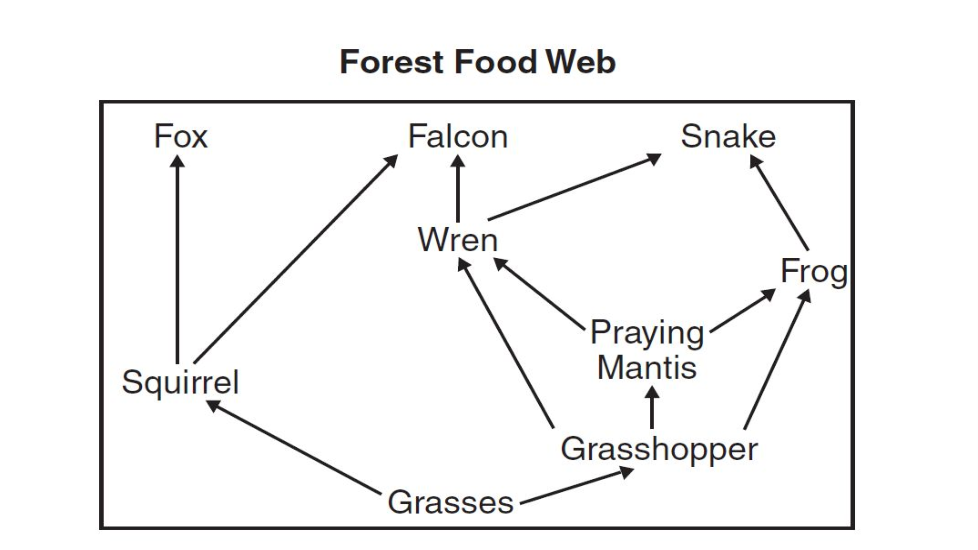
In the food chain, a squirrel is
producer
primary consumer
secondary consumer
top carnivore
In the food chain, a wren is
producer
primary consumer
secondary consumer
top carnivore
In the food chain, a snake is a
producer
primary consumer
secondary consumer
Tertiary Consumer
Quaternary Consumer
Select All that apply.

In the food chain, a Falcon is a
producer
primary consumer
secondary consumer
Tertiary Consumer
Quaternary Consumer
In the food web, the praying mantis is a
an autotroph
herbivore
carnivore
omnivore
In the food web, the frog is a
an autotroph
herbivore
carnivore
omnivore
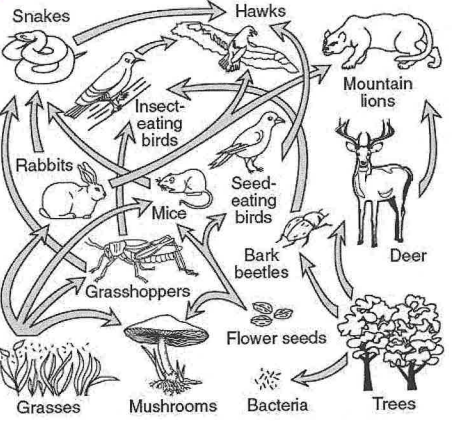
The diagram below represents a food web. Which organisms are correctly paired with their nutritional roles?
Hawk-decmoposer; insect-eating bird-parasite
mouse-autotroph; flower seed-heterotroph
Mountain Lion-predator; bark beetle-herbivore
grasshopper-carnivore; grass-autotroph
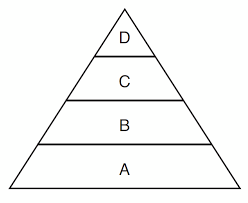
An energy pyramid is represented below. The energy for use by organisms in level A originally comes from
producers
the sun
level B
level D
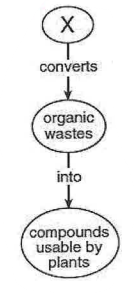
The process illustrated in the sequence below occurs constantly in the ecosystems. Which type of organisms is most likely represented by X?
decomposer
producer
herbivore
carnivore