Read the text and answer questions 1 through 7.
by Ellen R. Braaf
Like all living things, you need energy. The energy you use to live every day travels from one living thing to another, in a chain that starts with the sun.
The energy in all your food comes from the sun, 93 million miles away. How did the sun's energy end up in the things you eat? You can thank green plants. They contain chlorophyll—a substance that traps the energy in sunlight. This energy then helps plants change water from the soil and carbon dioxide from the air into oxygen and carbohydrates that power their cells. This process is called photosynthesis.
Most plants make more food than they need. They store the extra in their roots, leaves, stems, flowers, fruit, and seeds. So, when you eat carrots, spinach, celery, cauliflower, bananas, or walnuts, some of the energy stored in plants passes on to you.
Certain bacteria also make their own food. So do most algae. Found just about everywhere on Earth—in lakes, streams, oceans, deserts, soil, boiling hot springs, snow, and ice—algae range from 200-foot-long kelp to tiny ocean plants called phytoplankton. Living things that make their own food are called producers. All others—including humans—are consumers. They need to eat other living things to survive.
Food chains link producers and consumers together. When scientists talk about food chains, they're not talking about the E-Z Burger restaurant chain. They mean the paths along which energy and nutrients pass from one living thing to another in our "eat-or-be-eaten" world. Food chains everywhere—in grasslands and deserts, oceans and tropical rainforests—begin with the producers. They are the first link.
The consumers come next, starting with the plant eaters, or herbivores, the vegetarians of the animal kingdom. Elephants grazing on grass, caterpillars munching leaves, and pandas chomping bamboo get energy directly from producers. So do the shrimplike krill that dine on one-celled plants in the ocean.
Carnivores, who consume other animals, come next. These predators get energy from plants indirectly. When an owl eats a mouse that nibbled seeds, it tops a three-link chain. But if its prey is a snake that ate a mouse that nibbled seeds, the snake becomes the third link, and the owl, the fourth.
Because all organisms use the energy they get from food to live, grow, and reproduce, only small amounts remain to pass between the living links in a food chain. That's why most chains are short—usually about two to five links—and why it takes a lot of producers at the bottom of a food chain to support a few super-carnivores at the top. It's also why life on Earth depends on a constant supply of sunlight.
On Isle Royale—a small, remote island in Lake Superior—wolves, moose, and balsam fir trees are bound together in a three-link food chain. Moose came to the island around 1900. These long-legged herbivores probably swam 15 miles to the island from Canada. There they found moose heaven—lots of plants and no large predators. As a result, they thrived, and their numbers grew. Many lived a long time for moose, about 17 years.
In summer, moose eat a variety of ferns, shrubs, wildflowers, leaves, and water plants. An 800-pound moose can scarf down 40 pounds of vegetation a day, packing on an extra 200 pounds in just a couple of months. That's like an 80-pound kid gaining 20 pounds over summer vacation by eating 4 pounds of salad every day.
But in winter when food is scarce, moose eat mostly the twigs and needles of balsam fir trees. These meals are much less nutritious than their summer fare, and the moose use up lots of energy plodding through deep snow to feed. They lose all the weight they gained in summer.
Wolves came to Isle Royale around 1950. Scientists think a mated pair probably walked across an ice bridge between the island and Canada. Wolves are the island's only big predators. Their arrival changed the lives of Isle Royale's moose forever.
Scientists have been studying this isolated food chain for 50 years to understand how changes in one link can cause changes in another. As more moose are born on the island, they eat more balsam fir. The more they consume, the more they damage the trees. Stunted trees mean less food. Eventually, there's not enough food to support all the moose. Many starve, and their numbers decrease. With fewer moose dining on them, fir trees gradually recover.
A similar boom-and-bust cycle occurs between predator and prey. Ten times the size of a wolf, a moose has long, strong legs and a dangerous kick. So wolves prey mainly on old and weak animals. Good hunting means food for the whole pack. Wolves then raise lots of pups, and their numbers increase. More wolves mean more mouths to feed and more moose get eaten. However, when the moose population decreases, wolves starve.
With fewer predators stalking the moose, more survive to old age. The moose population increases, and the cycle begins again.
A student is writing a story for class about camping. Read the draft of the story and complete the task that follows.
Wilderness Getaway
Alexis and Simon would be leaving on a camping trip with family and friends later in the day. Simon did not know what to expect because he had never pitched a tent or stayed in one overnight. Alexis, however, had been camping many times and loved waking up with the sun and breathing the fresh morning air. She showed Simon pictures of roasting marshmallows and hot dogs over a large campfire. Alexis and Simon woke before dawn to help pack the camping supplies—a tent, hot dogs, graham crackers, chocolate, marshmallows, and sleeping bags.
Alexis, Simon, and their family and friends departed for the camping grounds at a nearby park. When they arrived, they searched for the perfect place to pitch the tent. Simon enjoyed the beautiful scenery. He was positive that he was going to have a great time at this getaway.
Choose the best sentence to add descriptive detail to paragraph two.
A student is writing a report for her English teacher about beneficial relationships between people and animals. Read the draft of the introduction to the report and the directions that follow.
The bond between people and animals has remained strong throughout history. In the past, tamed animals have helped humans with work such as hunting, farming, and transportation. More recently, animals have served people who are blind or have other disabilities. Today, people depend upon animals more for companionship than for work. One important benefit of such companionship for humans with pets is improved health.
The student took these notes from reliable sources:
Taking dog to dog park = chance to be with others
Engaging with others = healthy mind
Researchers studied people, pets more than 25 years
Strong relationship with pet = less stress
Lowering stress = lower blood pressure
Children with pets = fewer allergies to furry animals
Dog owners who walk dogs healthier = walking is good exercise
Taking care of a pet—walking, grooming, playing—helps a person think of others.
Using information from the student's notes, write one paragraph developing the idea in the last sentence of the introduction.
A student is writing an argumentative letter to the principal about a plan to have students attend school during the summer months. Read the paragraphs from the draft of the student’s letter and complete the task that follows.
I am writing in opposition to your proposal to extend the school year. I also urge you to consider carefully recommendations from everyone who would be affected—staff, parents, the community, and especially students—before making your decision. With so many changes occurring in education, a hasty decision would do more harm than good.
One reason I oppose your plan to extend the school year is that both students and parents are likely to oppose it. The students are the ones affected by this decision, and a survey by our school newspaper found that 76 percent of them like our schedule as it is. I am a member of the newspaper staff, and I helped conduct the survey. These students are likely to influence their parents' views. If that happens, you will be bombarded with hundreds of emails and phone calls, insisting that kids are perfectly capable of learning without an extension of the school year. Your email inbox would fill up in a hurry. Even if parents agree with you, there’s still the fact that when students are unhappy, their academic success rate goes down. That could undermine any additional learning achieved during the added time in class.
Choose the two sentences that should be removed from the second paragraph because they do not support the underlined sentence.
A student is writing a story for the school's online literary magazine. Read the draft of the story and complete the task that follows.
Martin visited his grandparents every summer near Round Lake. Typically, Martin refused to go fishing with his grandfather at the lake as he preferred to spend hours relaxing and reading books in the cool shade. The thought of sitting under the very bright sun on a boat in the middle of the lake sounded like a boring waste of time. After years of coaxing from his grandfather, however, Martin decided to attempt fishing. He listened intently to his grandfather's directions on how to cast the line of his fishing pole into the lake. Just seconds after his first cast, Martin felt a sharp tug on his fishing line.
Choose two words that best replace the underlined words.
A student is writing a report about the history of computers. Read both sources and the directions that follow.
Source 1: “The Speed of Computers” by Jonathan Anders
The first computers were designed to solve math problems more quickly than a person could. Essentially, computers were invented to help people be faster with their work. For example, the United States takes a census of people living in the country to find out information about the population. The Census of 1880 took about eight years to complete; however, the 1890 census took only two years. This was because a machine was used to count the results of the 1890 census. During the next 77 years, devices like counting machines slowly changed to today’s computers, which can do several jobs.
Source 2: “How Computers Became Common in the Business World” by Hanna James
Before computers appeared in most offices, there were three machines that helped businesses conduct work at a faster pace: the typewriter, the filing system, and the adding machine. Since the first computers were big machines that could only solve difficult math problems, it took time for them to be used in most offices. It took many inventors adding different capabilities to make computers what they are today. This eventually made it possible for offices to replace three machines with one. Nowadays people can solve math problems, type, copy, email, and save all from one device.
The student took notes about information in the sources. Which note correctly paraphrases, or restates, information from both sources?
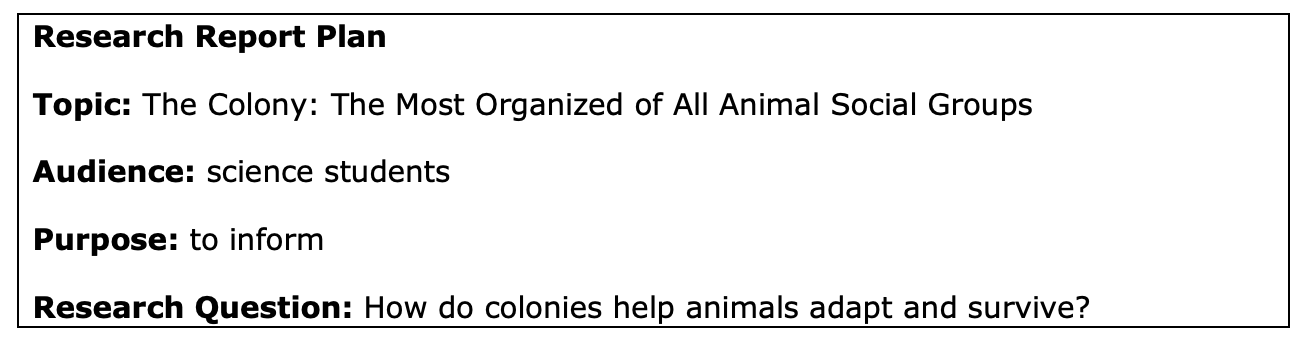
A student has made a plan for research. Read the plan and the directions that follow.

The student needs to find a credible, or trustworthy, source with relevant information. Which source would most likely have credible and relevant information?

Select the sentences that support the inference that the area is in danger of losing its moose population. Select all that apply.
Which of the following sentences from the passage best support the conclusion that all living organisms are part of the food chain?
Read the sentence from the text.
On Isle Royale—a small, remote island in Lake Superior—wolves, moose, and balsam fir trees are bound together in a three-link food chain.
The word remote has multiple meanings. What does the word remote most likely suggest about human contact with the island?
This question has two parts. First, answer part A. Then, answer part B.
Part A
Which of these inferences about the author's point of view is best supported by the text?
What is the author’s most likely reason for including the “Isle Royale” section in the text?
What are the most likely reasons the author included the section “Living Links” before the sections “Isle Royale: Predators, Prey, and Producers” and “Ups and Downs”? Select two options.
A student has written a paper for her English class about living in a rural area. Read the student's draft and complete the task that follows.
Of the many advantages of country life over city life, my favorite is the opportunity to observe farm animals—especially pigs. Rolling in the mud, I like to watch them play. Myths about pigs abound, including the belief that they aren't very smart. My own observations confirm what scientific research has shown, namely, that pigs are highly intelligent and have very good memories. They can remember where food is hidden, recognize as many as 30 other pigs, and learned their names within a week of birth.
Another myth is that pigs are dirty and love to wallow in mud. They actually prefer water to mud. When people joke about “pigging-out,” they can’t be talking about the animal because pigs eat slowly and savor their food. City folks could learn a lot by spending some time in the country.
Choose two sentences that contain errors in grammar usage.
A student is writing a research report about early sea navigation. She found a trustworthy source. Read the paragraph and the directions that follow.
“Harrison's Marvelous Clock,” from The Story of Longitude by H. O. Bellevue, history Professor
Before the use of planes and trains became popular forms of transportation, many people relied upon boats to travel from one destination to the next. Sailors were a group of individuals who helped to guide and navigate boats. Before the mid1700s, there was not a dependable or practical way to determine a boat's east-west position, or longitude. Knowing a boat's longitude was essential to its safely reaching its destination. The key was being able to keep accurate time at sea. Although clocks kept the correct time on land, they did not work well on a rolling ship's deck. After years of effort, John Harrison of England invented the marine chronometer. The marine chronometer is a clock that allows a ship to determine its longitude at sea. Solving the longitude problem meant that ships could navigate more safely and accurate maps could be made. It is hardly an understatement to say that Harrison's success saved lives and continues to allow people to find their way around the world.
Choose two facts that support the author's point of view about Harrison's clock.
Part B
Which sentence from the text supports your answer in part A?
