Chapter 4
El Castillo de San Marcos
The building on the right is a fort in St. Augustine, Florida, where the Spanish established a settlement in 1565. It is the oldest continuously occupied European settlement in the United States. You can visit there today and still see the old buildings standing.
This fort was built by the Spanish in the 1600s. It is called El Castillo de San Marcos. That is its Spanish name. Its English name is the Castle (or Fort) of Saint Mark.
El Castillo de San Marcos was not the first fort the Spanish built in St. Augustine. The Spanish built seven or eight forts before they built this one. But these earlier forts were made of wood and were not very strong. Some of them were destroyed in wars. Others were wrecked by hurricanes. In 1672, the Spanish decided to build a new fort. This time, they decided they would use stone to make it strong.
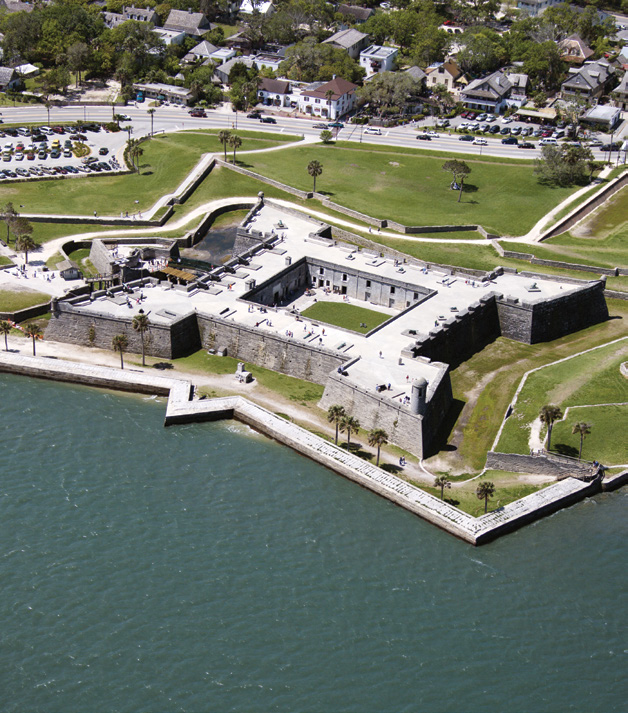
The inside of the fort is shaped like a square. On each corner, there is a bastion shaped like an arrow. A bastion is a raised gun platform. The bastions stick out from the fort. They let the Spanish fire out of the fort in just about any direction.
This is what a bastion looks like from the ground.
Imagine you are a soldier. Would you like to attack a bastion like this? How would you do it?
If you tried to get close, Spaniards on top of the bastion would open fire. They would shoot at you with guns and cannons.
If you got close enough to set up a ladder, the men in the fort would tip it over. They might drop hot oil on you. Ouch!
You could try to attack with cannons. But the walls of the fort are thick and strong. A few cannonballs would not harm them. But don’t forget, the Spanish had cannons of their own. They would fire back at you and you would not have thick stone walls to hide behind!
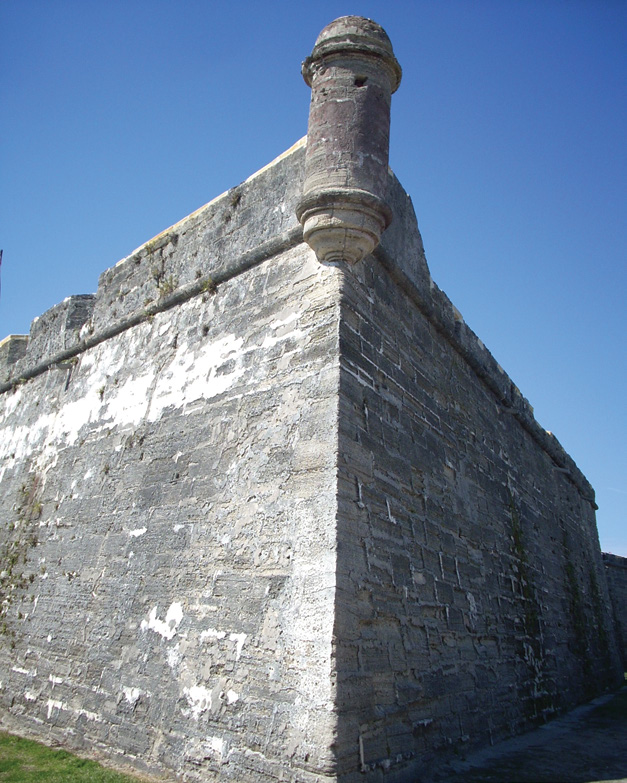
A bastion
Can you guess what the walls of El Castillo de San Marcos are made of? Believe it or not, they are made of seashells! The Spanish used a kind of rock called coquina. Coquina is a mixture of fossils and seashells.
Look at the stone on the right. It is coquina. Can you see the seashells? Those shells are the remains of tiny animals that lived in the sea long, long ago.
The Spanish found coquina along the Florida seashore. They used it to build the fort.
Coquina turned out to be a good stone for building forts. It is softer than other rocks. That means it does not crack or shatter when cannonballs hit it. A cannonball might make a dent in a coquina wall or it might be absorbed into the wall. But, in most cases, it would not crack the wall.
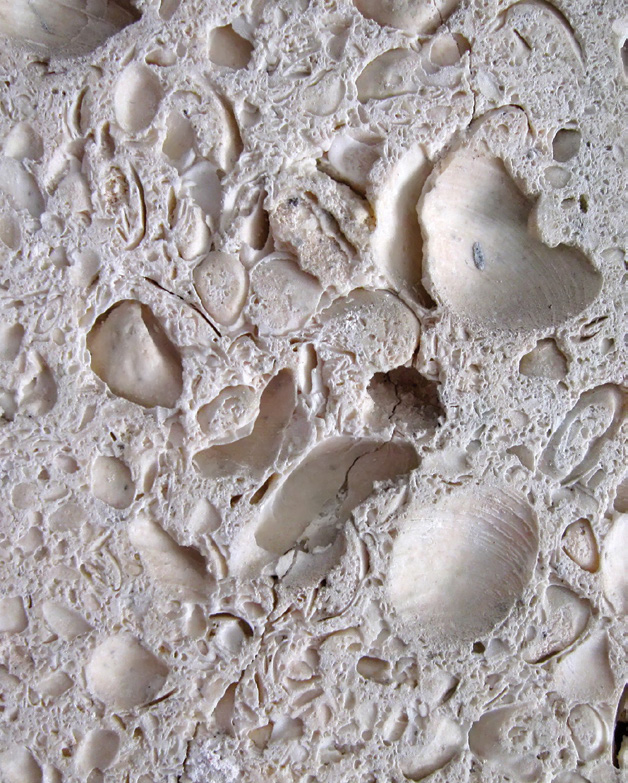
Coquina
The fort was surrounded by a moat. It is no longer filled with water. It is now a dry moat.
There was only one way into the fort. You had to enter a mini-fort that stood just in front of the main fort. This mini-fort was called the ravelin.
A bridge led from the ravelin across the moat and into the main fort. The last part of this bridge was a drawbridge. It could be lifted up to keep people from getting in.
It was not easy to open the drawbridge. It took five men fifteen minutes to open it.
In this image, you can see the bridge that leads into the fort. It is on the left.
El Castillo de San Marcos was a strong fortress. It was attacked many times but it was never captured.
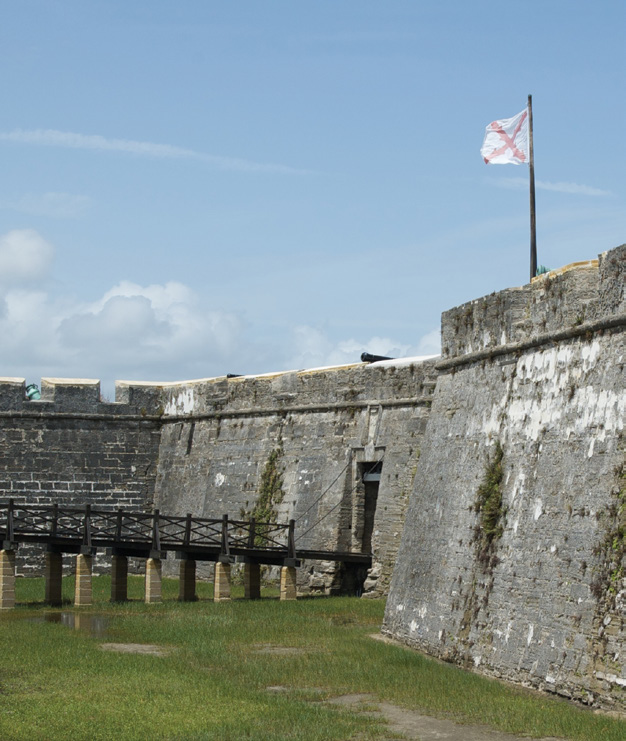
The drawbridge leading from the ravelin to the main fort