CKLA Unit 9 Chapter 5 Hernando de Soto
star
star
star
star
star
Last updated 5 months ago
12 Nsɛmmisa
Who did Hernando de Soto claim Florida for?
Chapter 5
On May 30, 1539, the veteran conquistador Hernando de Soto led a group of Spaniards ashore on the western coast of Florida. De Soto staked a flagpole into the sandy beach and claimed the land for the king of Spain.
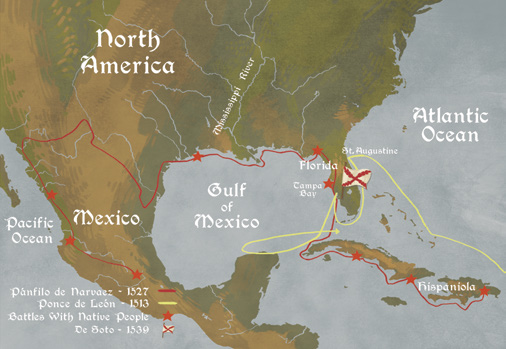
De Soto’s landing in Florida and map of prior Florida exploration.
De Soto was not the first Spaniard to explore Florida. Juan Ponce de León had explored the area in 1513 and again in 1521, but he had failed to establish a permanent Spanish colony in Florida. Another Spaniard, Pánfilo de Narváez [pahn-fee-lo de nar-vay-uz], also tried to conquer Florida but did not succeed. Many of his men died during fighting with the natives; others died from dehydration, being lost at sea, or drowning when a hurricane hit and sank their boats. In the end, of the six hundred men who began the voyage, only four men managed to get back to Mexico to tell the tale.
Hernando de Soto knew about the explorations of Ponce de León and Narváez. He knew it would be dangerous to explore Florida, but he felt he could achieve more than the men who had explored before him. After all, de Soto had been in Peru with Francisco Pizarro, one of the most successful of all the conquistadors, when Pizarro captured and held for ransom the Inca Emperor, Atahualpa [ah-tah-wal-pa]. De Soto had helped collect the great ransom of silver and gold that made Pizarro very rich.
And de Soto, too, became a very wealthy man through his relationship with Pizarro. Hernando de Soto believed he could make even more money by conquering Florida and gathering up the gold that was rumored to be there. De Soto invested much of his own money in his Florida expedition, and he prepared for it carefully. De Soto signed up lots of other experts, including soldiers, sailors, tailors, shoemakers, engineers, and priests. Most of the seven hundred men on his expedition were Spaniards, but there were a number of recruits from other countries in Europe. The expedition sailed from Spain in April of 1538. After a year in Cuba, de Soto and his men sailed to Florida, arriving at the end of May in 1539.
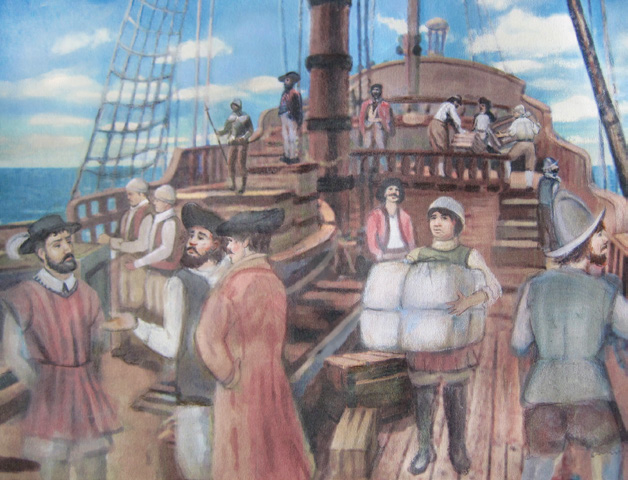
Hernando de Soto preparing for the expedition.
De Soto sent a scouting party inland and discovered an abandoned Indian village. Finding abandoned Indian villages was not unusual. By this time, many native people had learned that the arrival of Spaniards was usually not good news. Many chiefs decided that it would be best to avoid the Spanish so they abandoned their villages. Sometimes, they would return to the village after the Spanish moved away.
De Soto and his men established a base in the abandoned village and began to explore the surrounding land. They made a surprising discovery on their exploration when they found a Spaniard who had been living among the natives and had learned a little of their language. His name was Juan Ortiz, and he had been a member of the disastrous Narváez expedition. Sometimes, Native Americans would adopt outsiders—including Europeans—into their tribes. The Spanish listened to his stories and decided to make Ortiz one of their translators.
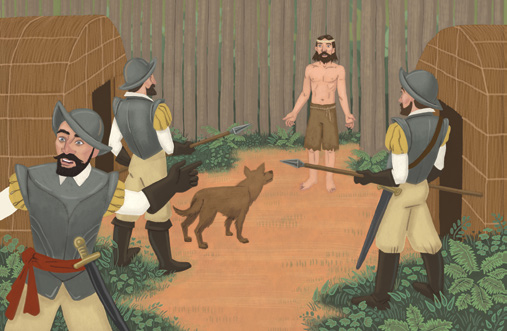
Hernando de Soto finding Ortiz at de Soto’s base camp.
De Soto left some men near the coast and took some other men to explore inland. He and his men made their way through swamps and forests. They found more deserted villages and helped themselves to whatever food and supplies were left behind. Some of the natives attacked the Spaniards as they marched. They would ambush, or attack, de Soto and his men in the swamps, and then run away. De Soto fought back viciously, hoping that if the natives heard how dangerous the Spaniards were, they would not attack.
By mid-September, de Soto and his men arrived at a village called Napituca [na-puh-tue-kah]. The local chief, Vitachuco [vee-ta-choo-ko], seemed friendly, but Juan Ortiz told de Soto that this friendliness might be an act. Ortiz had heard rumors that Vitachuco was plotting against de Soto.
De Soto decided to take no chances. He attacked the people of the village and took Vitachuco prisoner. Vitachuco wasn’t treated as poorly as other prisoners. He was allowed to keep some of his servants and often ate with de Soto. De Soto thought that if he kept the chief happy, Vitachuco and his people would cooperate with him. This plan seemed to be working, until one night Vitachuco and his people attacked. The Spaniards eventually won this battle and killed Vitachuco.
After that battle, the Spaniards went farther north into Florida. A native de Soto took as a prisoner told them of a city to the north in what is now South Carolina called Cofitachequi, [co-fit-a-cheh-kwee] where the chief was a woman who had lots of gold and pearls.
De Soto and his men went through what is now Georgia and into what is now north-central South Carolina. There they met la Señora de Cofitachequi, the Lady of Cofitachequi. At first, the Lady of Cofitachequi was friendly, allowing them to stay in her village. She had very little gold, but she did have some pearls that she gave to the Spaniards as gifts. Later, however, de Soto arrested the Lady of Cofitachequi, held her hostage, and marched on.
No one is sure what happened to the Lady of Cofitachequ, but some historians say that she stayed with de Soto and his men for a while until she had a chance to escape through the woods. The Spaniards could not track her down because they were unfamiliar with the land. They never saw her again.
De Soto and his men went on a trek north and west through what is now Georgia and South Carolina, to the edge of the Blue Ridge Mountains. They passed through territory controlled by the Mississippians. Everywhere they went they looked for gold but had very little success. The de Soto expedition eventually reached the area now known as Alabama, where de Soto and his men fought one of their biggest battles. They killed more than two thousand Mississippians. Only twenty-two of de Soto’s men were killed, but about two hundred were injured, including de Soto himself. The Spanish also lost many of their horses. By November of 1540, the de Soto expedition had entered into Mississippian territory in northeastern Mississippi. They spent the winter in an abandoned native village. Eventually, the Mississippians attacked, firing flaming arrows. The Spanish escaped only because their stampeding horses scared off the attacking natives.
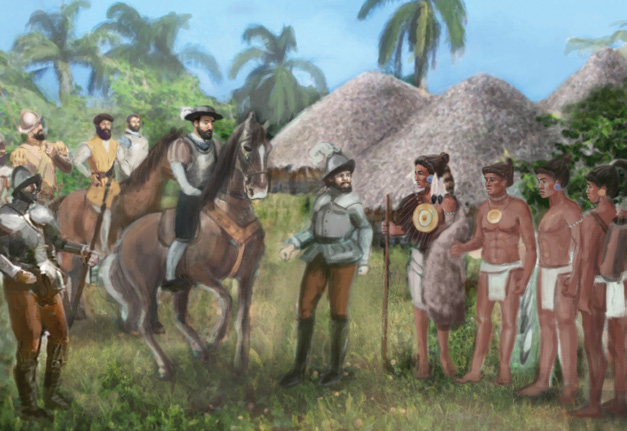
De Soto and his men marching inland.
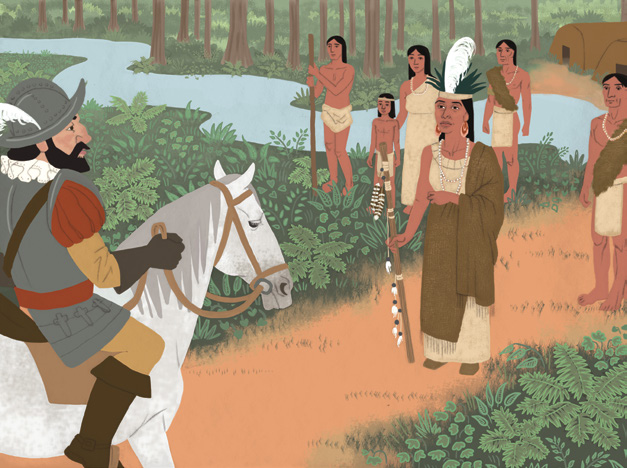
De Soto meeting with the Lady of Cofitachequi
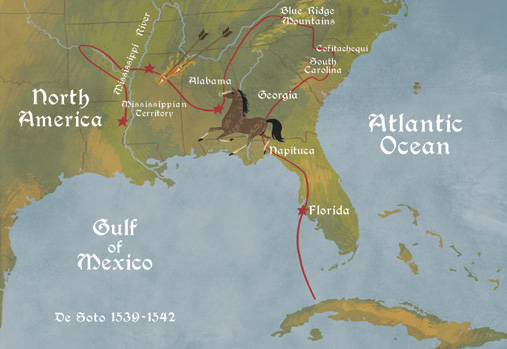
De Soto’s route with Indian territories marked
With all of the constant marching and fighting, De Soto’s men grew very tired and were ready to go home. They didn’t believe that there much gold to be found in these parts of America. Some of them began to plan a mutiny against de Soto. De Soto, however, did not want to give up and go home empty handed. He pushed his men on. They marched and fought their way west.
In May of 1541, they reached the mighty Mississippi River. De Soto and his men constructed flatboats to carry the men and horses, and crossed the river at night to hide from the attacking natives.
After De Soto and his men crossed the Mississippi River, they explored what is now Arkansas. They met natives near what is now Camden, Arkansas, who lived in tipis and hunted buffalo. De Soto and his men spent the winter there.
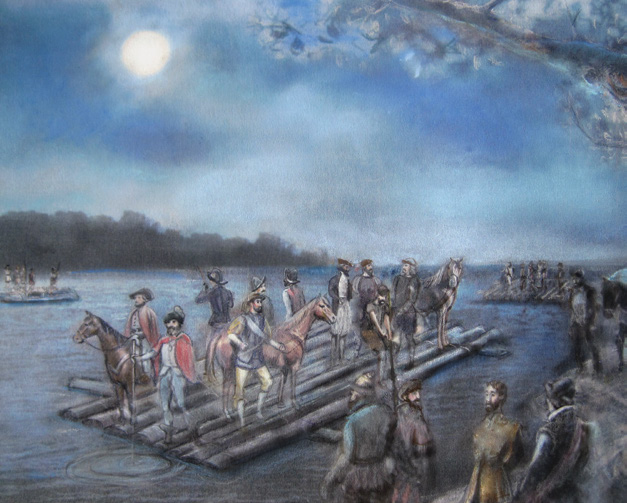
De Soto crossing the Mississippi
By the spring of 1542, even de Soto was becoming demoralized. De Soto had found almost no gold. He had lost many of his men, and his horses could barely walk. His translator, Juan Ortiz, had died, and the other translators were having trouble understanding the local natives. All of these terrible events together became the “last straw.”
In May of 1542, de Soto came down with a bad fever. He spent his days in bed, but the fever got worse. He finally died on May 21, 1542. According to legend, de Soto’s men attached stones to his body and then sank it in the Mississippi River, so that the Native Americans would not find it and realize that De Soto had told them a lie about being immortal, or able to live forever.
The remaining men of the de Soto expedition made their way back to the Gulf of Mexico where they built seven boats. In July of 1543, they floated along the Gulf Coast, past Texas, and eventually made their way back to the Spanish outposts in Mexico. Throughout this difficult journey, the men on the de Soto expedition were the first known Europeans to explore the southeastern United States north and west of present day Florida.
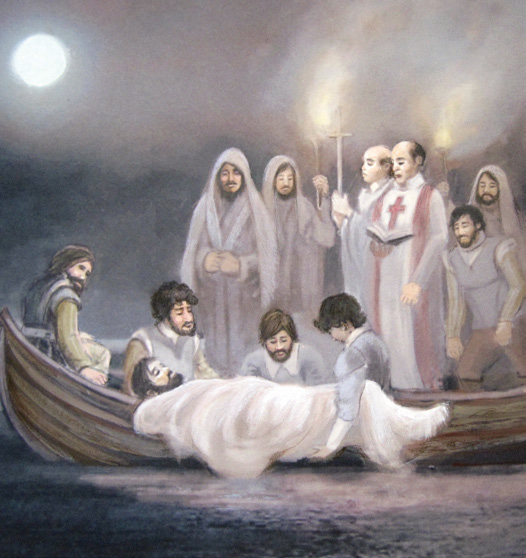
De Soto burial in the Mississippi
What was the purpose of de Soto's expedition?
Why did many native people abandon their villages?
What happened to de Soto in May 1542?
Read the passage and answer the questions.
Hernando de Soto was a Spanish explorer. On May 30, 1539, he landed on the western coast of Florida and claimed the land for the king of Spain. De Soto was not the first Spaniard to explore Florida. Juan Ponce de León explored the area in 1513 and again in 1521, but he did not create a permanent colony. Another explorer, Pánfilo de Narváez, tried to conquer Florida too, but most of his men died during fights, storms, and long trips at sea.
De Soto believed he could do better. He had been in Peru with Francisco Pizarro when the Spanish collected a huge ransom of gold and silver. De Soto became wealthy and hoped to find even more treasure in Florida. He spent much of his own money to prepare. He gathered soldiers and sailors, but also people with other jobs, like tailors, shoemakers, engineers, and priests.
When de Soto’s expedition arrived, many Native American groups were cautious. Some villages were abandoned because people believed the arrival of Spaniards usually meant danger. De Soto’s men sometimes took food and supplies that had been left behind. As they traveled, some native groups attacked the Spaniards by ambushing them in swamps and forests.
De Soto also relied on translators. The Spaniards found a man named Juan Ortiz, who had survived Narváez’s earlier expedition and had been living among native people. Ortiz helped the Spaniards understand some local languages, but the expedition still faced misunderstandings and conflict.
In May 1541, de Soto and his men reached the Mississippi River and crossed it in flatboats. By May 1542, the expedition had found almost no gold. De Soto became sick with a fever and died on May 21, 1542. According to legend, his men sank his body in the Mississippi River so local people would not discover he had died.
Even after de Soto died, the remaining men did not stop. They traveled to the Gulf of Mexico, built boats, and finally reached Spanish outposts in Mexico in July 1543.
According to the passage, who did Hernando de Soto claim the land for when he landed in Florida?
In the sentence, “Some villages were abandoned because people believed the arrival of Spaniards usually meant danger,” what does the word danger mean?
Which detail from the passage best shows a cause-and-effect relationship?
What was de Soto hoping to find in Florida? (Use 3 words or fewer.)
Which statement best describes how Juan Ortiz contributed to the expedition?
Which visual would best support the passage’s information?
Which detail is most likely included to help the reader understand the sequence of events in the expedition?
Name one reason some villages were abandoned. (3 words or fewer.)