S-Waves, P-Waves, and Epicenters
How are Earthquakes Located?
We can locate earthquakes using a simple fact: an earthquake creates different seismic waves (P waves, S waves, etc.) The different waves each travel at different speeds and therefore arrive at a seismic station at different times. P waves travel the fastest, so they arrive first. S waves, which travel at about half the speed of P waves, arrive later. A seismic station close to the earthquake records P waves and S waves in quick succession. With increasing distance from the earthquake the time difference between the arrival of the P waves and the arrival of the S waves increases. Although modern techniques are more complex, we have illustrated the basic concept using an example of an earthquake near Mexico and seismic stations in North America. The following two steps show how we determine distance from the seismograms and estimate the location using three stations.
Step 1. The time between the arrival of the P wave and the arrival of the S wave (S-P time) is measured at each station. The S-P time indicates the distance to the earthquake similar to how the time interval between the flash of light and the sound of thunder indicates the distance to a thunderstorm. In our example, station TEIG (with an S-P time of 1.5 minutes) is closest to the earthquake, and station SSPA (with an S-P time of 5 minutes) is farthest away. From observing and analyzing many earthquakes, we know the relationship between the S-P time and the distance between the station and the earthquake. We can therefore convert each measured S-P time to distance. A time interval of 1.5 minutes corresponds to a distance of 900 kilometers, 3 minutes to 1800 kilometers, and 5 minutes to 3300 kilometers.
Figure 1.
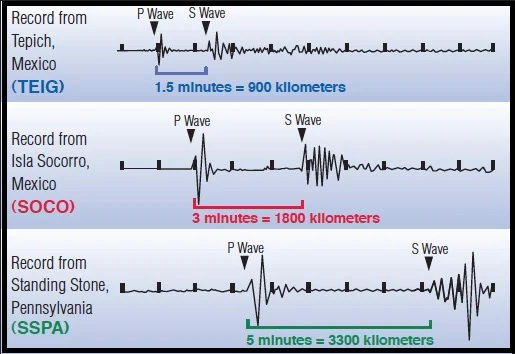
Figure 2.
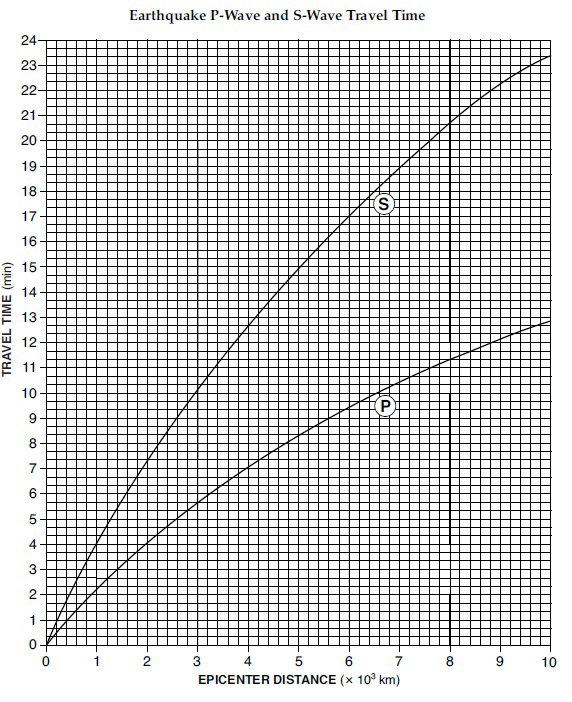 Source:
NYS Earth Science Reference Tables, 2011
Table 1.
Seismic Station | P-Wave Arrival Time | S-Wave Arrival Time | Difference in Arrival Times | Distance to Epicenter |
|---|
X | 10:42:00 | 10:46:40 | | |
Y | 11:39:20 | 11:42:00 | | |
Z | 12:01:20 | 12:04:40 | | |