Winds Series
Air Pressure and Winds
Within the troposphere are convection cells (Figure 1 below).
Figure 1.
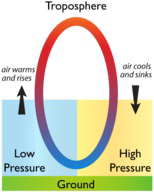
Warm air rises, creating a low pressure zone; cool air sinks, creating a high pressure zone.
Air that moves horizontally between high and low pressure zones makes wind. The greater the pressure difference between the pressure zones the faster the wind moves.
Convection in the atmosphere creates the planet’s weather. When warm air rises and cools in a low pressure zone, it may not be able to hold all the water it contains as vapor. Some water vapor may condense to form clouds or precipitation. When cool air descends, it warms. Since it can then hold more moisture, the descending air will evaporate water on the ground.
Air moving between large high and low pressure systems creates the global wind belts that profoundly affect regional climate. Smaller pressure systems create localized winds that affect the weather and climate of a local area.
Atmospheric Circulation
Because more solar energy hits the equator, the air warms and forms a low pressure zone. At the top of the troposphere, half moves toward the North Pole and half toward the South Pole. As it moves along the top of the troposphere it cools. The cool air is dense and when it reaches a high pressure zone it sinks to the ground. The air is sucked back toward the low pressure at the equator. This describes the convection cells north and south of the equator.
If the Earth did not rotate, there would be one convection cell in the northern hemisphere and one in the southern with the rising air at the equator and the sinking air at each pole. But because the planet does rotate, the situation is more complicated. The planet’s rotation means that the Coriolis Effect must be taken into account.
Let’s look at atmospheric circulation in the Northern Hemisphere as a result of the Coriolis Effect (Figure 2 below). Air rises at the equator, but as it moves toward the pole at the top of the troposphere, it deflects to the right. (Remember that it just appears to deflect to the right because the ground beneath it moves.) At about
Figure 2.
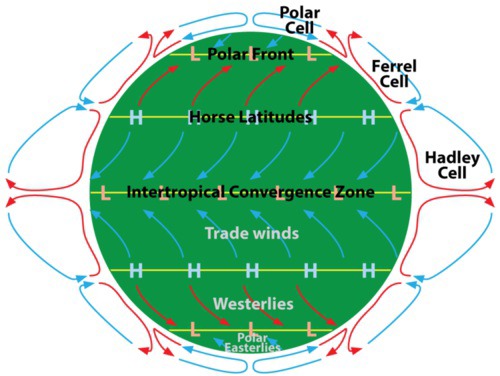
There are two more convection cells in the Northern Hemisphere. The Ferrell cell is between
There are three mirror image circulation cells in the Southern Hemisphere. In that hemisphere, the Coriolis Effect makes objects appear to deflect to the left.
Global Wind Belts
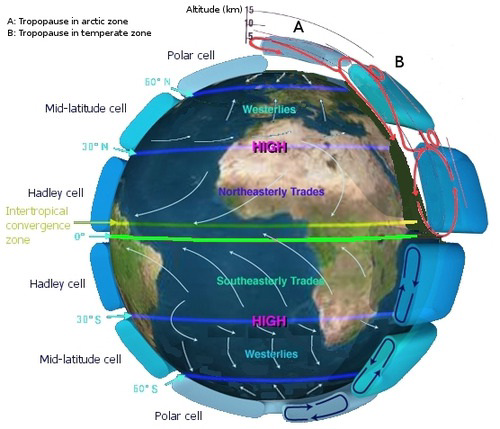
Global winds blow in belts encircling the planet. The global wind belts are enormous and the winds are relatively steady (Figure 3 below). These winds are the result of air movement at the bottom of the major atmospheric circulation cells, where the air moves horizontally from high to low pressure.
Figure 3.
Global Wind Belts
Let’s look at the global wind belts in the Northern Hemisphere.
In the Hadley cell air should move north to south, but it is deflected to the right by Coriolis. So the air blows from northeast to the southwest. This belt is the trade winds, so called because at the time of sailing ships they were good for trade.
In the Ferrel cell air should move south to north, but the winds actually blow from the southwest. This belt is the westerly winds or westerlies. Why do you think a flight across the United States from San Francisco to New York City takes less time than the reverse trip?
In the Polar cell, the winds travel from the northeast and are called the polar easterlies. The wind belts are named for the directions from which the winds come. The westerly winds, for example, blow from west to east. These names hold for the winds in the wind belts of the Southern Hemisphere as well.
Global Winds and Precipitation
Besides their effect on the global wind belts, the high and low pressure areas created by the six atmospheric circulation cells determine in a general way the amount of precipitation a region receives. In low pressure regions, where air is rising, rain is common. In high pressure areas, the sinking air causes evaporation and the region is usually dry.
Polar Fronts and Jet Streams
The polar front is the junction between the Ferrell and Polar cells. At this low pressure zone, relatively warm, moist air of the Ferrell Cell runs into relatively cold, dry air of the Polar cell. The weather where these two meet is extremely variable, typical of much of North America and Europe.
The polar jet stream is found high up in the atmosphere where the two cells come together. A jet stream is a fast-flowing river of air at the boundary between the troposphere and the stratosphere. Jet streams form where there is a large temperature difference between two air masses. This explains why the polar jet stream is the world’s most powerful (Figure 4 below).
Figure 4.
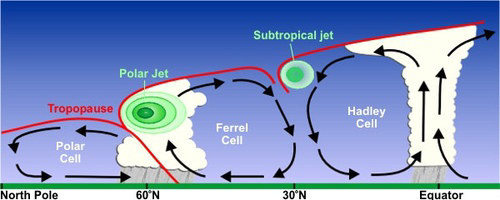
Jet streams move seasonally just as the angle of the Sun in the sky moves north and south. The polar jet stream, known as “the jet stream,” moves south in the winter and north in the summer between about 30°N and 50° to 75°N.