Coevolution Series
Introduction
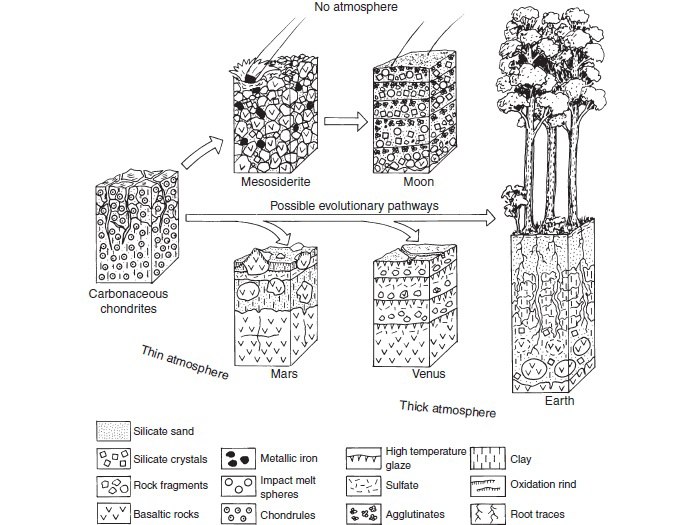
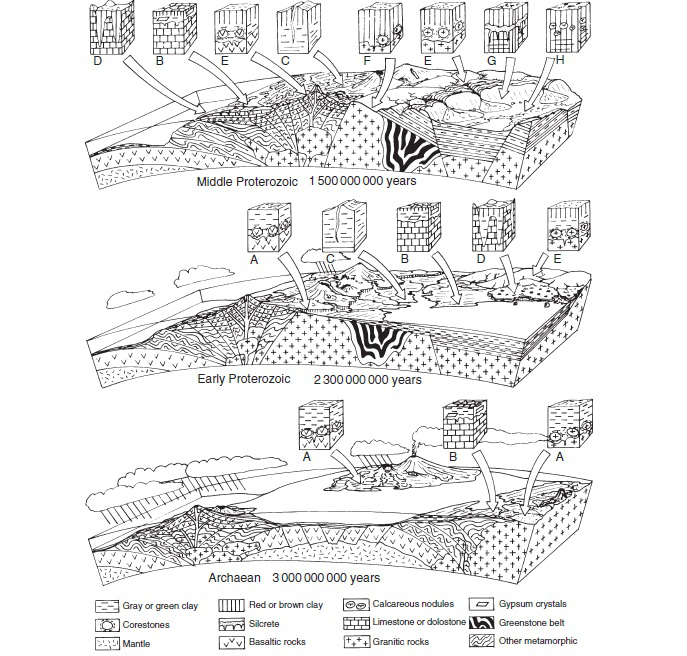
Earth is one of the oldest words in our language (from Old English ‘eorde’) meaning both our planet (customarily capitalized in this sense) as well as the soil beneath our feet. Here I explore both ends of its meaning by emphasizing how small-scale biological and soil-forming processes have played a role in the very significant differences between our planet and other planetary bodies in our solar system. Such processes as the growth of trees are commonly regarded as mundane, in the sense of commonplace or trivial, but they can be mundane also in the more important sense of global, as apparently understood by Chekhov (1899). The media which elevate biological processes to global scope are air, water, and soil. Air and water are important to the coevolution of life and earth (Nisbet and Sleep, 2001), but we will take the path less traveled here, and present a perspective on coevolution of life and earth from my research experience with ancient and modern soils. When soil, air, and water became alive, unlike the apparently sterile but discernibly altered soils of the Moon, Venus, and Mars (Figure 1), it must have been an important time in the history of our Earth. Soils gave life access to fundamental nutrients such as phosphorus at their source in the weathering of rocks. Soils allowed life to colonize a significant fraction of Earth’s surface, thus enhancing their volumetric effect on surficial fluids. Life gave soils increased depth and stability to enhance rates of physicochemical weathering. Life also gave soils a variety of biosignature horizons and deep weathering products (Retallack, 2001a).
Figure 1.
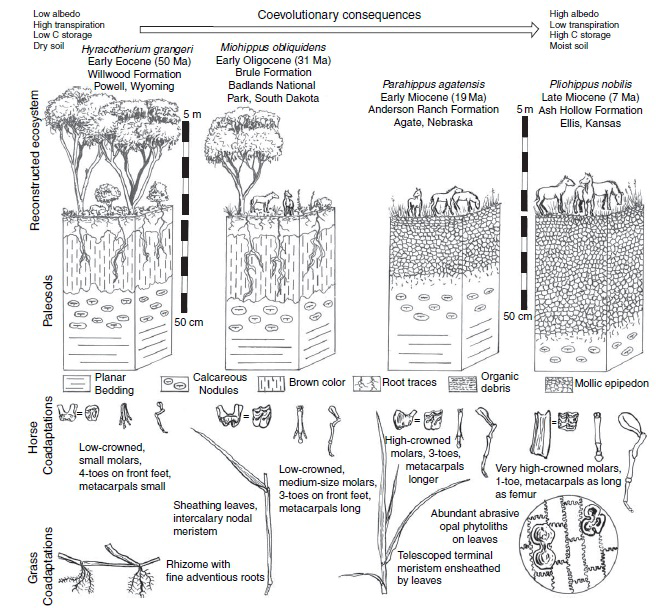
The evolution of life and soil can be viewed as a coevolutionary process, like the coevolution of grasses and grazers, as first proposed by Kowalevsky (1873). Coevolution is the coordinated evolution of phylogenetically unrelated organisms (in this case, plants and animals), which coevolved to enhance their mutual interdependence. Grasses evolved subterranean rhizomes, basal tillering of adventitious roots, intercalary meristems, telescoped internodes, and opal phytoliths to withstand grazing.
Figure 2.
Biosignatures of Earth
Uniqueness of our planet is best considered by comparison with other planetary bodies, which turn out to have a variety of common features, such as basalt and CO$_2$-rich atmosphere. Water beyond Earth is frozen or vaporized, with the possible exception of Jupiter’s moon Europa (Marion et al., 2005). Impact glasses, shocked minerals, clays, evaporites, carbonates, oxides, and a variety of high-temperature minerals also are found beyond Earth (Squyres et al., 2004). Also found beyond Earth are rugged desert-like landscapes, volcanos, and ice caps (Carr, 1981). Such pervasive similarities to Earth make the search for biosignatures and their coevolutionary effects difficult.
The reason for the cosmically peculiar composition of our atmosphere may be the widespread metabolic process of photosynthesis (Rosing et al., 2006) not only by plants, and a variety of protists, but also by a host of bacteria as well. Photosynthesis, or assembly by light, is a process by which sugars are synthesized using light from the Sun and a catalyst (commonly chlorophyll) from CO$_2$ of the atmosphere (Table 1). The low amount of CO$_2$ in our current atmosphere is a testament to the success of photosynthesis, but replacement of a primordial reducing atmosphere of CO$_2$ and CH$_4$ by O$_2$ had many ups and downs over 3.5 Ga of Earth’s history known from the rock record (Berner et al., 2000).
Table 1.
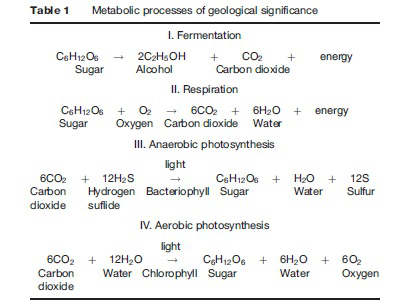
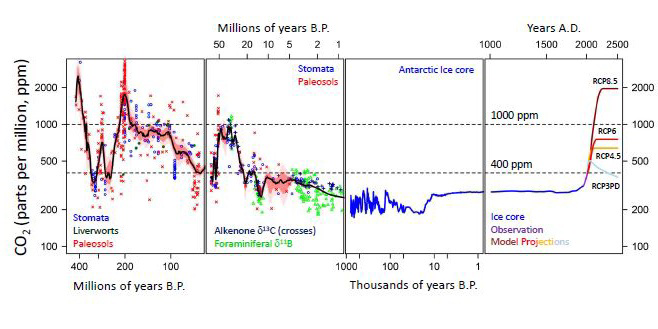
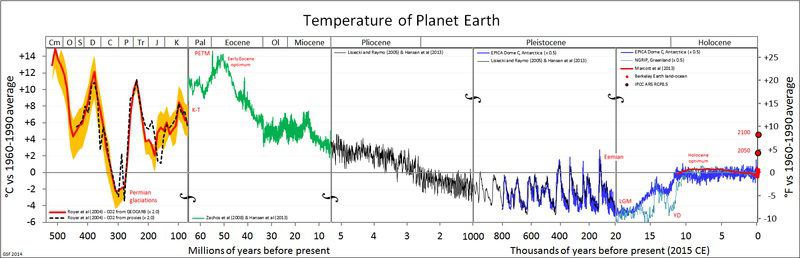
The reason for the maintenance of Earth’s temperature within the bounds of liquid water for some 4.3 Ga remains uncertain, but life is suspected to have a role because of its coevolved metabolic systems. This general idea of a thermocouple of opposing forces acting as a thermostat is clearly expressed in ‘Daisyworld’ albedo models of the Gaia hypothesis (Watson and Lovelock, 1983). Imagine a world with only black and white daisies vying for the light of the Sun in order to photosynthesize. White daisies cool by reflecting sunlight back into space. Black daisies warm by absorbing heat. Populations will be dominated alternately by black then white daisies, until mixed populations converge on temperatures that optimize photosynthesis. A more realistic model is the ‘Proserpina principle’ (Retallack, 2004a), which postulates that photosynthesis cools the planet by drawing down the greenhouse gas CO$_2$, whereas respiration warms the planet because it draws down O$_2$. If either one of these metabolic systems had evolved in isolation it would have resulted in a respirator’s hell like Venus, or a photosynthesizer’s freezer like Mars. Fortunately, photosynthesizers and respirers such as plants and animals are mutually interdependent for food and breath: a coevolutionary thermostat. Plants cool the planet by photosynthesis which is curtailed as they are covered by snow of icehouse atmospheres. Animals warm the planet by respiration but die in high temperatures of greenhouse atmospheres that are less fatal to plants. Population balances between them have the effect of adjusting greenhouse gases in the atmosphere to habitable ranges given external inputs of solar radiation.
Carbon-Based Life
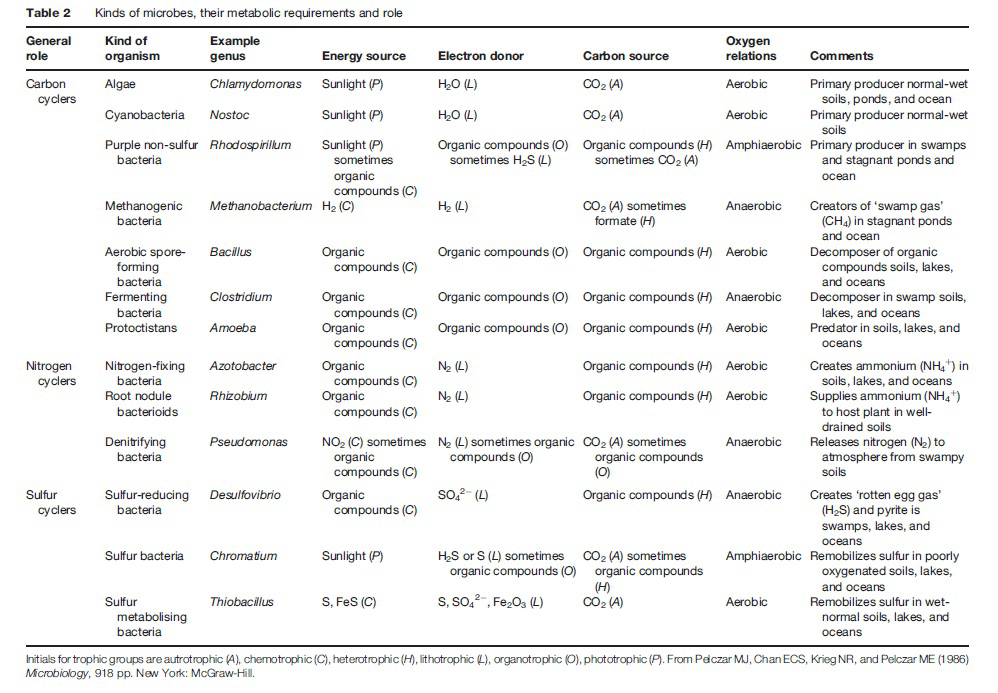
Science fiction movies make alien life instantly recognizable by emphasizing the salient features of humans or insects. Recognizing alien life on sight may not be so easy because much life is immobile or microscopic, and its activities too varied to be easily characterized (Table 2). Life on Earth has a marked preference for six elements: carbon, hydrogen, oxygen, nitrogen, phosphorus, and sulfur (CHONPS: Schoonen et al., 2004). Of these only oxygen is a common component of most rocks.
Three general features are regarded as necessary for life: bodies, metabolism, and reproduction. Even bodies of such simple organisms as the common gut bacterium Escherichia coli have an astonishing complexity of interacting parts, including high molecular-weight organic compounds which provide both structure and function. If there is a common theme to the great variety of metabolic reactions, it is lack of chemical equilibrium that drives them and that has left an imprint on our cosmically peculiar atmosphere (Lovelock, 2000).
Reproduction is also quite varied, ranging from simple cell division, to clonal budding, parthenogenesis, and the romantic complexity of sex. If there is a common theme to biological reproduction it is remarkable speed. Astonishing numbers of individuals can be produced in days or years as long as food is available. Whole worlds can be populated in a geological instant, which should be encouraging to the search for life on other worlds. If life is anywhere on a planet, it is likely to be everywhere.
Table 2.
Coevolutionary Histories
...the history of life and Earth environments should demonstrate a pattern of adaptations in one segment of the ecosystem followed by compensatory coadaptations in another part of the ecosystem. The following sections attempt to identify such reciprocal changes in air, water, soils, and rocks. There are also catastrophic alterations of surface environments after large bolide impacts, giant volcanic eruptions, and metamorphism of limestone and coal (Retallack, 2002). There are biological perturbations, such as seasonal leaf-shedding and soil fertility cycles, on such short timescales (100–105 years) as well (Retallack, 2004a). Biological flexibility on these timescales may have aided biotic recovery from abiotic catastrophes. The present account however will deal only with evolutionary timescales (106–109 years).
Figure 3.
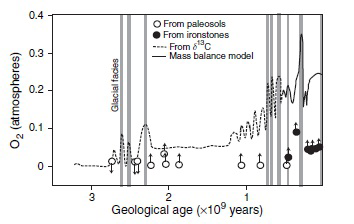
Bioterrraforming, or re-engineering of planetary environments by life, as may be possible for Mars (Fogg, 1998), could already have happened on Earth during the Precambrian evolution of cyanobacterial photosynthesis to create our oxygen-rich atmosphere. Evidence from paleosol geochemistry suggests an especially marked oxidation at about 2.3 Ga.
Figure 4.
Conclusions
Figure 5.
Source:
https://earth.org/data_visualization/a-brief-history-of-co2/
A coevolutionary perspective explains many aspects of our Earth’s distinctive geological history. As in classical cases of coevolution, such as grasses and grazers, interactions between unrelated but mutually dependent organisms promote the persistence of new and earth-changing ecosystems, such as grasslands.
The global-change capabilities of such ecosystems arise because organisms are evolving primarily in response to other organisms, and only indirectly in response to their physicochemical environment. As coevolved ecosystems proliferated to commandeer the nutrient supply of soil, the metabolic gases of the air, and the medium of water, they altered the atmosphere, hydrosphere, pedosphere, and deep lithosphere.
At the heart of any coevolutionary process is the natural selection of specific coadaptations to other components of the biota. These inventions are rare events that appear to flout the laws of thermodynamics and entropy, because they promote continuing metabolism and disorder. As rare events, such adaptations are followed at long geological intervals by coadaptations, with the directed trends of coevolution achieved through a series of discrete oscillations. As these ecosystems spread and proliferated, coevolutionary oscillations of life were transferred to the geological history of our air, water, soil, and rocks.
From this perspective, human agroecosystems are not the first coevolved ecosystem to induce global warming. Just as cyanobacterial mats cooled a world of methanogenic slimes about 2 Ga, forests cooled a world of millipedes about 390 Ma, and grasslands cooled a world of large mammals about 35 Ma, we can hope that new coevolutionary initiatives will restore Earth to a livable temperature. If we fail in this mission, other organisms may succeed.