Convection and Perturbations
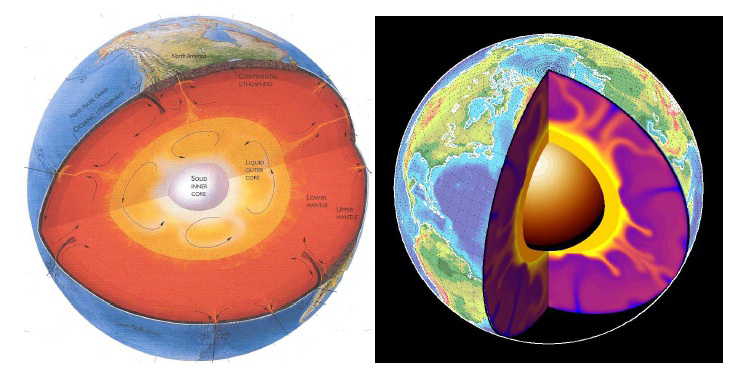
Figure 1.
Graphic renditions of cut aways of Earth’s structure showing crust, mantle and core (left) and of the convecting mantle (right). The relevant dimensions are that the Earth’s average radius is $6371 \text{ km}$; the depth of the base of the oceanic crust is about $7 \text{ km}$ and continental crust about $35 \text{ km}$; the base of the lithosphere varies from $0 \text{ km}$ at mid-ocean ridges to about $100 \text{ km}$ near subduction zones; the base of the upper mantle is at $410 \text{ km}$ depth, the Transition Zone sits between $410 \text{ km}$ and $660 \text{ km}$ depths; the depth of the base of the mantle (the core-mantle boundary) is $2890 \text{ km}$; and the inner core–outer core boundary is at a depth of $5150 \text{ km}$.
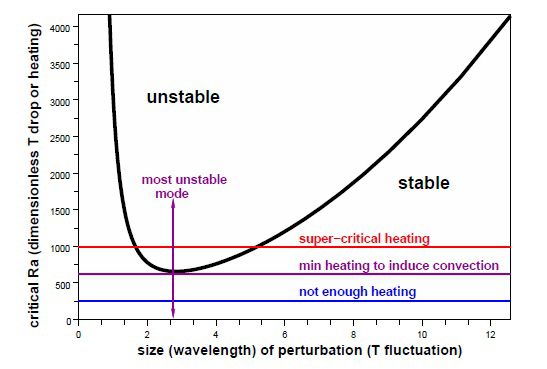
Figure 2:
The critical Rayleigh number $Ra$ for the onset of convection is a function of wavelength or size of the thermal perturbation to a static conductive state. Values of $Ra$ above the $Ra_{crit}$ curve are associated with the conductive layer being convectively unstable (perturbations grow), while below the curve the layer is stable (perturbations decay). The minimum in the $Ra_{crit}$ curve occurs at the wavelength of the first perturbation to go unstable as heating and $Ra$ is increased, often called the most unstable mode.