Cycling and Thermal Convection
Develop a model based on evidence of Earth's interior to describe the cycling of matter by thermal convection involves understanding how heat drives the movement of materials within Earth. The Earth's interior is structured with a hot, solid inner core surrounded by a liquid outer core, which is in turn enveloped by the mantle and the crust. Thermal convection in the mantle, driven by the heat from the core, causes the semi-fluid mantle to circulate. Hot material rises towards the surface at mid-ocean ridges, cools, and then sinks back down in other regions, such as subduction zones. This convection process creates a cycle that moves and recycles matter within the Earth, driving the movement of tectonic plates and influencing geological processes such as volcanic activity and the formation of mountain ranges. The main concepts include:
The Earth's interior is composed of several layers, including the crust, mantle, outer core, and inner core. The crust is the thin, outermost layer of the Earth, and it is composed of solid rock. The mantle is the largest layer and is composed of hot, semi-solid rock. The outer core is composed of liquid iron and nickel, while the inner core is a solid ball of iron and nickel.
The Earth's interior is not static but undergoes constant movement and change. Convection currents in the mantle cause the tectonic plates to move, leading to earthquakes, volcanoes, and the formation of mountain ranges.
Thermal convection is the process by which heat is transferred within the Earth's mantle. As hot material rises and cool material sinks, it creates convection currents that move the tectonic plates.
One-dimensional and three-dimensional models of the Earth's interior are used to understand the structure and processes occurring within the Earth. These models use data from a variety of sources, such as seismic waves, to create images of the Earth's interior.
Plate tectonics is the theory that explains how the Earth's crustal plates move and interact. It is based on the idea that the Earth's lithosphere is broken up into a number of plates that move relative to one another.
Rocks and minerals can be identified and classified using various tests and protocols that determine their physical and chemical properties. These tests include hardness, color, luster, streak, and crystal structure.
Evidence such as seismic waves, magnetic field records, and high-pressure laboratory experiments can be used to develop models of the Earth's interior. Seismic waves from earthquakes can be used to study the interior of the Earth, and magnetic field records can help identify the Earth's magnetic field reversal. High-pressure laboratory experiments can also simulate the conditions of the Earth's interior to study its properties.
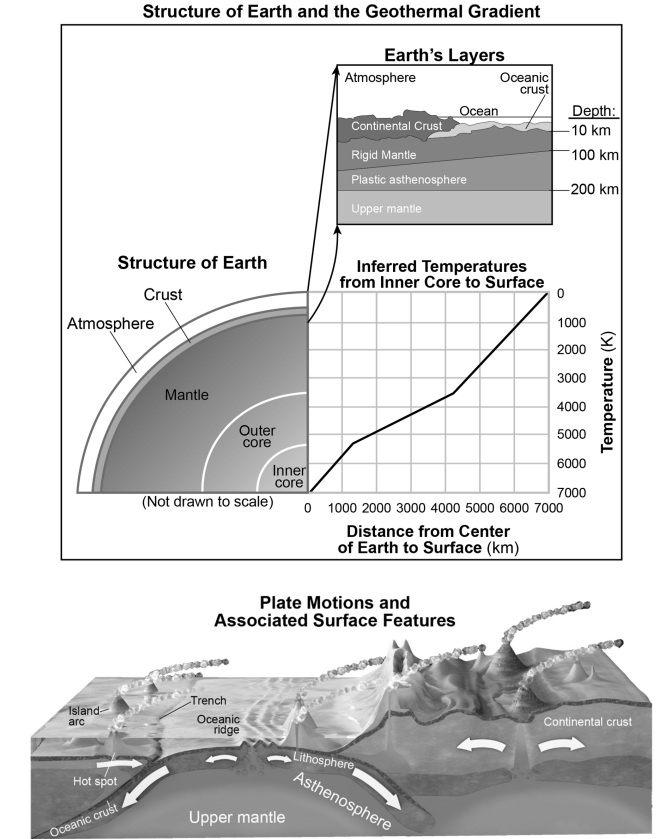
One of the pieces of evidence that Wegener was missing to explain his theory was the driving force for moving tectonic plates across Earth. The diagram below represents the structure of Earth and the geothermal gradient (the rate of change in temperature with respect to increasing depth in Earth’s interior). The model is a block diagram of a portion of Earth, with arrows representing the motion of tectonic plates.