Feedback and Earth’s Changes
Analyzing geoscience data reveals that a change to Earth's surface can trigger feedbacks that affect other Earth systems. For example, melting ice reduces the Earth's albedo (reflectivity), leading to increased absorption of sunlight and further warming, which in turn accelerates ice melt. Such feedback loops illustrate how interconnected Earth's systems are, where a change in one area, like surface conditions, can lead to significant and sometimes amplified impacts on climate, weather patterns, and ecosystems. The main concepts include:
Geoscience data is a collection of information about the Earth and its systems, including the atmosphere, hydrosphere, lithosphere, and biosphere. Scientists use various tools and techniques to collect and analyze geoscience data, including remote sensing, geophysical surveys, drilling, and sampling. This data is essential to understanding Earth's systems and their interactions, which in turn helps to predict and mitigate natural hazards, manage resources, and make informed decisions about environmental policies.
Feedback mechanisms are processes that amplify or dampen the effects of a particular factor on a system. In the context of Earth's systems, feedback mechanisms are important in understanding the cause-and-effect relationships between different systems. For example, if warming temperatures cause more ice to melt in the Arctic, the decreased albedo (reflectivity) of the exposed ocean water absorbs more heat, leading to further warming and more ice melt. This positive feedback loop can have significant impacts on global climate and sea levels.
Climate feedbacks are the most well-known examples of feedback mechanisms that cause changes to Earth's systems. These feedbacks can be positive or negative and can occur within individual systems or between systems. For example, warming temperatures can cause permafrost to thaw, releasing large amounts of methane into the atmosphere, which can further increase global temperatures. Loss of ground vegetation, dammed rivers, and loss of wetlands are other examples of feedback mechanisms that can have significant impacts on Earth's systems. For example, when forests are cleared, the loss of vegetation can lead to soil erosion, which in turn can cause changes in river channels, sediment deposition, and nutrient cycling.
Human activities, such as burning fossil fuels, deforestation, and urbanization, have a significant impact on Earth's systems and can cause severe changes in the environment. These changes can affect climate, water availability, soil quality, and biodiversity. For example, burning fossil fuels releases greenhouse gases into the atmosphere, which trap heat and contribute to global warming. Deforestation can lead to soil erosion, loss of biodiversity, and changes in local climate patterns. Urbanization can cause changes in land use, water availability, and air quality, affecting both human health and ecosystems.
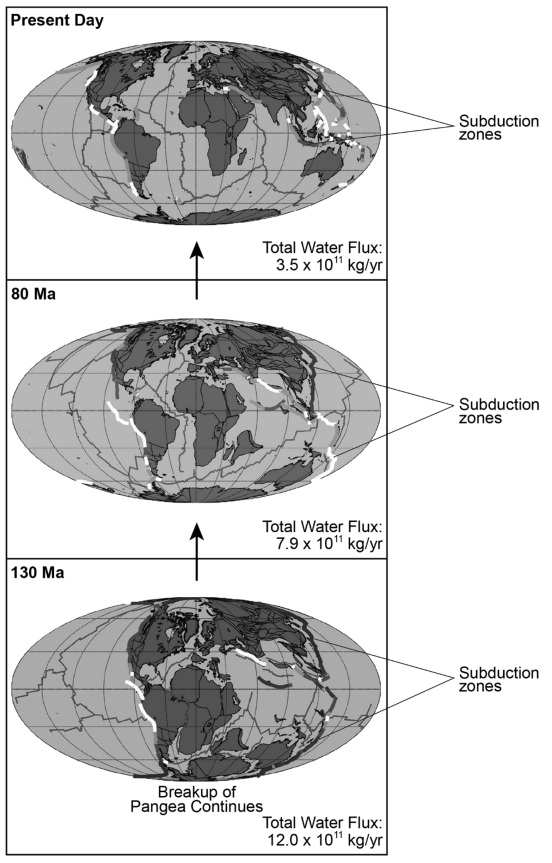
The maps below show the distribution of continents 130 Ma (million years ago) to the present day. Water flux is the amount of water flowing into Earth’s mantle at subduction zones. White subduction zones indicate less
relative water flux while black subduction zones indicate a greater water flux relative to white.