Twa kɔ nsɛm atitiriw so
Log in
Sign up for FREE
arrow_back
Laabri

Relative Humidity - HS - ESS - Earth's Systems

star
star
star
star
star
Last updated 3 months ago
8 Nsɛmmisa
Hyɛ no nsow a efi ɔkyerɛwfo no hɔ:

Directions: Use the information provided and your knowledge of Earth and Space Sciences to answer the following questions. Show all work where necessary.

Directions: Use the information provided and your knowledge of Earth and Space Sciences to answer the following questions. Show all work where necessary.

0
Ɛhia
4
DOK 2
HS-ESS2-5
Ɛhia
2
DOK 1
HS-ESS2-5
Ɛhia
6
DOK 3
HS-ESS2-5
Ɛhia
4
DOK 2
HS-ESS3-6
Ɛhia
2
DOK 1
HS-ESS2-5
Ɛhia
4
DOK 2
HS-ESS3-6
Ɛhia
6
DOK 3
HS-ESS3-6
Ɛhia
4
DOK 2
HS-ESS3-6

Relative Humidity

Relative humidity is calculated using temperature and moisture fields from NASA’s GEOS-FP system. GEOS-FP combines millions of weather observations with a predictive model to create a global best estimate of weather conditions that are used to begin a forecast. Below is a view of the world’s relative humidity on November 5th, 2024 at 2:00 PM EST.

Figure 1.
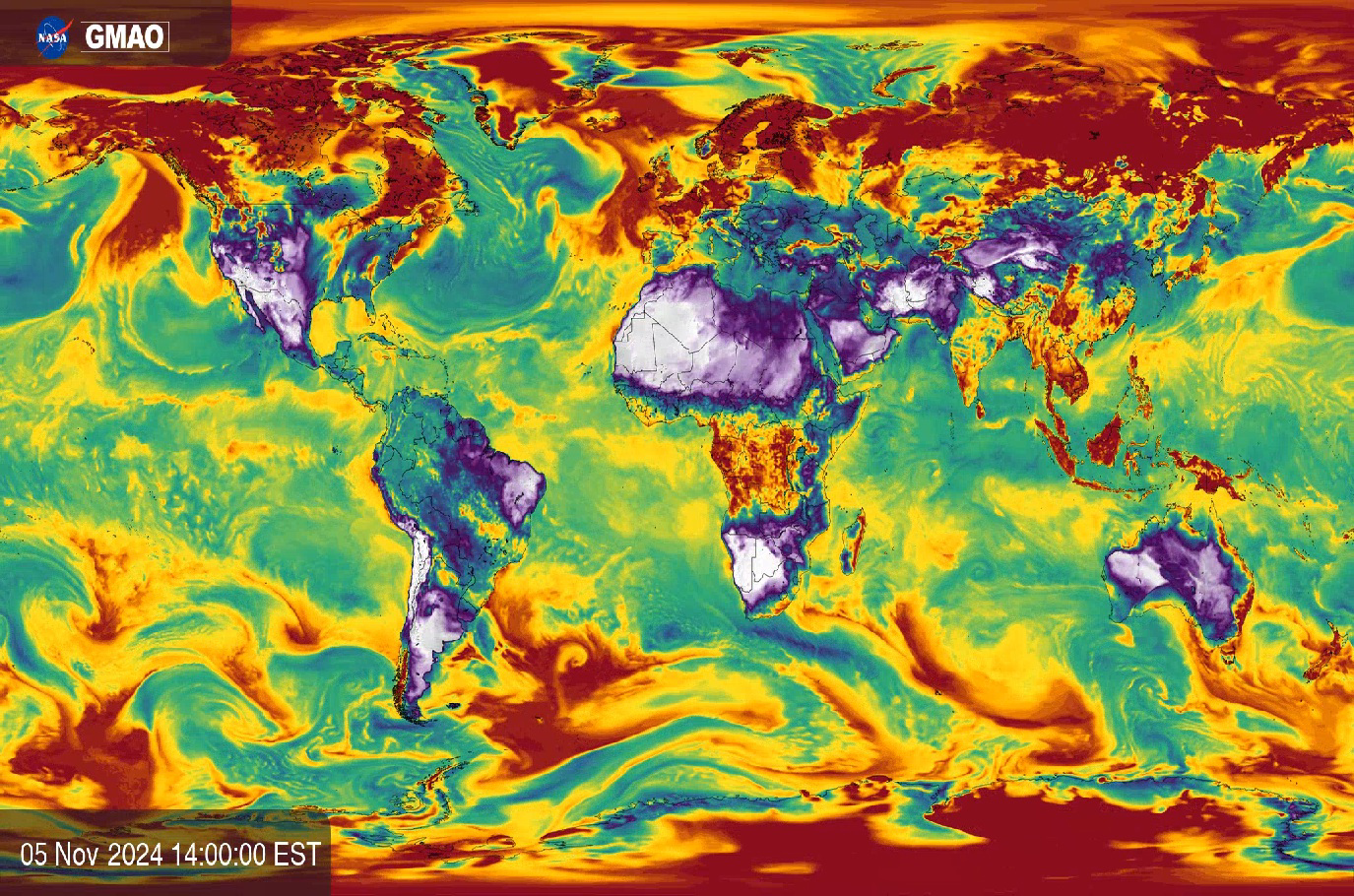
World map showing relative humidity from NASA GEOS-FP on November 5, 2024 at 2 PM EST.Source:

https://svs.gsfc.nasa.gov/5150/

Relative humidity is the amount of moisture in the air at a certain temperature compared to what the air can “hold” at that temperature. When the air in your home reaches a specific capacity of water vapor, it will condense as moisture, causing the air to feel damp. When relative humidity gets too high, usually above 50%, mold and mildew growth and trapped allergens become more likely which, in turn, may cause allergy and asthma symptoms to appear.

Figure 2.
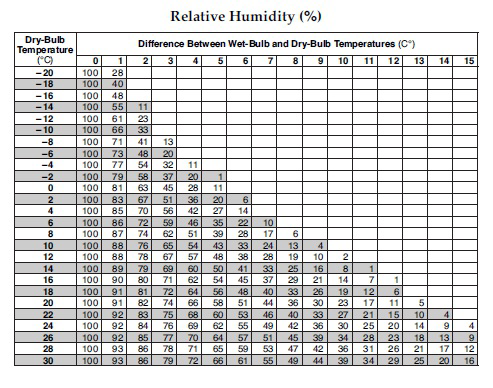
Table of relative humidity values based on dry-bulb temperature and difference between wet-bulb and dry-bulb temperatures.Source:

NYS Earth Science Reference Tables, 2011

Asemmisa {{asɛmmisaAhyɛnsode}}
1.

Explain how relative humidity depends on both temperature and moisture content of the air.

Asemmisa {{asɛmmisaAhyɛnsode}}
2.

If air temperature rises while the amount of water vapor remains constant, what happens to relative humidity?

Asemmisa {{asɛmmisaAhyɛnsode}}
3.

Using the dry-bulb and wet-bulb data ($20^\circ\text{C}$ and $11^\circ\text{C}$), determine the relative humidity from the Earth Science Reference Table and describe whether the home is in danger of mold growth.

Asemmisa {{asɛmmisaAhyɛnsode}}
4.

Describe how humidity sensors in climate models help improve weather forecasts.

Asemmisa {{asɛmmisaAhyɛnsode}}
5.

When air becomes saturated, what must happen for condensation to occur?

Asemmisa {{asɛmmisaAhyɛnsode}}
6.

Explain how humidity levels can influence human comfort and health indoors.

Asemmisa {{asɛmmisaAhyɛnsode}}
7.

Using the home measurement data, answer: Is your home in danger of mold and mildew growth?

Asemmisa {{asɛmmisaAhyɛnsode}}
8.

Explain how climate control systems in homes and buildings can help manage humidity levels and prevent mold.