Twa kɔ nsɛm atitiriw so
Log in
Sign up for FREE
arrow_back
Laabri

Wind Chill - HS - ESS - Earth's Systems

star
star
star
star
star
Last updated 4 months ago
8 Nsɛmmisa
Hyɛ no nsow a efi ɔkyerɛwfo no hɔ:

Directions: Use the information provided and your knowledge of Earth and Space Sciences to answer the following questions. Show all work where necessary.

Directions: Use the information provided and your knowledge of Earth and Space Sciences to answer the following questions. Show all work where necessary.

0
Ɛhia
4
DOK 2
HS-ESS2-4
Ɛhia
6
DOK 3
HS-ESS3-1
Ɛhia
2
DOK 1
HS-ESS2-4
Ɛhia
4
DOK 2
HS-ESS3-1
Ɛhia
2
DOK 1
HS-ESS2-4
Ɛhia
4
DOK 2
HS-ESS2-4
Ɛhia
6
HS-ESS2-4
Ɛhia
4
DOK 2
HS-ESS3-4

Wind Chill

Wind Chill is a term used to describe what the air temperature feels like to the human skin due to the combination of cold temperatures and winds blowing on exposed skin. In simple terms, the colder the air temperature and the higher the wind speeds the colder it will feel on your skin if you're outside. So even if it remains the same temperature, but the wind speed increases it will actually feel colder to your skin.

So why does it feel colder if the wind speed increases but the temperature remains the same? The reason is because as wind blows across our bodies it takes the heat we naturally emit and blows it away from our bodies. The faster the wind speed the faster our body heat is taken away and the colder it feels. It is a similar process for when you blow on a hot bowl of soup to cool it down. The temperature that it feels like outside due to the air temperature and wind speed is called the "Wind Chill."

Below is a chart that shows the wind chill for various air temperatures and wind speeds. The colors represent a frostbite indicator, showing the points where temperature, wind speed and exposure time will produce frostbite on humans. Each shaded area shows how long a person can be exposed before frostbite develops. For example, a temperature of 0°F and a wind speed of 15 mph will produce a wind chill temperature of -19°F. Under these conditions, exposed skin can freeze in 30 minutes.
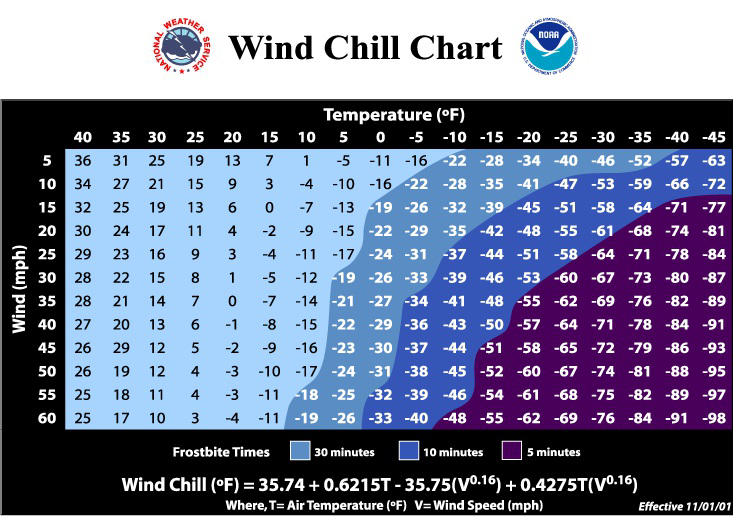
Wind Chill Chart showing wind chill for various air temperatures and wind speedsSource: National Weather Service

Asemmisa {{asɛmmisaAhyɛnsode}}
1.

Explain why increasing wind speed makes it feel colder to human skin even when the air temperature does not change.

Asemmisa {{asɛmmisaAhyɛnsode}}
2.

Using the wind chill chart, determine the wind chill temperature and approximate frostbite risk for an air temperature of $0^\circ\mathrm{F}$ and a wind speed of 15 mph.

Asemmisa {{asɛmmisaAhyɛnsode}}
3.

What is the main process that causes the “wind chill” effect on human skin?

Asemmisa {{asɛmmisaAhyɛnsode}}
4.

Describe how wind chill can be used to assess risk for outdoor workers, athletes, or emergency responders.

Asemmisa {{asɛmmisaAhyɛnsode}}
5.

A scientist observes that a 10 mph wind produces a greater drop in wind chill at $0^\circ F$ than at $30^\circ F$. What does this indicate about the relationship between wind speed and air temperature?

Asemmisa {{asɛmmisaAhyɛnsode}}
6.

Explain how the concept of wind chill demonstrates the flow of energy between humans and their environment.

Asemmisa {{asɛmmisaAhyɛnsode}}
7.

Claim:
Wind speed has a measurable and predictable effect on perceived temperature.

Use evidence from the wind chill chart to support this claim.

Asemmisa {{asɛmmisaAhyɛnsode}}
8.

Propose one engineering or safety strategy that can help reduce the risk of frostbite or hypothermia in windy, cold conditions.