Faults, Plate Tectonic, Ocean Floor
What is a fault?
A fault is a fracture or zone of fractures between two blocks of rock. Faults allow the blocks to move relative to each other. This movement may occur rapidly, in the form of an earthquake – or may occur slowly, in the form of creep. Faults may range in length from a few millimeters to thousands of kilometers. Most faults produce repeated displacements over geologic time. During an earthquake, the rock on one side of the fault suddenly slips with respect to the other. The fault surface can be horizontal or vertical or some arbitrary angle in between.
A fault plane is the plane that represents the fracture surface of a fault. A fault trace or fault line is the intersection of a fault plane with the ground surface. A fault trace is also the line commonly plotted on geologic maps to represent a fault.
Figure 1.
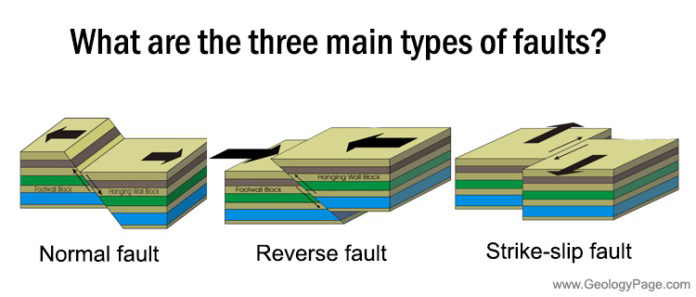
Source: https://www.geologypage.com/2017/10/three-main-types-faults.html
Plate tectonics and the ocean floor
Bathymetry, the shape of the ocean floor, is largely a result of a process called plate tectonics. The outer rocky layer of the Earth includes about a dozen large sections called tectonic plates that are arranged like a spherical jig-saw puzzle floating on top of the Earth's hot flowing mantle. Convection currents in the molten mantle cause the plates to slowly move about the Earth a few centimeters each year. Many ocean floor features are a result of the interactions that occur at the edges of these plates.
The shifting plates may collide (converge), move away (diverge) or slide past (transform) each other. As plates converge, one plate may move under the other causing earthquakes, forming volcanoes, or creating deep ocean trenches. Where plates diverge from each other, molten magma flows upward between the plates, forming mid-ocean ridges, underwater volcanoes, hydrothermal vents, and new ocean floor crust. Transform boundaries are faults that connect two areas where plates are converging or diverging. The edges of these continental boundaries usually form zig-zag patterns.