Twa kɔ nsɛm atitiriw so
Log in
Sign up for FREE
arrow_back
Laabri

Radioactive Elements and Half-Life - HS - ESS - History of the Earth

star
star
star
star
star
Last updated 3 months ago
8 Nsɛmmisa
Hyɛ no nsow a efi ɔkyerɛwfo no hɔ:

Directions: Use the information provided and your knowledge of Earth and Space Sciences to answer the following questions. Show all work where necessary.

Directions: Use the information provided and your knowledge of Earth and Space Sciences to answer the following questions. Show all work where necessary.

0
Ɛhia
4
DOK 2
HS-PS1-8
Ɛhia
2
DOK 1
HS-PS1-8
Ɛhia
6
DOK 3
HS-PS1-8
Ɛhia
4
DOK 2
HS-ESS1-6
Ɛhia
2
DOK 1
HS-ESS1-6
Ɛhia
4
DOK 2
HS-PS1-8
Ɛhia
6
DOK 3
HS-ESS1-6
Ɛhia
4
DOK 2
HS-ESS2-1

Radioactive Elements and Half-Life

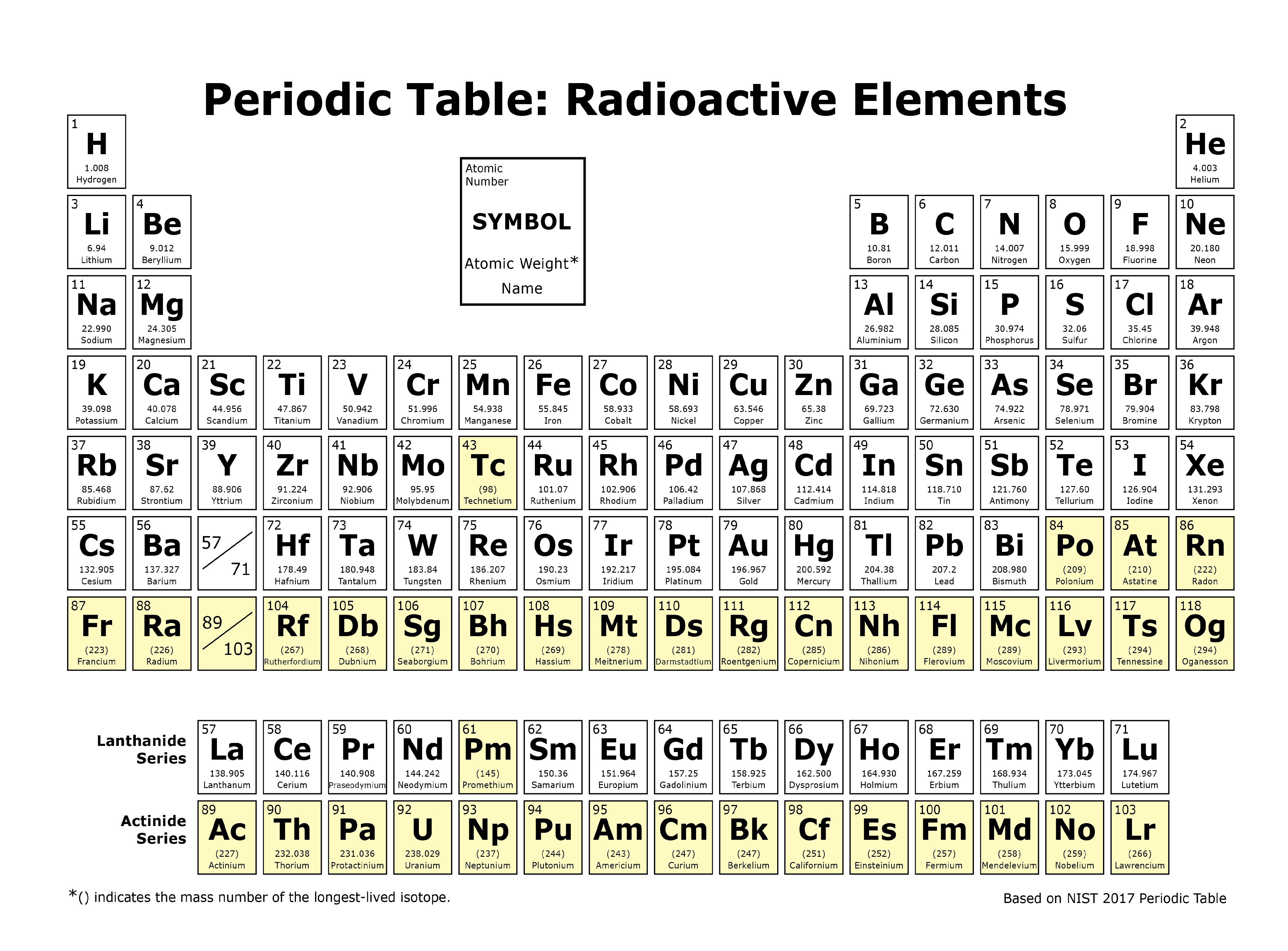
Chemical elements can take several related forms, known as isotopes. Some of these forms are unstable, also known as radioactive isotopes. But they don’t want to be unstable. So they morph by shedding one or more subatomic particles. Through this process, they naturally transform into a more stable (and always smaller) element. The expelled particles and energy are known as radiation. That morphing process is called radioactive decay.

The protons and neutrons inside the nuclei of radioactive isotopes are unstable. Forces holding together the protons and neutrons inside an atom’s nucleus are out of balance. This atom now strives to become balanced. To do this, it gives off some of its energy and particles. There are lots of ways the decay can happen. But the result is the same: the unstable isotope eventually becomes a new, stable one.

Figure 1.
Morphing at a clock-like rate

How long it takes an isotope to decay depends on a lot of factors. But scientists describe the process in terms of its half-life. An isotope’s half-life is defined as the amount of time it takes for one-half of the atoms of a radioactive isotope to decay. That half-life is always the same - like an unwritten rule - that is specific to each isotope.

If you start with 80 unstable atoms, 40 (or 1/2) atoms will remain at the end of the first half-life. The rest will have decayed to a new isotope. After two half-lives, just 20 (or 1/4) atoms of the original isotope would remain. Three half-lives would leave only about 10 (or 1/8) atoms of the original isotope. By the end of the fourth half-life, there are only five (or 1/16) atoms of the original isotope. All of the rest have morphed into stable atoms.

Figure 2.
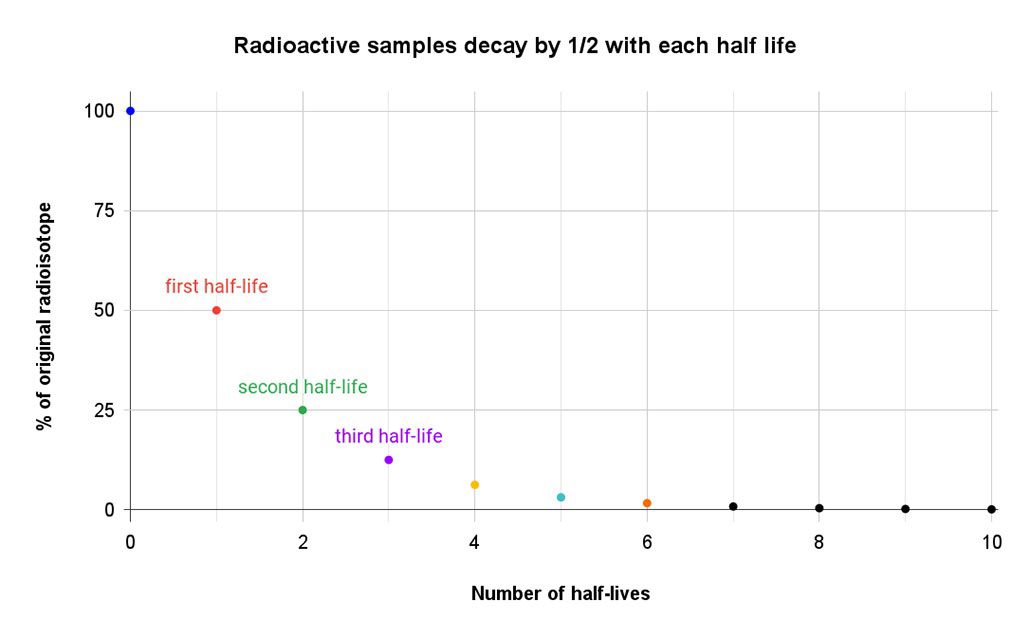
Graph showing radioactive samples decaying by one-half with each half-life, plotting percent of original radioisotope versus number of half-lives.

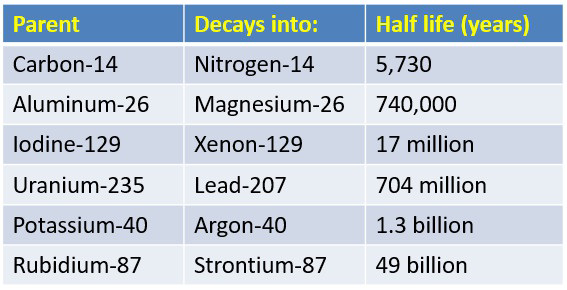
Figure 3.

Table listing radioactive parent isotopes, the isotopes they decay into, and their half-lives in years.

Asemmisa {{asɛmmisaAhyɛnsode}}
1.

Explain what happens inside an atom when a radioactive isotope decays.

Asemmisa {{asɛmmisaAhyɛnsode}}
2.

What determines the rate of radioactive decay for a given isotope?

Asemmisa {{asɛmmisaAhyɛnsode}}
3.

If a sample of potassium-40 has a half-life of $1.3 \times 10^{9}$ years, what fraction of the original isotope remains after $2.6 \times 10^{9}$ years?

Asemmisa {{asɛmmisaAhyɛnsode}}
4.

Describe how scientists use radioactive decay to determine the age of rocks and fossils.

Asemmisa {{asɛmmisaAhyɛnsode}}
5.

Why is carbon-14 dating not effective for rocks that are millions of years old?

Asemmisa {{asɛmmisaAhyɛnsode}}
6.

Explain why the half-life of an isotope is considered constant and reliable for scientific measurements.

Asemmisa {{asɛmmisaAhyɛnsode}}
7.

Use the reading and data on isotopes to answer: Can radioactive decay be used as reliable evidence to date Earth materials?

Asemmisa {{asɛmmisaAhyɛnsode}}
8.

Explain how the concept of radioactive decay connects atomic structure to large-scale Earth processes.