Evidence for Plate Tectonics
Plate tectonics is the scientific theory explaining the movement of the earth’s crust. It is widely accepted by scientists today. Recall that both continental landmasses and the ocean floor are part of the earth’s crust, and that the crust is broken into individual pieces called tectonic plates. The movement of these tectonic plates is likely caused by convection currents in the molten rock in Earth’s mantle below the crust. Earthquakes and volcanoes are the short-term results of this tectonic movement. The long-term result of plate tectonics is the movement of entire continents over millions of years. The presence of the same type of fossils on continents that are now widely separated is evidence that continents have moved over geological history.
Figure 1.
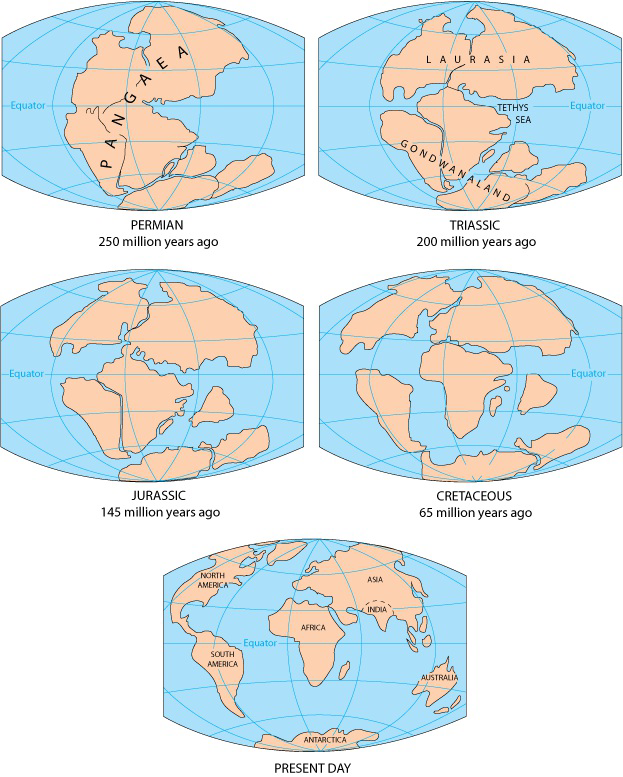
Evidence for the Movement of Continents
The shapes of the continents provide clues about the past movement of the continents. The edges of the continents on the map seem to fit together like a jigsaw puzzle. For example, on the west coast of Africa, there is an indentation into which the bulge along the east coast of South America fits. The shapes of the continental shelves—the submerged landmass around continents—shows that the fit between continents is even more striking (Figure 1).
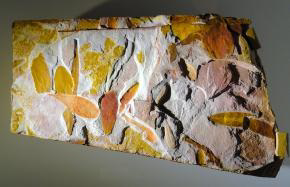
Some fossils provide evidence that continents were once located nearer to one another than they are today. Fossils of a marine reptile called Mesosaurus (Figure 2) and a land reptile called Cynognathus (Figure 3) have been found in South America and South Africa. Another example is the fossil plant called Glossopteris, which is found in India, Australia, and Antarctica (Figure 4). The presence of identical fossils in continents that are now widely separated is one of the main pieces of evidence that led to the initial idea that the continents had moved over geological history.
Figure 2.
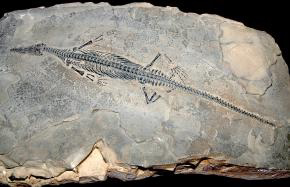
Figure 3.
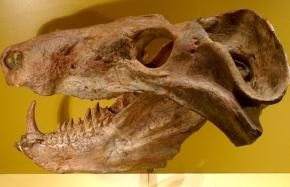
Figure 4.
Evidence for continental drift is also found in the types of rocks on continents. There are belts of rock in Africa and South America that match when the ends of the continents are joined. Mountains of comparable age and structure are found in the northeastern part of North America (Appalachian Mountains) and across the British Isles into Norway (Caledonian Mountains). These landmasses can be reassembled so that the mountains form a continuous chain.
Paleoclimatologists (paleo = ancient; climate = long term temperature and weather patterns) study evidence of prehistoric climates. Evidence from glacial striations in rocks, the deep grooves in the land left by the movement of glaciers, shows that 300 mya there were large sheets of ice covering parts of South America, Africa, India, and Australia. These striations indicate that the direction of glacial movement in Africa was toward the Atlantic ocean basin and in South America was from the Atlantic ocean basin. This evidence suggests that South America and Africa were once connected, and that glaciers moved across Africa and South America. There is no glacial evidence for continental movement in North America, because there was no ice covering the continent 300 million years ago. North America may have been nearer the equator where warm temperatures prevented ice sheet formation.