Twa kɔ nsɛm atitiriw so
Log in
Sign up for FREE
arrow_back
Laabri

Unit 2 Performance Task: The Flashy Guppy Data Analysis

star
star
star
star
star
Last updated 3 months ago
16 Nsɛmmisa

Introduction: The Flashy Guppy

A properly dressed male guppy, with its bright blue spots and brilliant splashes of orange, can’t help but stand out. But for a fish that spends its life swimming among predators, it seems that good camouflage would have a big advantage over colors that attract attention. If flashiness is a dangerous risk, why do we still see this trait in the population?

Endler’s Research

In the 1970s, a scientist named John Endler studied guppies in Trinidad. He noticed that guppies in different streams looked very different. Even guppies in the same stream looked different.  Males from one pool had bright blue and orange spots along their sides, while those farther downstream carried only small dots of color near their tails. Endler also observed differences in the location of guppy predators and in the color and size of gravel in different stream locations.
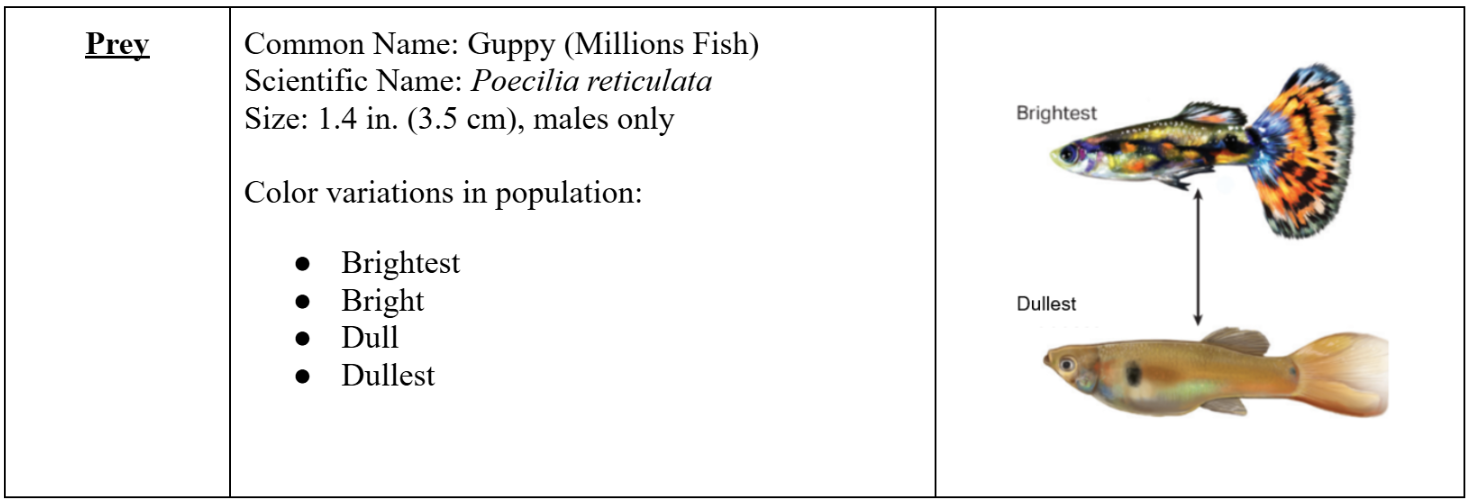
Endler photographed hundreds of guppies and carefully collected data about their size, color, and the size and placement of their spots. He began to see a strong relationship between where guppies lived in a particular stream and whether the fish were bright or dull. But what was responsible for these trends in coloration? And if bright colors made guppies more noticeable to predators, why should males be colorful at all? To find out, Endler formed a hypothesis based on his observations and then set out to test it. Based on his tests, he made one of the most important discoveries in evolutionary biology.
ANALYZING DATA

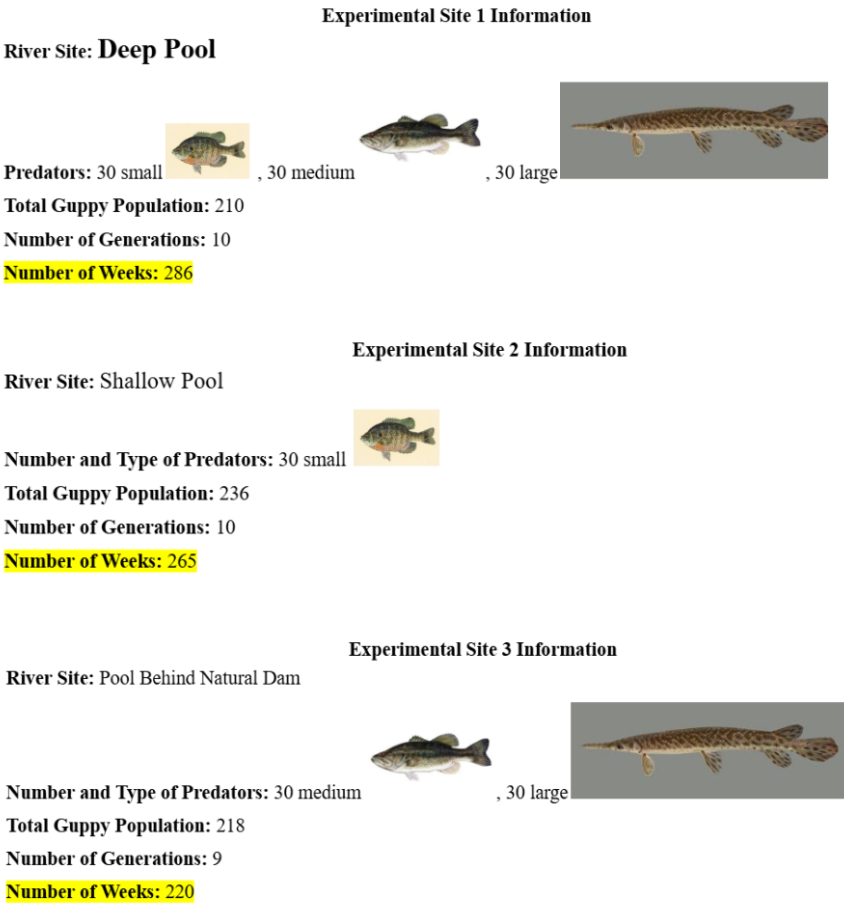
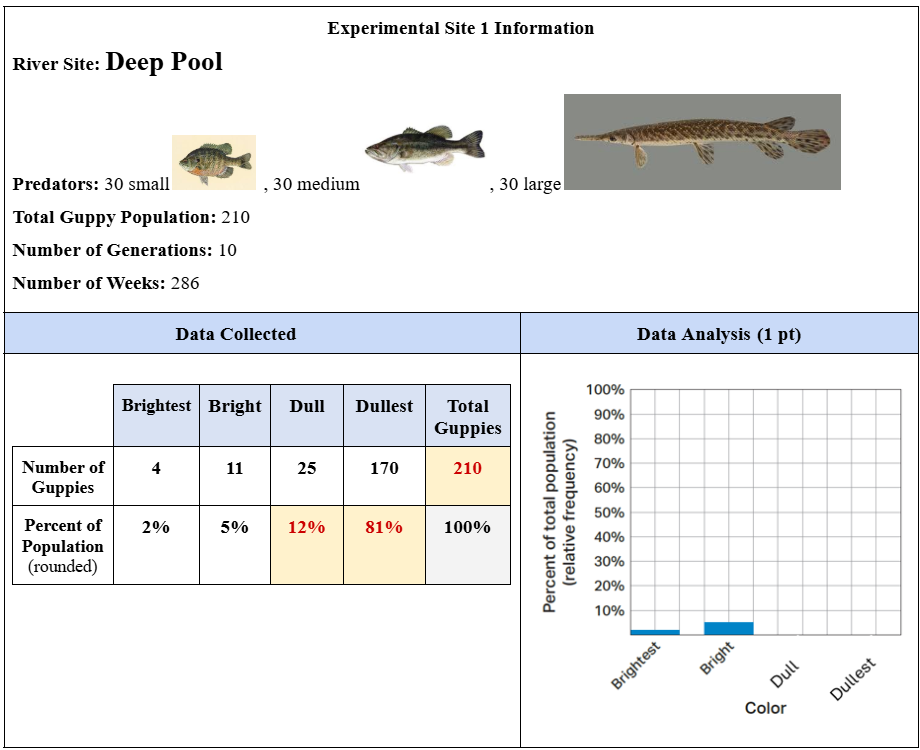
(Experimental Site 1 - Deep Pool)

Directions: The data sets shown are representative of findings from Endler’s research. Examine the data and complete the tables and graphs for experimental site 1.

Ɛhia
1
Asemmisa {{asɛmmisaAhyɛnsode}}
1a.

Complete the Percent of Population vs. Color bar graph in the image below.

Ɛhia
1
Asemmisa {{asɛmmisaAhyɛnsode}}
1b.
Ɛhia
1
Ɛhia
1
Asemmisa {{asɛmmisaAhyɛnsode}}
1d.

Reasoning: Explain your reasoning as to why your 2 chosen pieces of evidence prove your claim.

Your reasoning section should be 3-5 sentences in length to fully explain each piece of evidence and how it proves the claim.

ANALYZING DATA

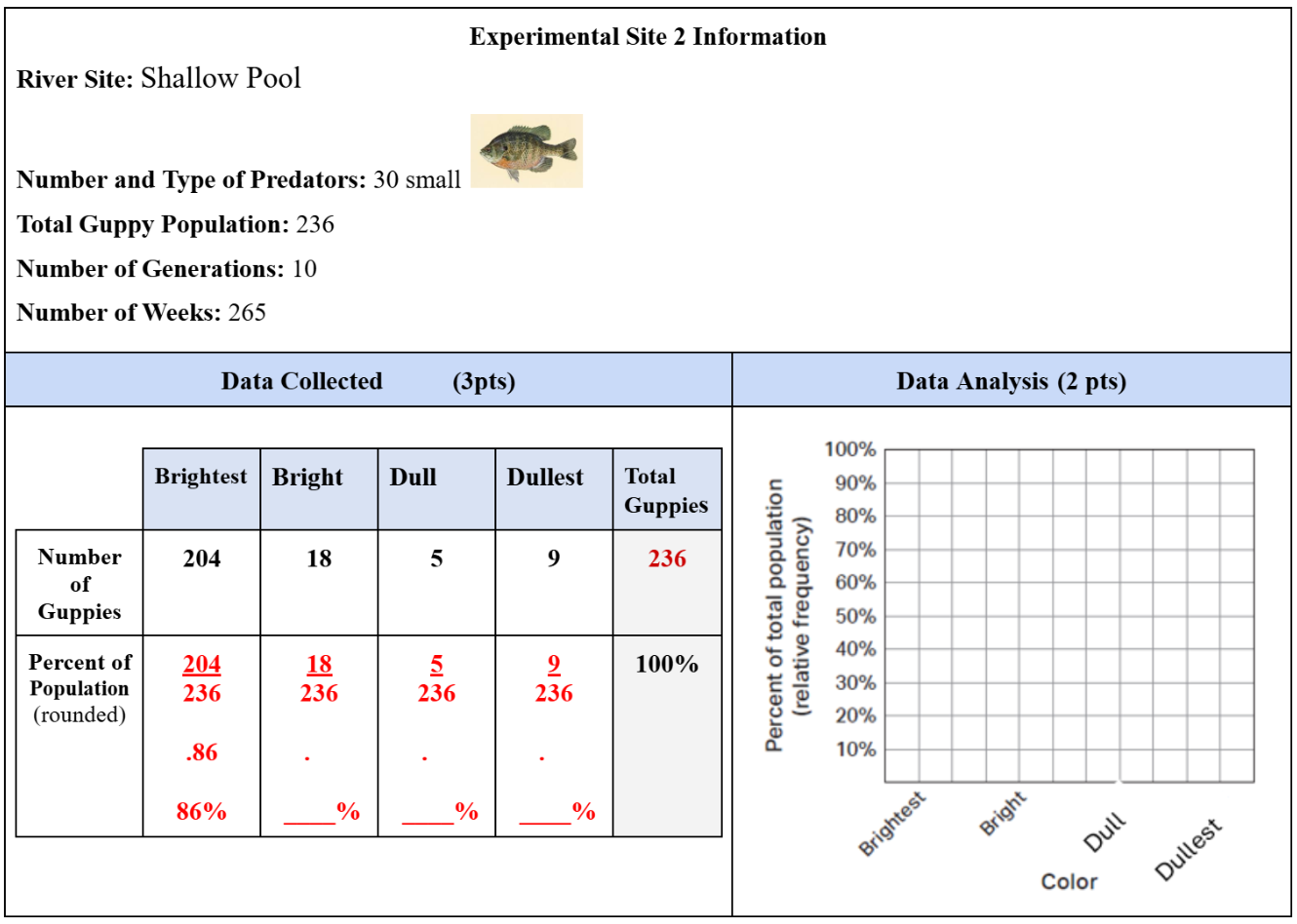
(Experimental Site 2 - Shallow Pool)

Directions: The data sets shown are representative of findings from Endler’s research. Examine the data and complete the tables and graphs for experimental site 2.

Ɛhia
4
Asemmisa {{asɛmmisaAhyɛnsode}}
2a.

Complete the chart of Data Collected AND the Percent of Population vs. Color bar graph in the image below.

To complete the missing percentages in the data chart, you must CALCULATE the percentages using the percent formula and show your work. Round your final answer to a whole number. The first one has been done for you.

Ɛhia
1
Asemmisa {{asɛmmisaAhyɛnsode}}
2b.
Ɛhia
1
Ɛhia
1
Asemmisa {{asɛmmisaAhyɛnsode}}
2d.

Reasoning: Explain your reasoning as to why your 2 chosen pieces of evidence prove your claim.

Your reasoning section should be 3-5 sentences in length to fully explain each piece of evidence and how it proves the claim.

ANALYZING DATA

(Experimental Site 3 - Pool Behind Natural Dam)

Directions: The data sets shown are representative of findings from Endler’s research. Examine the data and complete the tables and graphs for experimental site 3.

.

Ɛhia
5
Asemmisa {{asɛmmisaAhyɛnsode}}
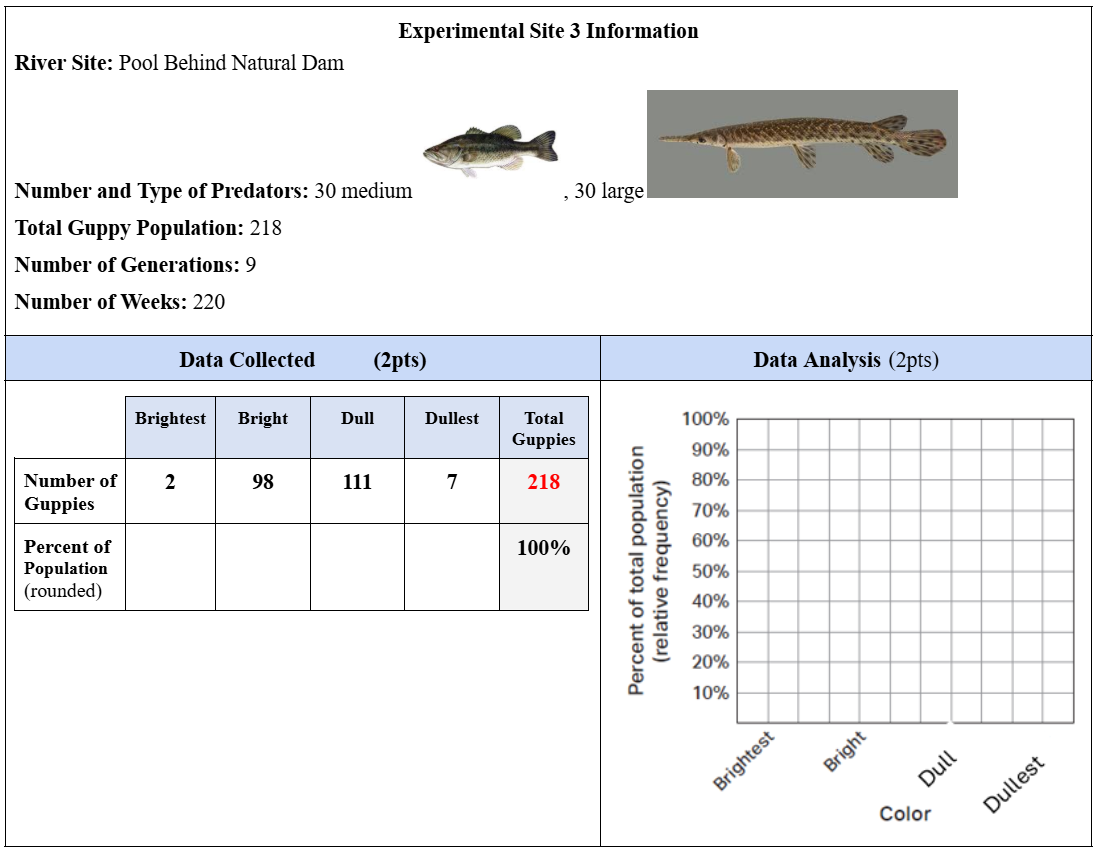
3a.

Complete the chart of Data Collected AND the Percent of Population vs. Color bar graph in the image below.

To complete all missing percentages in the data chart, you must CALCULATE the percentages using the percent formula and show your work. Round your final answer to a whole number.

Ɛhia
1
Asemmisa {{asɛmmisaAhyɛnsode}}
3b.
Ɛhia
1
Ɛhia
1
Asemmisa {{asɛmmisaAhyɛnsode}}
3d.

Reasoning: Explain your reasoning as to why your 2 chosen pieces of evidence prove your claim.

Your reasoning section should be 3-5 sentences in length to fully explain each piece of evidence and how it proves the claim.

Drawing Conclusions

Using all the data, reading, and resources thus far answer the following concluding questions.

Ɛhia
2
Asemmisa {{asɛmmisaAhyɛnsode}}
4a.

Examine the length of time Endler waited to collect data. Why do you think he waited this long?

Use one or more of the data sets to explain your answer.

Ɛhia
1
Ɛhia
1
Ɛhia
3
Asemmisa {{asɛmmisaAhyɛnsode}}
4d.

Make a final claim about whether natural selection is acting on guppy color variations. Identify three missing pieces of evidence needed for further support. Use the words heritability, selection and reproduction in your answers.

Missing Evidence 1:

Missing Evidence 2:

Missing Evidence 3:

Asemmisa {{asɛmmisaAhyɛnsode}}
1c.

Evidence: Provide 2 pieces of evidence that prove your chosen claim from question 1b from the data and reading.

Select ALL that apply.

Asemmisa {{asɛmmisaAhyɛnsode}}
2c.

Evidence: Provide 2 pieces of evidence that prove your chosen claim from for question 2b from the data and reading.

Select ALL that apply.

Asemmisa {{asɛmmisaAhyɛnsode}}
3c.

Evidence: Provide 2 pieces of evidence that prove your chosen claim from for question 2b from the data and reading.

Select ALL that apply.

Asemmisa {{asɛmmisaAhyɛnsode}}
4b.

Endler observed that even the dullest males varied in coloration across areas. What could cause this difference?

Asemmisa {{asɛmmisaAhyɛnsode}}
4c.

If the dullest male moved to a new area, how might its fitness change in a different environment with different predators?