Ellen is writing a story for her class about a day at the beach. She wants to revise her story to use more descriptive words. Read the draft and complete the task that follows.
It was Ellen's last day of summer vacation. She raced into the garage and announced, "Dad, we have to go to the beach today! It's our last chance this summer to go swimming and build sandcastles together!"
Dad smiled happily and, together, Ellen and Dad drove 45 minutes to the beach. Once there, they set up their chairs near the water. Dad read and Ellen played.
Ellen worked for about an hour on her sandcastle. Then, she noticed that her dad had spent that entire time just reading a book. She felt annoyed. She tugged at Dad's book. She looked at him.
Dad grinned and set his book aside. Together, the two raced into the warm, bubbly waves. They laughed with excitement.
Select two of the choices that have the best descriptive sentences to replace Dad read and Ellen played and She looked at him.
A student is writing a report for social studies class about the state of Alaska. The student wants to revise the draft to make sure it has enough details. Read this portion of the report and complete the task that follows.
Alaska is a very big state. It is bigger than Texas, California, and Montana put together! Even though it is a big state, only about 730,000 people live there. Alaska has 39 mountain ranges and two rain forests. A lot of different animals live in Alaska. In Barrow, the town located farthest north in the state, the sun doesn't set between May 10 and August 2, but between November 18 and January 23, the sun doesn't rise. Alaska is a very interesting and unusual place.
My notes on Alaska:
Black bears, brown bears, moose, musk ox, and whales are just a few animals that call Alaska home.
The capital of Alaska is Juneau.
There are 70,000 sea otters living in the waters of Alaska.
Alaska did not become a state until 1959.
The mountains in Alaska have the coldest temperatures in the United States.
Alaska is only 55 miles away from Russia.
Choose the two sentences from the student's notes that add more facts to the information given in the underlined sentence.
A student is writing an opinion article for her teacher about her favorite field trip. The student wants to revise the draft so that it has a logical conclusion. Read the draft of the opinion article and complete the task that follows.
Highlight the sentence in the draft below that is in the wrong place.
My favorite third-grade field trip is the trip to the zoo. There are many reasons that the zoo is the best field trip. First, when we go to the zoo, we get to ride on big buses that have televisions and bathrooms.
A student is writing an opinion paper for her teacher about dogs. Read this paragraph from the paper and the directions that follow.
Dogs are described as "people's best friend" because they make people happy. The fur on a dog can be long or short, or curly or straight, but most of the time it is soft. When people pet dogs, it makes them feel happy. There are community groups that bring dogs to nursing homes for the patients. Being able to play with the dogs makes the patients feel good. This is one reason why I think dogs are wonderful animals.
Select the best two words from the choices to replace the underlined words in the paragraph.
A student is writing a report about red foxes. She is looking for information about the body of the red fox. Which sentence has information that the student can use?
Read the sentence.
Jill likes to take care of the __________ in the nursery.
Which word should fill in the blank to correctly complete the sentence?
Read the paragraph.
(1) Jen takes good care of her bike. (2) She washed it yesterday afternoon. (3) Then she made sure the tires had enough air. (4) Tomorrow her dad put a new bell on the bike.
Which verb should be changed?
by Sue Barraclough
1 Your sensory system is made of the parts of your body that help you to understand the world around you. There are parts you can see, such as your nose and eyes. There are also parts inside your body that you cannot see, such as your brain.
2 You have five main senses. They are seeing, hearing, tasting, smelling, and touch. Your senses are involved in everything you do.
3 Your eyes are organs that help you to see. An organ is a part of your body that is made to do a certain job. Your eyes are in holes in your skull at the front of your head.
4 Your eyes are so balls. Your eyelids and eyelashes protect your eyes from dirt and sunshine. Blinking keeps your eyes wet and clean.
5 Your eyes collect light that bounces off things around you. Light goes into the eyeball through the pupil. The pupil is the round black hole in the middle of your eye. . . .
6 Your ears work by collecting sounds. Sounds make movements in the air called sound waves. Sound waves travel into your ears through the ear canal.
7 The sound waves make your eardrum move. As your eardrum moves it moves three tiny bones in your ear. Inside your ear these movements are picked up and sent as signals to your brain. . . .
8 Your nose picks up different smells. Smelling things can keep you safe. A smell can tell you if food is rotten. The smell of smoke can warn you of a f ire.
9 Smells are carried in the air and go into your nose as you breathe. There are tiny parts at the top of your nose that pick up smells.
10 Your nose sends signals about the smells to your brain. Your brain has lots of smells stored in your memory. Your brain can tell you what each smell is.
11 Your tongue is a part of your mouth. You use your tongue to help chew and swallow food. You use your tongue to help make sounds when you speak.
12 Your tongue helps you to taste and enjoy food. Your tongue also lets you know if something is not good to eat. Something that is bad to eat may taste bitter or horrible.
13 Your senses of smell and taste work together. When your nose is plugged from a cold your sense of taste does not work very well. . . .
14 Your sense of touch tells you what something feels like. It tells you if something is rough or smooth, or hot or cold.
15 Your sense of touch sends signals to the brain. This helps you to react to things. Touch tells you to scratch an itch on your leg. Touch helps you to move away from something that is prickly or hot. . . .
16 Your brain sorts and stores all the signals from your senses. Then it instantly sends millions of messages back to your body parts. Your brain tells all the different parts of your body what is happening and what to do.
by Nancy Viau

“Eeeww! Karly, get that slimy, disgusting piece of junk away from my doll!” Jessie hollered.
“It’s not slimy. It’s SHINY,” I said “Look!” I pushed my rock under Jessie’s nose. “Rocks aren’t disgusting, especially this one. It’s called obsidian, and it’s from a volcano. Dad and I bought it at the Natural Science Museum.”
Jessie shoved my rock. “Who cares? Karly, you are clueless. Girls don’t play with that stuff.”
“I like rocks.” I let out a puffy sigh and put the rock in my pocket. “I may be a famous geologist one day. What will you be?”
“Leave me alone,” Jessie snapped.
I didn’t feel like arguing, so I stomped out the door, plopped on the ground, and dug a hole. “Karly,” Mom called from the potting shed. “Do you have to play in the dirt? Look at your clothes They’re filthy.”
“Maybe I’ll be an archaeologist when I grow up,” I shouted. “They get paid to look for artifacts in the ground.” I dusted off my pants and marched to the porch. “Good dinosaur book?” I asked Dad, peering over his shoulder.
“Excellent, want me to read to you?” he asked.
“Not now. Sometime soon I want to get started on the book I got at the museum— the one that came with an awesome fish fossil and...”
Jessie interrupted and asked me, “What in the world would you do with a fossil?”
“I’d study a bunch of fossils and become a paleontologist. I might even discover a new dinosaur,” I replied.
My sister shook her head so hard I thought her braids would fly off. “Dad, we can’t possibly be twins,” she said. “Karly’s weird.”
Dad gave Jessie his don’t-mess-with-me look. “Not that again.”
Jessie took the hint. “I’m leaving. I have to find a shoebox and make a caveman diorama for school.”
“Wait!” I fished around in my pocket. “I found a chunk of granite earlier today. Do you want to use it?” I asked.
“Eeeww! You’ve got to be kidding.” Jessie grabbed my rock and threw it down the driveway. “I certainly don’t need that!”
I watched my sister disappear into the house, then wiped away an annoying tear. A scientist doesn’t cry, but I sure wished Jessie would see things my way sometimes. After lunch, I heard sobs coming from Jessie’s room. I was still upset, but I peeked around the door. Jessie was sitting on the floor in a heap of construction paper. “What’s wrong?” I asked.
Jessie sniffled. “I can’t think of any materials for this dumb diorama. Colored paper doesn’t look prehistoric.”
Jessie was right. An idea sizzled in my brain. I grabbed her hand and pulled her outside. I didn’t stop until we were next to Mom’s potting shed.
“What are we doing here?” Jessie whined. “I have a project to do.”
“Dig, just dig,” I said, “and no questions.”
My sister tickled the dirt with her fingertips “Eeeww!”
“Dig deeper,” I said. Jessie scrunched up her face, closed her eyes, and clawed at the earth. She felt something. “What is it?” I asked.
Jessie picked up a piece of hardened red clay. “What good is broken pottery?”
“It could be part of your caveman diorama, Jessie. It looks like a tiny primitive bowl, don’t you think?”
“Well... I guess,” said Jessie as she grinned and looked at the ground. “Maybe there’s a cup in here too.” My sister pushed and pulled at the dirt. I couldn’t believe she was giggling! Jessie worked for an hour on her diorama. She arranged the pottery bits around a fireplace that was made from crisscrossed twigs. Then Jessie sifted through layers of earth to find the right size stones for benches. “Now I need a cave,” she said. Racing down the driveway and skipping back, she opened her hand. “How about this? You said I could have it.”
I took the chunk of granite from my sister’s palm and gently placed it in the shoebox. “A granite cave,” I replied, “it’s perfect. And I have just the thing that looks like a cave drawing.” I ran into the house and brought out my fish fossil.
“Try this,” I said.
“Your museum fossil?” Jessie asked.
“You can borrow it. I will need it back, though, if I become a paleontologist and not a geologist or an archaeologist.”
“My diorama still needs something. I know! I have a miniature boy doll I can dress up like a caveman!” Jessie exclaimed.
“A doll?” I rolled my eyes. “Eeeww!”
“Ok, I’ll do this part myself. Thanks for helping me. I won’t call you weird anymore. I’d be lost without you for my sister,” Jessie said as she gave me a hug.
I hugged her back and whispered, “Sister scientists save the day.”
Read the sentence from the passage.
My sister tickled the dirt with her fingertips.
What does “tickled the dirt” mean in the sentence?
Which sentence best tells what the sisters learn in the passage?
This question has two parts. Answer Part One and then answer Part Two.
Part One: What is the result of Karly helping Jessie with her school project?
Part Two: Which evidence from the passage supports the answer in Part One? Choose two answers.
This question has two parts. Answer Part One and then answer Part Two.
Part One: From which point of view is the passage written?
Part Two: Which sentence from the passage best supports the answer in Part One? Choose one answer.
What does Karly want to become?
Read the passage and answer the questions.
by Marilyn Bolchunos
Once there was a man who lived with his two young sons on a farm in Vietnam. Since the man had to tend the field, the boys took care of the house. That is, they were supposed to take care of the house.
Often the father returned home to find that nothing had been done—he even had to cook dinner.
"What have you been doing all day, Ta?" he would ask his older son.
"Studying, Father, and thinking," Ta would reply.
"And what have you been doing, Hai, my young son?" the father would ask.
"Watching the house for you," Hai would answer.
A neighbor asked the old man, "Are your sons helping you?"
"Oh, they would," the father answered, "but they are young."
Some years later, the neighbor asked, "Aren't your sons helping you in the field?"
"Oh, they would," the father replied again, "but they are still young. I will let them enjoy life now. They will help me later on.
As the years went by, it became clear even to their father that the boys were lazy. Though they sometimes tended the field with him, they always made excuses to go home early.
Finally the father grew too old to work, and he took to his bed. The sons were sad, for they not only depended on their father, but they also loved him.
One day the old man called Ta and Hai to his side and said weakly, "I have a secret to tell you, my sons. Bend close."
Hai and Ta leaned over to hear the secret.
"A while ago," the old man said, "we learned that there is treasure buried in the field. It's still there, but you must dig for it."
The sons' eyes widened.
"Treasure in the field?" Ta said. "Where?" asked Hai.
"Dig for it, and you will find it," said their father. "But promise me that you will share it equally."
The sons promised and hurried out to begin. Day after day they dug. Their neighbor was astonished to see how long and hard the young men worked. As for Ta and Hai, they felt stronger and better than ever before.
At last, the entire field had been dug, but no treasure had been found. The brothers moped around with their heads down.
Finally an idea came to Ta. "The land is ready for planting," he said to his brother. "And our rice is almost gone. You take one half of the field, and I'll take the other. We'll tend it just as Father did."
The days passed and the seedlings grew. In due time, the field gave an abundant harvest. There was rice to eat and rice to sell.
When the sons took the rice to the marketplace, it brought a good price.
Excited, Ta and Hai ran back to the house and approached their father's bedside. They dropped coins into the old man's hands.
"Look, Father," said Hai. "We have sold rice and brought you gold!"
"Yes," said Ta. "Just as you said, the treasure was in the field."
The old man smiled. They had learned his secret.
"Treasure in the Field" by Marilyn Bolchunos, from Highlights for Children. Copyright
2004 by Highlights for Children, Inc.
Which detail from the passage best explains why the father must stop working in the field?
Read the sentences from the passage.
Day after day they dug. Their neighbor was astonished to see how long and hard the young men worked.
What does the word astonished most likely mean?
Part A
This question has two parts. First, answer part A. Then, answer part B.
Which statement about the boys is supported by the passage?
Part B
Which sentence from the passage best supports your answer in part A.
Which detail from the passage best shows that the old man's sons are lazy?
What is the most likely reason the author included the final sentence in the passage? Pick two choices.
Which sentence is most likely true about both sons in the passage?
Which of these best describes why the author used dialogue in the passage?
Read the sentence from the passage.
It became clear, even to their father, that the boys were lazy.
What does the phrase even to their father tell the reader about the story?
Read the passage and answer the questions.
by Stephen R. Swinburne
The Coleman brothers—Nelson, Ralph, and Harold—step out their front door in Vermont. They feel the wind. They feel the sun on their faces. "Sap could be running this morning," says Nelson.
As they pass 75-year-old sugar-maple trees, sap drips from holes in the trees into metal buckets. They know for sure that today will be a good day for sugaring.
Sap from sugar maples looks like water, but tastes sweet. That's because it has sugar in it. It also contains minerals from the soil. A 50-foot-high sugar maple has nearly two hundred thousand leaves. All these leaves drink in summer sunshine and make sugar. During winter, sugar is stored in the tree. Running sap in the spring contains the sugar that was made in the tree the summer before.
Every spring, the Colemans tap holes into sugar-maple trees, then hang a bucket under each hole to catch the sap. To make syrup, the sap is heated in big open pans so that most of the water will boil away. The Colemans say it takes about thirty-five gallons of sap to make one gallon of maple syrup.
More than a hundred years ago, scientist Charles Darwin wrote that sap flow was a "most mysterious subject." Since then, many people have studied how sap flows. Much of the research has been done at the University of Vermont, where sap is still being studied.
Nelson Coleman and his brothers have made maple syrup all their lives. It is a family tradition. They don't worry too much about why the sap is running in their trees this morning. They're just glad it is.
The Iroquois Legend of Woksis and Maple Syrup
According to legend, an Iroquois chief named Woksis yanked his tomahawk out of a maple tree one spring day. A bowl sat by the trunk of that tree. As the day warmed, sap dripped from the gash into the bowl. When Woksis's wife saw the sap in the bowl, she thought it was water. She used it to cook their meal. The sap boiled away, leaving maple syrup. When Woksis tasted the sweetened meat, he loved it. So, boiling sap to make maple syrup began.
What Makes Sap Run?
For years, people have thought that sap rises up from the roots of the sugar-maple tree. It doesn't. "During the time when sap flows from tap holes, the bulk flow of sap is downward," says Dr. Tim Perkins. He is a scientist at the University of Vermont.
How does sap flow? During cold nights, maple trees freeze solid. That's when water rises into the trunk and branches. The water forms frost inside tiny hollow spaces within the tree. In the morning, this frost melts and becomes sap, which flows down the tree.
Scientists say that anyone who cuts down a sugar-maple tree in freezing weather can see this is true. When the weather warms up, sap will flow from the cut end of the trunk—not from the stump.
"Sap's Running" by Stephen R. Swinburne from Highlights for Children.
Copyright
2004 by Highlights for Children, Inc.
Which sentence from the passage supports the idea that the Coleman brothers have experience with making maple syrup?
This question has two parts. First, answer part A. Then, answer part B.
Part A
Click on the sentence that gives the best conclusion about sugar-maple trees.
Part B
Highlight the sentence from the passage that best supports your answer in part A. Choose one answer.
A 50-foot-high sugar maple has nearly two hundred thousand leaves.
The Coleman brothers—Nelson, Ralph, and Harold—step out their front door in Vermont.
Scientists say that anyone who cuts down a sugar-maple tree in freezing weather can see this is true.
The author states that many years ago, sap flow was a "most mysterious subject." How does the author explain that this is no longer true?
Read the sentences from the passage.
More than a hundred years ago, scientist Charles Darwin wrote that sap flow was a "most mysterious subject." Since then, many people have studied how sap flows. Much of the research has been done at the University of Vermont, where sap is still being studied.
What does this paragraph show about the author's point of view?
What is the most likely reason the author included the legend in the passage? Pick two choices.
Read the sentences from the passage.
Nelson Coleman and his brothers have made maple syrup all their lives. It is a family tradition.
What is a family tradition?
Read the sentence from the passage.
All these leaves drink in summer sunshine and make sugar.
Which statement best describes what this sentence means?
by John Samony
1 So my mom mentions to the Clarksons that I’m sort of the baby-sitter in our building and that if they ever need me, I’m responsible and have reasonable rates (meaning I work cheap).
2 Three days later, I’m playing a matching game with Mr. and Mrs. Clarkson’s five-year-old son, Billy, while they enjoy dinner and a movie.
3 Things get interesting after a lightning bolt brightens the darkening sky like a camera flash, followed by a loud crash of thunder. Billy flies off the couch and runs to his room.
4 The Clarksons gave me emergency numbers and other instructions, but they didn’t tell me what to do if their kid decides to hide under his bed.
5 “What’s wrong, Billy?” I ask as if I don’t already know. . . .
6 Silence for a moment, then the truth. “I’m afraid of thunderstorms,” he says.
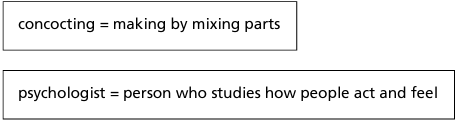
7 Part of being a great baby-sitter is being an expert in a lot of fields—a nurse for bandaging banged-up knees, a chef for concocting interesting snacks, and a writer for coming up with good bedtime stories. This time, I need to be a psychologist.
8 “Billy, a lot of people don’t like thunderstorms,” I say.
9 “I’m not a lot of people,” he points out.
10 I don’t know how to respond to that. I make a mental note to brush up on my psychology and I take a more basic approach. “You’ll miss my famous cheese-and-pepper-flavored popcorn. . . .”
11 I don’t want Billy to have a miserable night. What can I do?
12 I look around for inspiration and spot Billy’s sports trophies and ribbons. Then it hits me. “If you don’t come out, you’re going to miss the funderstorm.”
13 “You mean ‘thunderstorm,’ ” he corrects.
14 “Nope. I mean funderstorm.”
15 Billy peeks his head out. “What’s that?”
16 “It’s having fun during a thunderstorm,” I explain. “When the lightning strikes, you see how many things you can do before the thunder comes. . . .”
17 At that moment, lightning lights up the room. Billy looks at me expectantly.
18 I spot a lone sock dangling from his dresser drawer. “How many socks can you put on one foot? Go!”
19 He runs to his dresser and starts putting on socks. His right foot grows bigger with each new one.
20 I count along. “3 . . . 4 . . . 5 . . .” He gets to 8 before the thunder booms and rattles the windows.
21 It also rattles his nerves. Before he can dive back under the bed, I yell, “Fruits! How many can you name?”
22 The sky lights up.
23 “Apple, banana, pear . . . ,” he chants. He’s in the middle of listing melons when the round ends with a sharp crack.
24 “Pretty impressive,” I say.
25 “What else?” he says.
26 I smile. Now he’s really on board. “Let’s see your hopping skills.” I peek out the window. “Ready, set . . .” At the flash, I yell, “Go!”
27 He starts hopping on one foot. After 10 seconds, he switches to the other foot, then back again at 20 seconds. He’s at 29 hops when a softer boom signals the end of the round.
28 “That’s the best I’ve ever done,” he says.
29 “You getting hungry?” I ask, grinning like a cheetah. “At the next lightning bolt, go to the kitchen, grab the popcorn, and come back.”
30 I can still see a little worry in his eyes. “You OK?” I ask.
31 “Yes,” he says confidently, surprising me with the speed of his answer.
32 I yell, “Go!” exactly when the flash comes.
33 He peels out of his room. Sixteen seconds later, he leaps back in, drops the container of popcorn on his dresser, and falls breathlessly onto the floor.
34 “Sixteen seconds,” I say, looking at my watch and smiling. “Not bad.”
35 We don’t hear anything for a minute or two.
36 “I think the storm is going away,” he says.
37 So is the worried look in his eyes.
38 When the Clarksons return, they apologize for not calling home. They were in the theater and didn’t hear the storm.
39 “How’d our boy weather the thunderstorm?” Mrs. Clarkson asks as she gives Billy a hug.
40 “Funderstorm,” he corrects, giving me a sly look. “And I can’t wait till the next one!”
41 Billy isn’t kidding.
42 I can’t take other baby-sitting jobs if storm clouds start rolling in because I’ll know to expect a call from the Clarksons.
43 Billy has a lot of records to break.
What do the details in paragraphs 7 and 12 show about the baby-sitter?
How does paragraph 6 connect to paragraph 16 in the story?
Read this sentence from paragraph 21 of the story:
"It also rattles his nerves."
What is the meaning of the phrase “rattles his nerves”?
How does Billy feel about the baby-sitter’s ideas for what to do during the thunderstorm?
From whose point of view is the story told?
Which statement best shows a central idea of the story?
How does Billy feel at the end of the storm?
Which part of the eye lets light enter the eyeball?
Through what do sound waves first travel into your ear?
Which two senses work together to help you enjoy food?
What keeps eyes safe from dirt and sunshine?
What does your brain do with signals it receives from senses?
The sense of touch can warn you something is ________.
In which section should you read to find out information about how your body responds to the world around you.