Twa kɔ nsɛm atitiriw so
Log in
Sign up for FREE
arrow_back
Laabri

Week 4.3: Dealing with Problems

star
star
star
star
star
Last updated about 2 hours ago
44 Nsɛmmisa
Excerpt from Sea View Star
Excerpt from Raccoons
Excerpt from Big Moon Tortilla
Getting Even
Just Listen
Flying on Ice

Click submit when finished with all questions and check your answers. You may not be able to make corrections at this time.

1
1
1
1
1
1
1
1
1
1
1
1
1
1
1
1
1
1
1
1
1
1
1
1
1
1
1
1
1
1

Just Listen

by Kathleen Weidner Zoehfeld

1 Psssst! Your friend leans close and whispers a secret. Woof! Woof! His dog barks as a car zooms past. Beep beep! The driver honks her horn to say hello. People and animals and things are making sounds all the time. I hear birds singing. Is that rumbling sound thunder? Some sounds are as quiet as a leaf rustling in the breeze. Others are so loud you might cover your ears.

2 Pluck a guitar string or a rubber band stretched between your fingers. You see the string or rubber band go back and forth very fast. It is vibrating. You can’t see it, but the vibration makes waves in the air, like you make waves in a bathtub of water when you waggle your hand up and down quickly.

3 Every sound is made by vibrations. Place your fingertips lightly on the front of your throat. Say or shout a few words. Feel the tiny, quick, shaking movements? That is the vibration of the vocal cords in your throat. It makes the sound of your voice.

4 Your ears are sound wave collectors. Sit very quietly. Listen to all the different sounds you can hear.

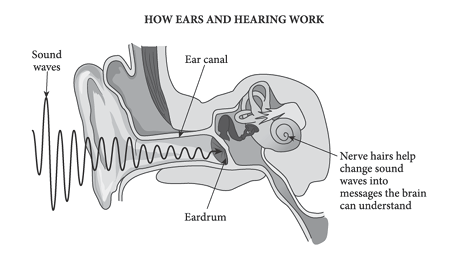
5 The sound waves your ear collects travel through your ear canal. At the end of the canal is a thin piece of skin called your eardrum. The sound waves make your eardrum vibrate. Special nerve hairs further inside your ear pick up the vibrations. They send signals to your brain. Your brain makes sense of all the sounds you hear. The faster your eardrum vibrates, the higher the sound you will hear. If the vibration is slower, you will hear a lower sound.

6 Sound waves travel not only through air but also through water. They can even travel through solid things, like wood. Knock on your table top. Listen to the sound. Now put one ear down on your table and knock again the same way. Does the knock sound different? Sound waves are traveling to your ear through the table top. They travel faster through wood or metal than they do through air.

7 In outer space, there is no air. And guess what. There are no sounds, either, because there is nothing for sound waves to travel through. If an astronaut bangs a hammer on the outside of a spaceship, people inside the spaceship may hear it. But there will be no sound outside the ship-no matter how hard the astronaut hammers! Because there is no air, the hammering creates no sound waves. There is only silence.

8 Sometimes your ear collects sound twice. If you make a wave of water in the tub, it will go to the edge and bounce back. Sometimes sound waves bounce back, too. If you clap your hands in an empty room, you hear the clap as soon as your hands come together. But you may hear it again, a split second later, as the sound waves travel to the wall and bounce back to your ear. It's called an echo.

9 The world is full of sounds. Just listen.
1
1
1
1
1
1
1
1
1
1
1
1
1
1

Excerpt from Sea View Star

by Ali Bovis

1 Sylvie tapped Sammy’s shoulder and pointed to the swing set. They always got their best ideas on the swings. “Race you up!” She hopped on a swing and pumped her legs. Sammy followed.

2 Sylvie tightened her grip and kicked in the air. “We need to do something extra stellar for the animals.” . . .

3 “Hmm.” Sammy tilted his head. “I have a few ideas too. Maybe we can look over our lists together.”
4 Sylvie knew Sammy would be full of awesome ideas. Sammy slowed his swing and pulled out a piece of paper. He passed it to Sylvie.

5 “An art show to raise money for animals?” asked Sylvie, waving her list. “I had the same idea! Here, number 139.”

6 “Number 139?” asked Sammy, his mouth opened wide. . . .

7 “Ready to start planning our art show for animals?” asked Sylvie. “Or ‘Paint Out!’ Sounds more stellar, doesn’t it?”

8 “Wait. What?” asked Sammy.

9 “The Paint Out. We can have it on Beach Street. People can paint portraits of their pets outside the shops. Then we can sell the paintings. We can donate the money to the Sea View Animal Shelter.”

10 “They could help all the animals in Sea View,” said Sammy. . . .

11 They got to work right away. Before dinner, they had gotten permission from the town to hold the Paint Out, informed the Sea View Animal Shelter of their upcoming “biggest donation ever,” and told friends and family to save the date. . . .

12 With all that planning, the week had flown by. The paint, glitter, glue, and sprinkles were gathered, ready to decorate the blank canvases. Make a Difference Day was finally here! . . .

13 How could it be 6:15 in the morning already? Sylvie flung the door open and pulled her best friend inside.

14 “Sammy, thank goodness. It’s getting late!”

15 Sammy looked at the clock. He made a confused face. “OK, we’re ready. Mom and Dad squeezed in the supplies you brought over yesterday into the car. And the booth for the dog.”

16 A smile spread across Sylvie’s face. “Ah, yes! You mean the booth for my Make a Difference Day star! He’ll sit in his booth for everyone to see, admire, and even paint!”

17 Sammy picked up the new boxes Sylvie had set out. “That sounds great,” he said. He pointed to the photo album on top of the boxes. “I brought some pictures of my pets that people can use as models.” . . .

18 Two hours later, Sylvie put down her glue and took in their work. She and Sammy had transformed Beach Street into the biggest Paint Out party in the history of Sea View.

19 Sylvie looked around. A balloon arch spelled “Happy Make a Difference Day” from streetlight to streetlight. Paint-themed songs blasted over speakers.

20 Blank canvases lined the street from Sea View Slices to Sea View Scoops, and everything in between. Paint cans and buckets of brushes were set out on a big table. Bowls of glitter, glue, and decorative rainbow sprinkles sparkled in the morning light.

21 People arrived by foot, car, and bus. And an occasional surfboard.

22 When Sylvie’s family got there, she put them into position.

23 Sammy flipped his photo album to a picture of his bearded dragon and turtle. “I think we’re ready,” he said.

24 “Just a few finishing touches,” Sylvie said. She ran to the booth and fluffed the dog’s pillows. She wiped drool off his jowls. She colored chalk stars on the street around him.

25 “Now?” Sammy asked.

26 Sylvie nodded. She squeezed in a few warm-up stretches and reached for her megaphone. “Places, people! We’re open for business. Let the Paint Out begin!” . . .

27 Before long, the Paint Out was in full swing. Empty canvases filled with color. Rainbows swirled in water jars as paintbrushes were rinsed. Dogs, cats, hamsters, and even a rat adorned the art of Sea View’s citizens.

Asemmisa {{asɛmmisaAhyɛnsode}}
1.

In paragraph 7, what does Sylvie mean when she says, “Sounds more stellar, doesn’t it?”

Asemmisa {{asɛmmisaAhyɛnsode}}
2.

What do the details in paragraphs 2 and 9 show about Sylvie?

Asemmisa {{asɛmmisaAhyɛnsode}}
3.

Based on paragraph 14, why does Sammy make a confused face in paragraph 15?

Asemmisa {{asɛmmisaAhyɛnsode}}
4.

“Preparation is the key to success” is a common saying that means when you plan for an event, it is more likely to go well. Which paragraph best shows how this idea is demonstrated in the story?

Asemmisa {{asɛmmisaAhyɛnsode}}
5.

Which detail best expresses a central idea of the story?

Asemmisa {{asɛmmisaAhyɛnsode}}
6.

By the end of the story, how does Sylvie most likely feel about the Paint Out?

Asemmisa {{asɛmmisaAhyɛnsode}}
7.

What idea did Sylvie and Sammy come up with for the animals?

Excerpt from Raccoons

by Meryl Magby

1 Raccoons are one of the best-known animals in the United States. This is because they live in almost every part of the country. Raccoons are easy to spot. They look like they are wearing black face masks and have bushy tails with black stripes. However, many people have never seen a raccoon in person. This is because raccoons tend to come out at night...

Flexible Fingers

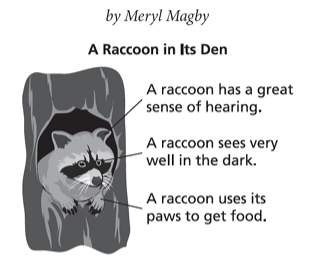
2 Raccoons have round bodies that are covered in thick brown or gray fur. They have black masks on their faces and black rings on their tails. They have four black paws. Raccoon paws have five fingers, just like a person’s hands do. Adults tend to weigh between 10 and 30 pounds. They are about 2 to 3 feet long from nose to tail.

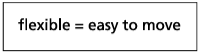
3 Raccoons are very smart and quick. They can use their flexible fingers on their front paws to do things that most other animals cannot do. These include untying knots and turning doorknobs!

Eating Almost Anything

4 Raccoons are omnivores. This means they eat both plants and animals. Exactly what a raccoon eats depends on where it lives. They may eat fruits, nuts, berries, seeds, eggs, insects, crayfish, frogs, fish, and turtles. Raccoons sometimes even catch young gophers, squirrels, mice, and rats. Raccoons living near people also eat pet food and garbage.

5 Raccoons look for food at night. They use the many nerves on the bottoms of their paws to feel their food. Raccoons often dip their food in water before they eat it. Scientists think that this softens the raccoons’ feet and makes it easier for them to feel their food. . . .

Night and Day

6 Raccoons are mostly nocturnal. This means that they rest during the day and are active at night. Raccoons can be pests for people in neighborhoods and cities. They tip over trash cans, dig through gardens, and pull down bird feeders looking for food. They may hide or have babies in places where they are not wanted, such as chimneys, attics, and basements.

7 Raccoons keep safe from predators and people by hiding during the day. However, they are sometimes killed by cougars, bobcats, coyotes, dogs, owls, eagles, and snakes. They also die from hunger, being hit by cars, or getting sick.

Many Different Dens

8 Raccoons are thought to be solitary animals. This means adults spend most of their time alone. Raccoons tend to stay within a home range of about one square mile. In this home range, they have many hiding places that they use as dens.

9 Unlike some other mammals, raccoons do not hibernate in the winter. During the winter, they spend a lot of time in their dens, keeping warm. However, they will leave their winter dens to find food if the weather is not too cold. Sometimes many raccoons will share a large den to keep warm and safe during a winter storm. . . .

People and Raccoons

10 Raccoons are in no danger of dying out in the United States. In fact, their numbers may be growing. This may be because they have adapted so well to living in neighborhoods and cities near people.

11 You may see raccoons around your home at night. Raccoons can be fun to watch, but you should never get too close. Raccoons can sometimes spread diseases to people. If you like raccoons, try visiting them at a zoo or looking for their tracks in a park!

Asemmisa {{asɛmmisaAhyɛnsode}}
8.

How does the graphic support the information in paragraph 2?

Asemmisa {{asɛmmisaAhyɛnsode}}
9.

Which sentence best explains why raccoons mostly come out at night?

Asemmisa {{asɛmmisaAhyɛnsode}}
10.

In which section would the reader find information about what raccoons do during the winter?

Asemmisa {{asɛmmisaAhyɛnsode}}
11.

Animals learn to do things a certain way because of their habitat. Which sentence from the passage best connects to this idea?

Asemmisa {{asɛmmisaAhyɛnsode}}
12.

Which detail from the passage best shows what the author thinks about raccoons?

Asemmisa {{asɛmmisaAhyɛnsode}}
13.

What is the central idea of the passage?

Asemmisa {{asɛmmisaAhyɛnsode}}
14.

What does "pests" mean as it is used in paragraph 6?

Asemmisa {{asɛmmisaAhyɛnsode}}
15.

What type of eater is a raccoon?

Excerpt from Big Moon Tortilla

by Joy Cowley

1 Grandmother’s big moon tortillas were the best in the world!

2 The head of Marta Enos was filled with the knowing of fresh tortillas. Oh, that sweet, crisp, little-bit-burnt smell! It went to Marta’s stomach, which rumbled and growled, and then on down to her feet, making her toes twitch towards the cookhouse.

3 The legs of Marta Enos would not wait another minute. They were in such a hurry to run to the cookhouse that they knocked over Marta’s table, and that is when a disaster happened.

4 The homework papers with their neat writing and beautiful drawings went out the window onto the breath of the fussing wind.

5 The wind huffed the papers high into the air. Then, with a little cough, it spread them over the village.

6 The legs of Marta Enos were sorry for their mistake, and they ran out to chase the homework papers, which slipped and slid like kites without string.

7 But the dogs, too, were chasing. Leaping into the air, they barked to each other. A game! A game!

8 In no time at all, the beautiful homework papers were torn and chewed into trash.

9 The second disaster happened when Marta tried to pull a page away from a puppy. Her glasses fell off, and she stepped on them. One arm of her glasses broke in half.

10 She did not smell the tortillas anymore. Her head was filled up to her eyes with grief and tears as hot as chili peppers. Ruined homework! Broken glasses! Marta Enos ran to Grandmother.

11 Grandmother left her tortillas and sat down, as big as a bed and warm from the cooking. As she smoothed Marta’s hair with her floured hands, she said, “Hush! Hush! If you cry so much you’ll put out the fire.”

12 “The dogs ate my homework, and I can’t see to do any more!” Marta sobbed.

13 Grandmother rocked her. “Little problems,” she said. “Too small for a big rainstorm. We’ll repair your eyeglasses.”

14 But the tears of Marta Enos still ran through her eyes and nose and made hiccups in her throat.

15 So Grandmother sang to her an old healing song, and with the healing song there was a story.

16 “When we have a problem we must choose what we will be. Sometimes it is good to be a tree, to stand up tall in the desert and look all ways at once.”

17 “Sometimes it is best to be a rock, to sit very still, seeing nothing and saying nothing.”

18 “Sometimes when you have a problem, you have to be a strong mountain lion, fierce and ready to fight for what is right.”

19 “Sometimes the wisest thing is to be an eagle and fly. When the eagle is high up, it sees how small the earth is. It sees how small the problem is, and it laughs and laughs.”

20 Grandmother wound some tape around the arm of the glasses. She put the glasses back on the nose and ears of Marta Enos. “That should be OK until we get them fixed,” she said. “Now, one tortilla before supper?”

21 Grandmother pinched a ball of dough and slapped it between her hands, flip-flap, flip-flap, flip-flap. When it was as big and pale as a rising full moon, she dropped it onto the iron plate above the red-hot coals of the fire.

22 Ah, the smell as the tortilla bubbled and browned!

23 “I have decided,” said Marta Enos, her legs doing a tortilla dance. “I am going to be the eagle.”

24 Grandmother nodded. “That is very wise,” she said, turning the tortilla over. “Fly high and laugh. Then come back and do your homework.”

Asemmisa {{asɛmmisaAhyɛnsode}}
16.

Why is the information in paragraph 3 important to the story?

Asemmisa {{asɛmmisaAhyɛnsode}}
17.

Which meaning of the word “spread” is used in paragraph 5?

Asemmisa {{asɛmmisaAhyɛnsode}}
18.

Which detail from the story best tells why Marta begins crying?

Asemmisa {{asɛmmisaAhyɛnsode}}
19.

Which detail from the story best tells what Grandmother believes?

Asemmisa {{asɛmmisaAhyɛnsode}}
20.

What does Marta most likely think about Grandmother’s healing song?

Asemmisa {{asɛmmisaAhyɛnsode}}
21.

Which detail would be most important to include in a summary of the story?

Asemmisa {{asɛmmisaAhyɛnsode}}
22.

What problem did Grandmother say Marta's issues were?

Getting Even

by Deb Westgate-Silva

1 “Want to go to the pool tomorrow?” Rosa asked Stephanie during recess. The pool at the YMCA was one of their favorite places.

2 Rosa and Stephanie did everything together. They rode the school bus together. They sat together during lunch. They took dance lessons together and even went to the same summer camp. They were best friends. Most of the time.

3 Sometimes, though, when Stephanie was with other friends, she ignored Rosa or treated her like a little kid, even though they were the same age. Rosa and Stephanie had played together since they were babies, but sometimes Stephanie didn’t act like a friend.

4 Today was one of those times.

5 “Sorry. I’m already going to the pool,” Stephanie said. “Toni and Vanessa and I are going.” She smiled, but it wasn’t her nice smile. She walked away to join Toni and Vanessa, and Rosa was le standing alone.

6 After school, at dance class, Stephanie talked and giggled with the other dancers as they stretched in front of the mirror. Rosa wanted to join them, but she still felt too upset.

7 Then she noticed Kiara, the new girl, standing with one leg up on the barre. Rosa joined her and began stretching, too. Kiara smiled, and Rosa smiled back. Rosa tried not to check the mirror to see if Stephanie had noticed. I hope she feels left out, Rosa thought.

8 The next morning, when Rosa boarded the bus, Stephanie was waiting in their usual seat. Stephanie quickly moved her backpack off the seat to make room for Rosa. But Rosa walked past her and slid into the empty seat next to Kiara. How does it feel now? Rosa thought.

9 On the bus ride, Rosa discovered that Kiara was not the quiet girl Rosa had thought she was. She talked a lot—about her little brother, about the tree house her uncle had built, and even about swimming.

10 “I love swimming!” Rosa said.

11 “Me, too,” Kiara said. “We just joined the YMCA. My dad said he’d take my brother and me tonight.”

12 “It’s awesome there,” Rosa said. “Sometimes the lifeguards put giant floats in the pool to climb on and slide off. I want to have a pool party there for my birthday this year!”

13 “Maybe you can come with us tonight,” Kiara said. “I’ll ask my dad.”

14 “That would be fun. I’ll ask my mom,” said Rosa.

15 When they stepped off the bus, Stephanie was waiting on the sidewalk. “Did you still want to go swimming tonight?” Stephanie asked Rosa.

16 Here’s my chance, Rosa thought. “I’m already going,” she said. “Kiara and I are going together.” She smiled. Somehow she knew it wasn’t her nice smile. There, she thought.

17 Stephanie nodded and looked at her feet.

18 Rosa’s heart sank and her cheeks began to burn.

19 Why didn’t she feel happy? Getting even is what she’d wanted, wasn’t it?

20 I could walk away with my new friend and not look back, Rosa thought. But it was too late. She had seen Stephanie’s face. Getting even didn’t feel the way she’d expected. It didn’t feel good at all. “Um,” she said instead, “maybe we could all go together.”

21 Stephanie brightened. “I’d like that.”

22 Rosa smiled. “Kiara, meet my friend Stephanie.”

Asemmisa {{asɛmmisaAhyɛnsode}}
23.

In paragraph 3, what is most likely the narrator’s point of view of Stephanie?

Asemmisa {{asɛmmisaAhyɛnsode}}
24.

What does the phrase “left out” mean as used in paragraph 7?

Asemmisa {{asɛmmisaAhyɛnsode}}
25.

Which quotation best shows how Rosa and Stephanie usually act with each other?

Asemmisa {{asɛmmisaAhyɛnsode}}
26.

In paragraphs 16 through 20, the reader can see that Rosa changes from

Asemmisa {{asɛmmisaAhyɛnsode}}
27.

In paragraph 21, what does the phrase “Stephanie brightened” mean?

Asemmisa {{asɛmmisaAhyɛnsode}}
28.

Which sentence best supports the central message of the story?

Asemmisa {{asɛmmisaAhyɛnsode}}
29.

How did Rosa feel when Stephanie walked away?

Asemmisa {{asɛmmisaAhyɛnsode}}
30.

What realization did Rosa have about getting even?

Asemmisa {{asɛmmisaAhyɛnsode}}
31.

What question does paragraph 3 help to answer?

Asemmisa {{asɛmmisaAhyɛnsode}}
32.

Which sentence explains why there are no sounds in outer space?

Asemmisa {{asɛmmisaAhyɛnsode}}
33.

What happens right after sound waves cause the eardrum to vibrate?

Asemmisa {{asɛmmisaAhyɛnsode}}
34.

Which phrase from the passage best explains the meaning of “silence” as it is used in paragraph 7?

Asemmisa {{asɛmmisaAhyɛnsode}}
35.

Which sentence best states the main idea of the passage?

Asemmisa {{asɛmmisaAhyɛnsode}}
36.

Based on the passage, what does the author most likely think about how people hear?

Asemmisa {{asɛmmisaAhyɛnsode}}
37.

What is it called when sound bounces back?

Flying on Ice

by Valerie Hunter

1 Craig watched his older sister, Riley, and her friend Liz race up and down the lake on their skates, dodging the other hockey players. Their skate blades looked like silver smoke.

2 When the game was over, the girls skated up to the bench where Craig was sitting. Craig asked Riley what skating felt like.

3 “When I go really fast, I feel like I’m flying,” she said.

4 That’s silly, thought Craig. Flying is something birds do in the air, not something people do on ice skates. Then he watched Riley go back out on the ice. She skated around and around the edge of the lake with her arms pumping and her scarf trailing behind her. Soon she was going so fast that her arms looked like wings and her scarf looked like a feathery tail. Maybe skating really was like flying.

5 When Riley sat down to take her skates off, Craig said, “I wish I could fly.”

6 Riley retied her skate laces and crouched next to Craig. “Get on my back,” she said, and Craig did. Riley started skating, but Craig didn’t feel like he was flying. It just felt like a wobbly piggy-back ride.

7 “You’re too heavy,” Riley said. “I can’t go fast when I’m carrying you.” She skated slowly back to the bench. Craig got off her back.

8 “Even if you could go fast, I wouldn’t be flying,” he said sadly. “I need skates to fly.”

9 Riley didn’t say anything on the walk home, but a few days later she asked Craig if he wanted to go skating.

10 “To watch?” he asked.

11 “No, to skate,” she said cheerfully. “Mom and I found a pair of my old skates. They might fit you.”

12 The skates were a little big, but when Riley stuffed newspaper in the toes, they fit. Craig couldn’t stop smiling. He didn’t want to take them off, but he had to so he could walk to the lake.

13 Riley and Liz went with him. They carried their hockey sticks, two orange cones, and a wooden chair. When they got to the lake, Craig put his skates back on and Riley helped him onto the ice. Then she put his hands on the back of the chair.

14 “Hang on to this and you won’t fall,” she said. “Just push it along in front of you, OK?”

15 Craig grinned. “OK.” His feet felt wobbly, but he held on to the chair and he didn’t fall. Riley and Liz cheered him on as he started to move forward. Then they set up the cones and practiced passing the puck to each other and shooting goals.

16 Craig watched them. They made skating look easy. He tried to skate like them, but when he let go of the chair he fell. So he grabbed on to it again and inched along. His skate blades went scritch scritch scritch instead of the swish swish sound that his sister’s blades made. This wasn’t like flying at all. It was like being a snail.

17 “Ready to go home?” Riley finally asked.

18 Craig nodded, frowning. Riley had never said how hard skating was.

19 “What’s wrong?” she asked.

20 “I wanted to skate like you,” Craig said. “I wanted to fly.”

21 “Someday you will,” Riley said. “It takes practice.” She patted his shoulder. Then she whispered something to Liz, who grinned and winked at Craig. Each girl took one of Craig’s hands.

22 “Someday you’ll fly on your own,” Riley said. “But today Liz and I will help you.”

23 Riley and Liz started skating, pulling Craig with them. The edges of his skate blades just touched the ice. The girls went faster and faster, and so did he. When he looked down, his skate blades were a silver blur. His hat nearly blew off.

24 “I’m flying!” he yelled, and the words blew away in the wind like a bird’s happy song.

Asemmisa {{asɛmmisaAhyɛnsode}}
38.

What does the word “crouched” mean as it is used in paragraph 6?

Asemmisa {{asɛmmisaAhyɛnsode}}
39.

In paragraph 9, what is the most likely reason Riley stay quiet as she and Craig home?

Asemmisa {{asɛmmisaAhyɛnsode}}
40.

What does paragraph 12 help the reader understand about Craig?

Asemmisa {{asɛmmisaAhyɛnsode}}
41.

In paragraph 16, what does the phrase “like being a snail” help the reader to understand about Craig?

Asemmisa {{asɛmmisaAhyɛnsode}}
42.

Which sentence best describes how paragraph 6 relates to paragraph 23?

Asemmisa {{asɛmmisaAhyɛnsode}}
43.

Which sentence best describes a central message of the story?

Asemmisa {{asɛmmisaAhyɛnsode}}
44.

What does Riley say it takes to skate well?