Imagine living in a world without writing. That’s prehistory. Prehistory is the time before humans wrote. Until 5,500 years ago, people had no system of writing. Without such a system, keeping records was more difficult. People couldn’t write down information to pass on to the next generation. The people who lived during this vast period of time are known as prehistoric people. This includes different species of early humans--the close relatives of today's human species.
Scientists have been able to learn a lot about prehistoric people. How? They study the clues these people left behind. The clues include fossils and tools buried in the ground for thousands of years. Scientists study bones to figure out what prehistoric people looked like at different times. Bones can also reveal how long these ancient humans lived. Scientists study prehistoric teeth as well. These teeth can tell them what prehistoric people ate. In addition, researchers study pottery and tools, which tell them about prehistoric life. Other scientists research the plants, rocks, and animals that were around during prehistoric times.
By studying all these things, scientists have learned a lot. For instance, they have learned that the earliest human species from millions of years ago looked different from people today. These prehistoric people stood upright, but they looked somewhat like apes. Their faces were sloped and their skulls were long, though their brains were only about one-third the size of our brains. The canine teeth of these prehistoric people were smaller than the canine teeth of apes. This clue, as well as the environment of these people and other clues from close relatives, tell scientists about what they ate. They probably ate foods such as fruits, vegetables, nuts, insects, and small animals.
Choose the answer that best completes the sentence.
Scientists study fossils learn more about ancient people.
Written language helps people to communicate over long distances, record history, and share ideas. Why did writing systems develop? In ancient times, civilizations formed in different parts of the world. As these societies grew, people needed a way to keep records of the things they traded. They wanted to write letters to each other, and they also wanted to preserve their stories. All of these needs led to the creation of writing systems.
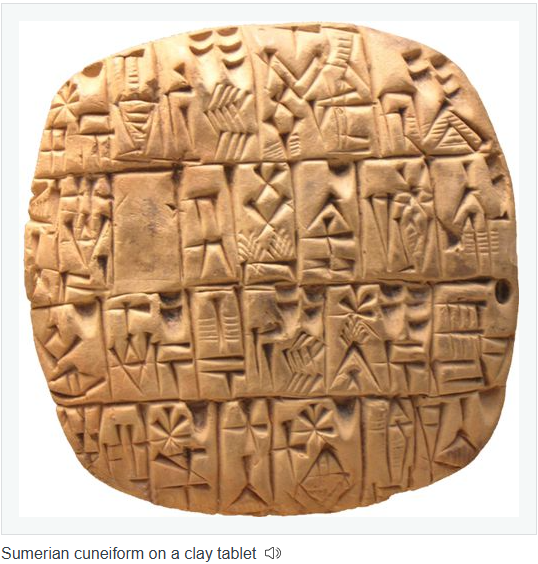
Some of the earliest writing systems were created in Mesopotamia. Mesopotamia was an area where many of the earliest civilizations formed. It was mainly located where the countries of Iraq and Kuwait are today. The Sumerian civilization formed in southern Mesopotamia about 6,000 years ago, and they were the first Mesopotamian society to develop a writing system.
The first system Sumerians created used pictograms. To write, Sumerians used clay tablets and a pointed tool made from a type of grass. They used this tool to carve pictograms into the clay tablet. Pictograms were drawings. Each pictogram represented a word or idea. For example, a drawing of a star symbolized the sky or heaven. The Sumerians created hundreds of pictograms.
To make written communication more efficient, Sumerians developed a faster way of writing. This new writing system was called cuneiform [kyoo-NEE-uh-form]. Each symbol stood for a word or a sound. In Mesopotamia, the people who wrote using this system were called scribes. It was their job to create or copy records. Scribes used a grass tool with a wedge shape at its tip to write things down. They pressed the tool into clay tablets to make the symbols.
Scribes spent years memorizing the symbols and what they represented. They also learned how to combine these symbols to create different words and meanings. A symbol that represented a sound could be combined with another sound symbol to create a new word. Over time, many other civilizations started using this system. The cuneiform system became the most widespread writing system in Mesopotamia. Using cuneiform signs allowed people to share ideas and develop large trade networks.
As time passed, cuneiform signs were used less and less, and new writing systems developed. These writing systems used alphabets instead. Today, researchers study cuneiform and pictograms from thousands of years ago. Through these writing systems, they learn more about the cultures of the people who lived in ancient Mesopotamia.
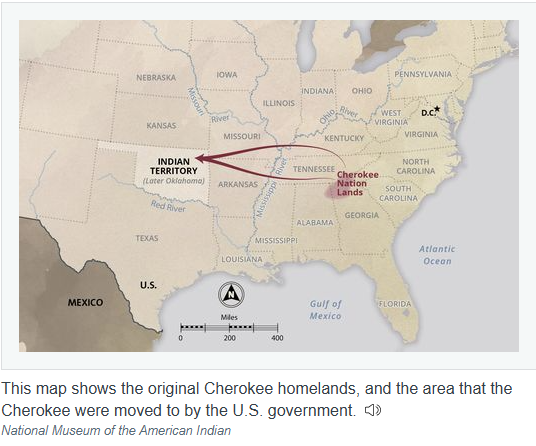
The Cherokee (/chair*uh*key/) are a southeastern Native American Nation. Their homeland was what are now the American states of western North Carolina, eastern Tennessee, and northern Georgia. Some Cherokee still live there. However, the U.S. government forced most of the Cherokee to move from their homeland to what is now Oklahoma.

Before coming into contact with European settlers in the 1700s, the Cherokee lived in small communities on good farming land. They built wood-frame houses with walls made of woven vines or branches plastered with mud. Each village had a central building, or council house, for celebrations, ceremonies, and meetings.
Each group of Cherokee had two chiefs. One chief ruled during peacetime. The other chief ruled during war. The chiefs helped to guide the people and make decisions. But the chiefs did not have complete control over the people. The people had a say in how they were ruled.
Important parts of the Cherokee culture were captured in stories, or legends. These stories were part of a Cherokee tradition of oral storytelling. Their important legends were passed down through the generations. These legends explained how their world had come into being and how people should live.
In the late 1700s and early 1800s, the Cherokee became the only Native American people in the United States at the time who kept written records.
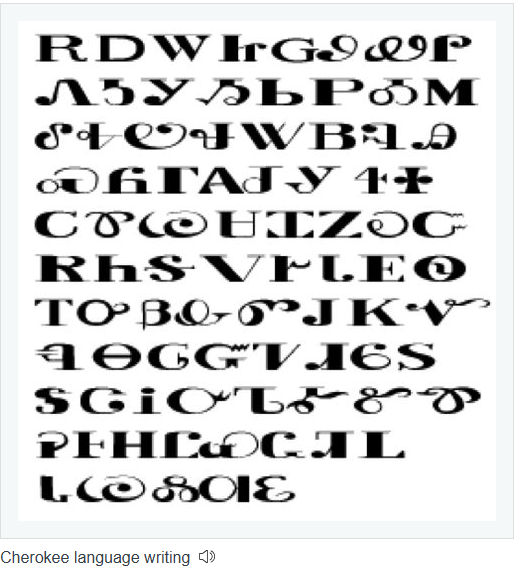
The written language of the Cherokee was created by a man named Sequoyah (/si*kwoi*uh/). He was born in the 1770s in what is now Tennessee. Sequoyah became interested in books and letters, which he had seen written in English. He wanted the Cherokee to have a way to preserve their language and stories, too. He invented a set of symbols for the Cherokee language. This allowed the Cherokee language to be written and read.
A Cherokee newspaper, the Cherokee Phoenix, was first published in 1828. The newspaper was published in both English and Cherokee. This newspaper is still published today! Over its many years, the Cherokee Phoenix has been used to unite the Cherokee around important causes. For example, on many occasions, the newspaper informed Cherokee about U.S. policies that impacted the Cherokee Nation. It’s an important way for the Cherokee Nation to stay connected and informed. Oral storytelling and written language are both important ways for the Cherokee to celebrate their history!
According to the text, what is prehistory?
What does the author describe in the second paragraph?
The bones of prehistoric people can tell us a lot about them.
What evidence from the text supports this conclusion?
Based on the text, what have scientists learned by studying clues from early humans?
What is this passage mostly about?
Read these sentences from the text.
Scientists study bones to figure out what prehistoric people looked like at different times. Bones can also reveal how long these ancient humans lived.
As used in these sentences, what does the word "reveal" mean?
How do scientists learn about prehistoric people?
Where were some of the earliest writing systems formed?
The first writing system the Sumerians created was made of pictograms. How does the text describe this writing system?
The cuneiform system made it easier for people from different civilizations to communicate with each other. What evidence from the text best supports this conclusion?
Based on the text, why might researchers study cuneiform and pictograms of ancient Mesopotamia?
What is the main idea of this text?
What was a reason for the development of writing systems?
What material did Sumerians mainly use for writing?
What is a pictogram?
Many years ago, life was hard for Deaf people. Back then, like today, Deaf people could not hear. It could be very hard for them to learn words. With no words, it was hard for them to share their thoughts. They did not learn to read, write, or speak. Many people thought Deaf people were not smart. Deaf people were smart, of course. They just could not hear.
Then, in the early 1800s, a man named Thomas Gallaudet met a Deaf girl. This changed everything for Deaf people.
Thomas was a minister in a church. He helped many people. One day, he went home to see his family. That was the day he met Alice Cogswell.
Alice was the young daughter of a neighbor. She was Deaf. Thomas saw her watching other children play. She did not play. She could not speak to them. She could not share her thoughts. He watched as she sat alone.
Thomas sat next to her. He put his hat on the grass. He picked up a stick. He wrote the word "hat" in the dirt. At first, Alice thought he was playing. She picked up a stick, too. She made lines in the dirt like he did. He tried again. Thomas tapped on his hat. He wrote the word "hat" again. She thought it was funny.
Then, Alice got it! She picked up the hat. She tapped the word in the dirt. She smiled. She knew the lines in the dirt meant "hat." At nine years old, she finally had her first word. She was so happy!
Alice's family was happy too. Her dad was a doctor. He told Thomas that he thought Deaf people could learn words. They could learn to read. They could learn to write. With words, they could share their thoughts. He thought Thomas could teach them. He wanted Thomas to start a school for Deaf people.
Thomas liked the idea. But he wanted to learn more first. He went to England. There was a school for Deaf people there. He went, but he did not like it. The Deaf people were taught only how to read lips. He did not think it was a good system. Also, the teachers were not kind.
Thomas went to France. He found a good school for Deaf people there. The Deaf people there learned to read lips. But they also learned to form words with their hands. They called this "sign language."
Thomas came home to the U.S. with a French teacher. His name was Laurent Clerc. Together, they started a school for Deaf people. Alice went to the school. The school began with eight students. But many Deaf people and their families wanted a school like this. Soon the school had 30 students.
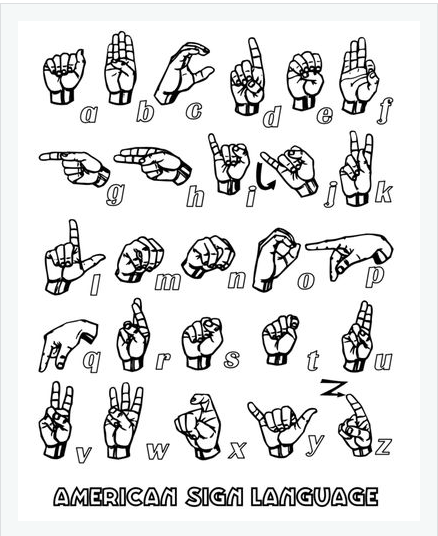
At the school, they started teaching and learning French sign language. Then they formed their own signs. They made American Sign Language. It has changed life for Deaf people. It made their lives better. And it is still used today!
In American Sign Language, people move their hands and fingers. They form letters. There is a sign for every letter. They can also form words. Many words have their own signs.
You can try signing both ways. You can form the letters for the word "eat." To form an "E," curl your fingers to touch your palm. Then curl your thumb to your palm, below your fingers. To form an "A," touch the heel of your hand with your fingers. Stick your thumb up. To form a "T," make a fist. Then put your thumb between your index and middle fingers. The tip of your thumb will peek out. You have just finger-spelled the word "eat."
But you can also use the sign for "eat." To form the sign, put your thumb and fingers together. Then touch your mouth with them. You have just signed the word "eat."
Signing words is faster than finger-spelling. Most Deaf people finger-spell only names and odd words.
American Sign Language has hundreds of signs. New signs are still being added. There are now signs for "hip-hop" and "blog."
Other groups are also using sign language. Some parents teach their babies and toddlers to sign. Babies and toddlers are not always able to speak. But they can sign. They can tell their parents what they need.
People who study gorillas also use American Sign Language. Some gorillas can learn to sign. A famous gorilla, Koko, learned more than 1,000 signs. She used them to speak to her trainer.
American Sign Language made life better for Alice. It has since made life better for millions of Deaf people. It has even made life better for a few gorillas, too.

A Deaf person is someone who cannot do what?
When Thomas Gallaudet wrote the word “hat” in the dirt, Alice, a Deaf girl, could understand the word. What effect did this event have?
Thomas’ school changed a French system to help Deaf people in the United States.
What evidence from the passage supports this conclusion?
The author says that American Sign Language has hundreds of signs, and that new signs are still being added. What does this tell you about American Sign Language?
What is the main idea of this text?
What was hard for Deaf people many years ago?
Where did Thomas Gallaudet find a good school for Deaf people?
What did American Sign Language help Deaf people do?
Before coming into contact with European settlers in the 1700s, what did each Cherokee village have?
How does the text describe Cherokee stories?
Read the following sentences from the text.
“The written language of the Cherokee was created by a man named Sequoyah. He was born in the 1770s in what is now Tennessee. He wanted the Cherokee to have a way to preserve their language and stories, too. He invented a set of symbols for the Cherokee language. This allowed the Cherokee language to be written and read.”
What can you conclude from this evidence?
According to the text, how did the Cherokee Phoenix help connect the Cherokee?
What is the main idea of this text?
Read the following sentences from the text.
“He wanted the Cherokee to have a way to preserve their language and stories, too. He invented a set of symbols for the Cherokee language. This allowed the Cherokee language to be written and read.”
As used in this excerpt, what does the word “preserve” most closely mean?
Choose the answer that best completes the sentence below.
the Cherokee had chiefs, the people still had a say in how they were ruled.
Why is the Cherokee Phoenix still important today?