Plate Tectonics
To explain the ages of crustal rocks, scientists evaluate evidence of the past and current movements of continental and oceanic crust within the framework of plate tectonics. This theory helps to understand how the Earth's lithosphere is divided into tectonic plates that move over time, leading to the formation, destruction, and recycling of crustal rocks. By studying the patterns of seafloor spreading, magnetic anomalies, fossil distributions, and the age differences between oceanic and continental rocks, scientists can trace the history of plate movements and the processes that shape Earth's surface over millions of years. The main concepts include:
Plate tectonics theory is the scientific explanation for the movement of Earth's lithospheric plates and the geological processes resulting from this movement. The lithosphere is the solid outer layer of the Earth, which consists of several large plates that fit together like puzzle pieces. These plates can move due to the flow of the underlying mantle.
One of the pieces of evidence supporting the theory of plate tectonics is the ages of crustal rocks. Scientists can determine the age of rocks using various techniques such as radiometric dating. By analyzing the ages of rocks across different plates, scientists have been able to support the idea that plates move and interact with each other.
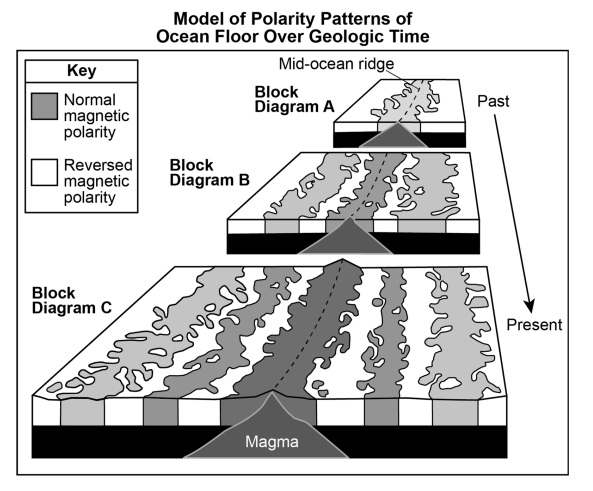
The ages of oceanic crust increase with distance from mid-ocean ridges. This is because new oceanic crust is formed at these ridges through volcanic activity, pushing older crust away from the ridge as it spreads outwards. This process, known as seafloor spreading, is one of the main mechanisms driving plate tectonics.
The North American continental crust contains a much older central ancient core compared to the surrounding continental crust. This is due to complex and numerous plate interactions. The ancient core, known as the Canadian Shield, formed about 2.5 billion years ago and is surrounded by younger rocks that have been added over time due to plate interactions.
Figure 1.