Sustainable Development Goals: Peace, Justice and Strong Institutions
The Sustainable Development Goals Report 2023
Special Edition provides a powerful call to action, presenting a candid assessment of the SDGs based on the latest data and estimates. While highlighting the existing gaps and urging the world to redouble its efforts, the report also emphasizes the immense potential for success through strong political will and the utilization of available technologies, resources, and knowledge. Together, the global community can reignite progress towards achieving the SDGs and create a brighter future for all.
According to the report, the impacts of the climate crisis, the war in Ukraine, a weak global economy, and the lingering effects of the COVID-19 pandemic have revealed weaknesses and hindered progress towards the Goals. The report further warns that while lack of progress is universal, it is the world’s poorest and most vulnerable who are experiencing the worst effects of these unprecedented global challenges. It also points out areas that need urgent action to rescue the SDGs and deliver meaningful progress for people and the planet by 2030.
About this Report
The Sustainable Development Goals Report 2023: Special Edition is the only UN official report that monitors global progress on the 2030 Agenda for Sustainable Development. Using the latest available data and estimates, the report provides a comprehensive midpoint assessment of the 2030 Agenda, highlighting not only impacts of multiple crises affecting people's lives and livelihoods, but also areas of progress where acceleration is needed. This annual SDG Report is prepared by UN DESA, in collaboration with the entire UN Statistical System, consisting of more than 50 international and regional agencies, based on data from over 200 countries and territories.
GOAL 16 - Peace, Justice and Strong Institutions
Rising conflicts and violent organized crime persist around the world, causing immense human suffering and hampering sustainable development. The number of forcibly displaced people reached an unprecedented 120 million in May 2024. Civilian casualties in armed conflicts surged by 72 per cent in 2023.
Corruption continues to divert resources from sustainable development, with one in five people reporting being asked to pay or having paid a bribe to a public official in the last 12 months. With one third of prisoners unsentenced worldwide, achieving just judicial processes and improving prison conditions is imperative.
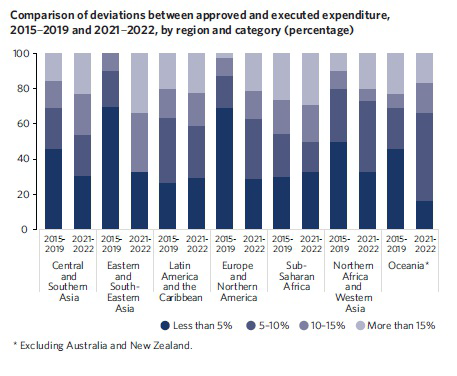
Governments globally are struggling to restore pre-COVID-19 budget reliability. New international pressures affecting economies have increased budget expenditures beyond initial approvals.
All SDGs depend on establishing lasting peace and preventing violent conflicts. Urgent action is needed to combat corruption and organized crime, strengthen the rule of law and access to justice, build effective and inclusive governance institutions, and protect rights and fundamental freedoms.
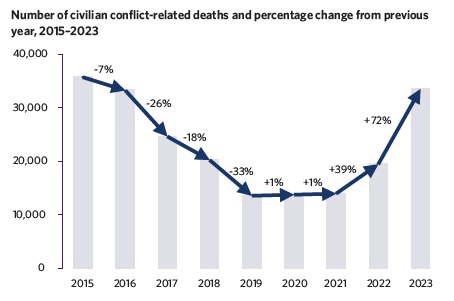
Civilian deaths in armed conflict saw the steepest rise since 2015
In 2023, civilian casualties in armed conflicts surged by a staggering 72 per cent, the steepest rise since 2015. Despite fewer civilian deaths in some conflict zones, others witnessed significant increases, with 7 in 10 recorded deaths occurring in Israel and the Occupied Palestinian Territory in 2023. For the second consecutive
year, the number of civilians killed in conflict rose dramatically, reversing a downward trend from 2016 to 2019. By 2023, civilian casualties had soared to over 33,400, nearing the 2015 peak. Additionally, the number of women killed in conflict increased for the first time since 2015. In 2022, 2 in 10 civilians killed in conflicts were women; 1 in 10 were children. By 2023, 4 in 10 were women and 3 in 10 were children. These alarming figures indicate that the road to global peace and security, essential for sustainable development, has been diverted. The trend must be reversed, conflicts must end, and parties to conflicts must strictly abide by international humanitarian and human rights obligations to protect civilians’ lives.
Figure 1.
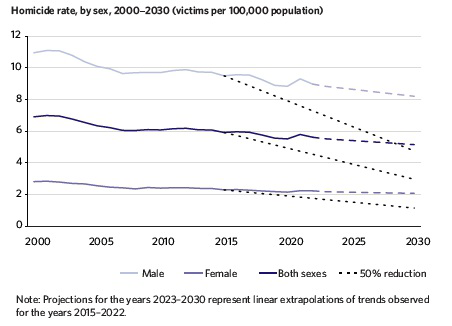
Slow progress in reducing homicides continues even as the world has moved past a 2021 spike in rates
The global homicide rate gradually decreased from 5.9 victims per 100,000 population in 2015 to 5.5 in 2020. This downward trend was disrupted in 2021, when the rate sharply rose to 5.8 before slightly retreating to 5.6 in 2022. The global homicide rate declined by 5 per cent between 2015 and 2022. If this pattern persists, the rate is projected to be 5.1 per 100,000 population by 2030, an overall decrease of just 13 per cent since 2015. The two regions with the highest rates are Latin America and the Caribbean, which is plagued by organized crime and gang activities, and Africa, which has a large youth population, increased incidences of extreme heat and persistent inequality. In 2022, 88,000 women became homicide victims globally compared to 360,000 men.
Figure 2.
The experience of bribery differs by national income level
About 19 per cent of people reported being asked to pay or having paid a bribe to a public official in the last 12 months, based on 138 countries with available data from 2015 to 2022. Notable regional variations were apparent. In Oceania and sub-Saharan Africa, an average of 29.7 per cent and 26.6 per cent of the population, respectively, experienced bribery in the last 12 months, compared to 10.1 per cent in Europe and Northern America. The prevalence of bribery varied by national income level, ranging from an average of 9 per cent in high-income countries to 32 per cent in low-income countries. Data from 18 countries from 2010 to 2021 suggested that men were more likely than women to engage in bribery, often influenced by differing interactions with male-dominated sectors like the police or customs.
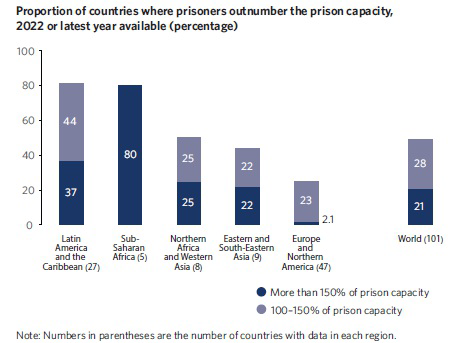
Half of countries have overcrowded prisons, sparking concerns about health and human rights
The global prison population rose from 11.1 million in 2015 to 11.5 million in 2022, a growth rate slower than that of the world population as a whole. Consequently, the prisoner-to-population rate decreased from 150 prisoners per 100,000 population in 2015 to 144 per 100,000 in 2022. Central and Southern Asia had the lowest rates at 54 per 100,000, while Latin America and the Caribbean had the highest at 277 per 100,000.
Access to justice is a fundamental human right. In 2022, however, nearly a third (3.5 million) of the global prison population was held in pretrial detention, a share that remained stable between 2015 and 2022. While most regions showed some improvements, Central and Southern Asia saw a worrying rise; almost 60 per cent of prisoners was held unsentenced. Overcrowding in prisons operating at over 100 per cent of intended capacity was a concern in half of countries with data. This issue was particularly severe in Latin America and the Caribbean and sub-Saharan Africa, where over three quarters of countries reported overcrowding. Globally, one in five countries operates prisons at over 150 per cent of intended capacity, with documented harm to health and higher rates of mortality.
Figure 3.
Killings of human rights defenders decreased but remain high, and more journalists died in conflict zones
In 2023, 320 human rights defenders, journalists and trade unionists in 40 countries were killed, down from 448 cases in 36 countries in 2022, based on cases recorded by national human rights institutions and the United Nations. Conflict zones saw a sharp increase in the killings of journalists and media workers, with 40 lives lost, reversing a downward trend since 2017. Latin America and the Caribbean remained the deadliest region, accounting for 70 per cent of all killings. Enforced disappearances globally nearly doubled for the second consecutive year, with at least 54 cases reported in 14 countries in 2023.
Nearly a decade since Member States committed to zero killings and attacks against defenders of rights and freedom of speech, incidents have been observed in at least 97 countries. The total number of annual killings has not fallen below 300 since 2015, with peaks in 2018 and 2022. Kidnapping, detention, legal harassment and online attacks are other major threats. Strong protection frameworks are needed to stem this trend, particularly in countries where violent conflict or social unrest erupts or escalates.
Multiple crises affect government budget reliability
Governments across the world have found it difficult to return to pre-COVID-19 levels of budget reliability, in part due to new international challenges impacting economies, including global political instability, inflation and volatile resource prices. Attempts to support economic activity and address social stresses have resulted in higher budget expenditure than originally approved across all regions. Budget reliability improved in 2021 and 2022 compared to 2020 but remained weaker than pre-pandemic levels. Northern Africa and Western Asia,
Central and Southern Asia, and Europe and Northern America experienced the highest spending deviations relative to the pre-pandemic period, likely due to factors such as geopolitical tensions, inflation and higher-than expected
revenues. Multiple crises emphasize the need for governments to better prepare for future emergencies.
Figure 4.