Sustainable Development Goals: Zero Hunger
The Sustainable Development Goals Report 2023
Special Edition provides a powerful call to action, presenting a candid assessment of the SDGs based on the latest data and estimates. While highlighting the existing gaps and urging the world to redouble its efforts, the report also emphasizes the immense potential for success through strong political will and the utilization of available technologies, resources, and knowledge. Together, the global community can reignite progress towards achieving the SDGs and create a brighter future for all.
According to the report, the impacts of the climate crisis, the war in Ukraine, a weak global economy, and the lingering effects of the COVID-19 pandemic have revealed weaknesses and hindered progress towards the Goals. The report further warns that while lack of progress is universal, it is the world’s poorest and most vulnerable who are experiencing the worst effects of these unprecedented global challenges. It also points out areas that need urgent action to rescue the SDGs and deliver meaningful progress for people and the planet by 2030.
About this Report
The Sustainable Development Goals Report 2023: Special Edition is the only UN official report that monitors global progress on the 2030 Agenda for Sustainable Development. Using the latest available data and estimates, the report provides a comprehensive midpoint assessment of the 2030 Agenda, highlighting not only impacts of multiple crises affecting people's lives and livelihoods, but also areas of progress where acceleration is needed. This annual SDG Report is prepared by UN DESA, in collaboration with the entire UN Statistical System, consisting of more than 50 international and regional agencies, based on data from over 200 countries and territories.
GOAL 2 - Zero hunger
After rising sharply in the wake of the COVID-19 pandemic, global hunger and food insecurity remained persistently high and almost unchanged for three years. In 2023, about 733 million people faced hunger, and 2.33 billion people experienced moderate to severe food insecurity. Despite progress, 148 million children under age 5 suffered from stunting in 2022. If current trends persist, one in five children under age 5 will be affected by stunting in 2030.
In 2022, almost 60 per cent of countries worldwide faced moderately to abnormally high food prices due to the spillover effects of conflicts, such as disrupted supply chains.
Achieving zero hunger requires intensified efforts to transform food systems so they are sustainable, resilient and equitable. Moreover, accelerating improvements in diets, nutrition, health and hygiene is crucial to meeting the target of halving the number of children suffering from chronic undernutrition.
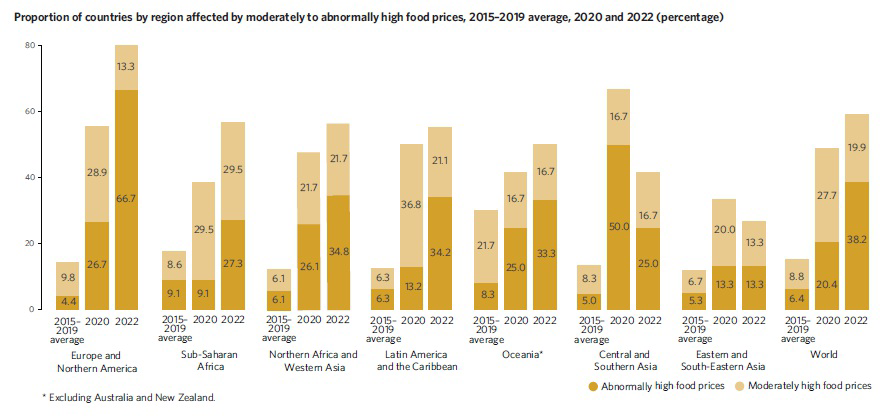
Accelerated action could bring productive and sustainable agriculture within reach globally.
Productive and sustainable agriculture is key to ensuring the attainment and continued satisfaction of human needs in present and future generations. To assess global progress in sustainable agriculture, the Inter-agency and Expert Group on SDG Indicators adopted a new set of seven subindicators covering economic, social and environmental dimensions. Data from 2021 suggested that the world was at a moderate distance from achieving productive and sustainable agriculture (with a score of 3.4 out of 5) and had witnessed a slight improvement since 2015. Regional disparities were evident, however, with the highest score of 4.1 in Europe and Northern America compared to the lowest score of 2.6 in the LDCs. While more detailed analysis is required to investigate the root causes of varying rates of progress, evidence suggests that all regions urgently need to take sustained, concerted actions to improve productive and sustainable agriculture by 2030. They otherwise risk missing the target by a wide margin.
Figure 1.
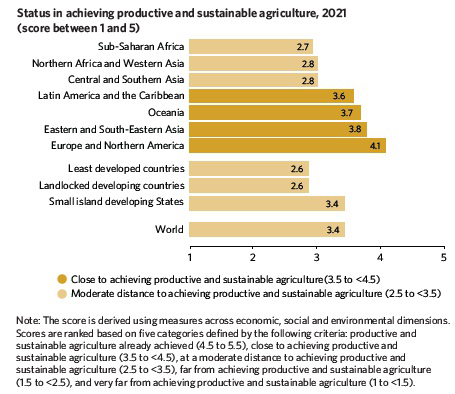
Global government spending and aid for agriculture surge amid economic challenges.
Government spending reflects national priorities and can directly respond to economic and social challenges such as the COVID-19 pandemic, natural disasters or inflation. Between 2015 and 2022, global government spending on agriculture increased steadily, reaching a record high of $749 billion in 2022. Government expenditure on agriculture relative to the sector’s GDP contribution, as measured by the agriculture orientation index, declined from 0.5 in 2015 to 0.43 in 2021 before rebounding to 0.48 in 2022. The pandemic contributed to the fall as government resources were allocated to other sectors.
From 2015 to 2022, the volume of aid for agriculture provided to developing countries increased by 47.2 per cent, from $12.3 billion to $18.1 billion (in constant 2022 prices). A 33 per cent increase from 2021 to 2022 was primarily driven by agricultural development projects and initiatives in agricultural policy, administrative management and financial services. Notably, Africa accounted for 65 per cent of the increase in 2022, mainly due to non-concessional loans for agricultural development projects from the Islamic Development Bank in Egypt.
Figure 2.
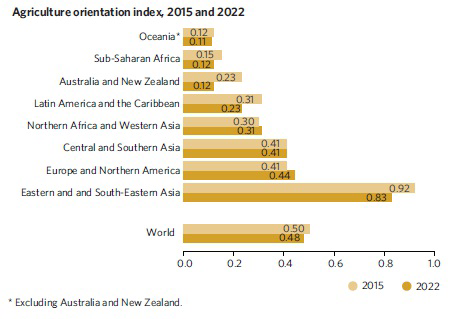
Nearly 60 per cent of countries faced moderately to abnormally high food prices in 2022.
Globally, the proportion of countries facing moderately to abnormally high food prices rose sharply in 2022, reaching a new record high of 58.1 per cent. This represented a nearly fourfold increase from the 2015–2019 average level of 15.2 per cent. In Central and Southern Asia and Eastern and South-Eastern Asia, the share of countries facing moderately to abnormally high food prices in 2022 was lower than the peak in 2020 but remained higher than the yearly average and the 2015–2019 average. The share steadily increased in sub-Saharan Africa between 2020 and 2022. Major disruptions to logistics and food supply chains after war broke out in Ukraine resulted in higher food and energy prices, particularly during the first half of 2022. The war also exerted strong upward pressure on fertilizer prices, adding uncertainty to farmer planting decisions.
Figure 3.