Look at the image below from a student's lab worksheet and answer which of following statements are true.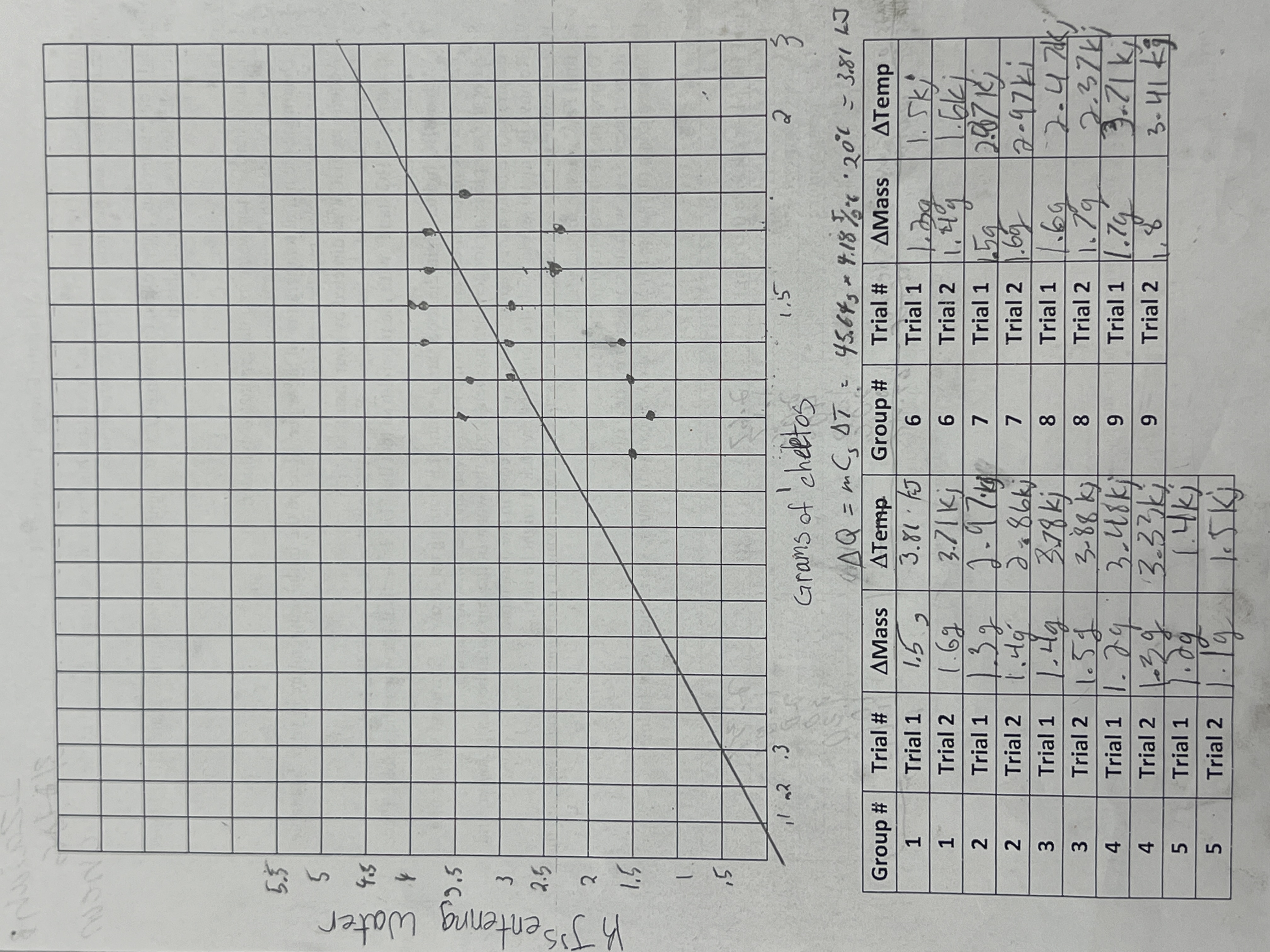
Look at the image below from a student's lab worksheet and answer which of following statements are true.
Look at the image below from a student's lab worksheet and answer which of following statements are true.
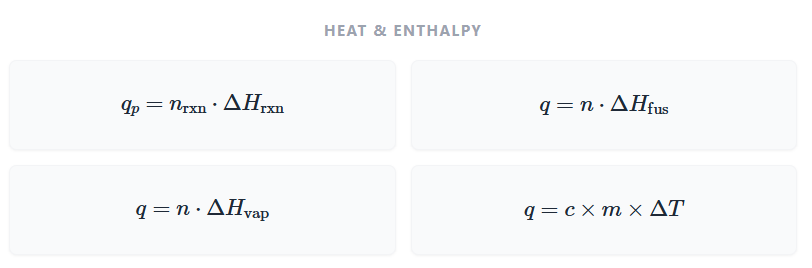
Use the following equations for the problems below:
| Draggable emne | arrow_right_alt | Korresponderende emne |
|---|---|---|
What is the specific heat, expressed in J/g · ◦C, of a 10.0 g sample that absorbs 60.0 J of heat to raise its temperature by 1.25 ◦C? | arrow_right_alt | 9.00 |
What is the Enthalpy Heat of Reaction (∆Hrxn), expressed in kJ/mol, if 0.500 moles of reactant releases 3.25 kJ of heat? (Express as absolute value). | arrow_right_alt | 4.80 |
How many Joules are required to heat 1.20 g of a substance (cs = 0.300 J/g · ◦C) by a temperature of 25.0 ◦C? | arrow_right_alt | 3.19 |
How many Joules are required to melt 0.750 moles of a substance if the ∆Hfus is 4.25 kJ/mol? (Express your answer in kJ). | arrow_right_alt | 6.00 |
How many moles (n) are present in a sample that requires 27.0 kJ of heat to vaporize if the ∆Hvap is 4.50 kJ/mol? | arrow_right_alt | 6.50 |
Match the correct Set of Three Coefficients from the list below to the unbalanced equations.
Each coefficient set corresponds to the order of species in the equation
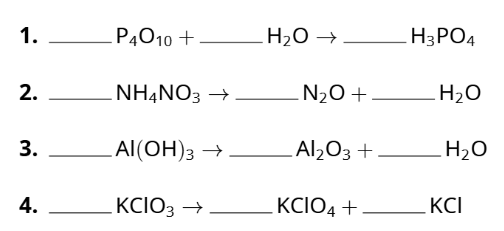
| Draggable emne | arrow_right_alt | Korresponderende emne |
|---|---|---|
4 | arrow_right_alt | [1, 6, 4] |
1 | arrow_right_alt | [1, 1, 2] |
2 | arrow_right_alt | [2, 1, 3] |
3 | arrow_right_alt | [4, 3, 1] |
Identify each of the following six reactions using the categories listed in the instructions.
C + O2 → CO
C4H10 + O2 → CO2 + H2O
H2CO3 → 2H2O + CO2
Mg + HCl → MgCl2 + H2
Only Combustion
Both Synthesis and Combustion
Decomposition
Single-Replacement
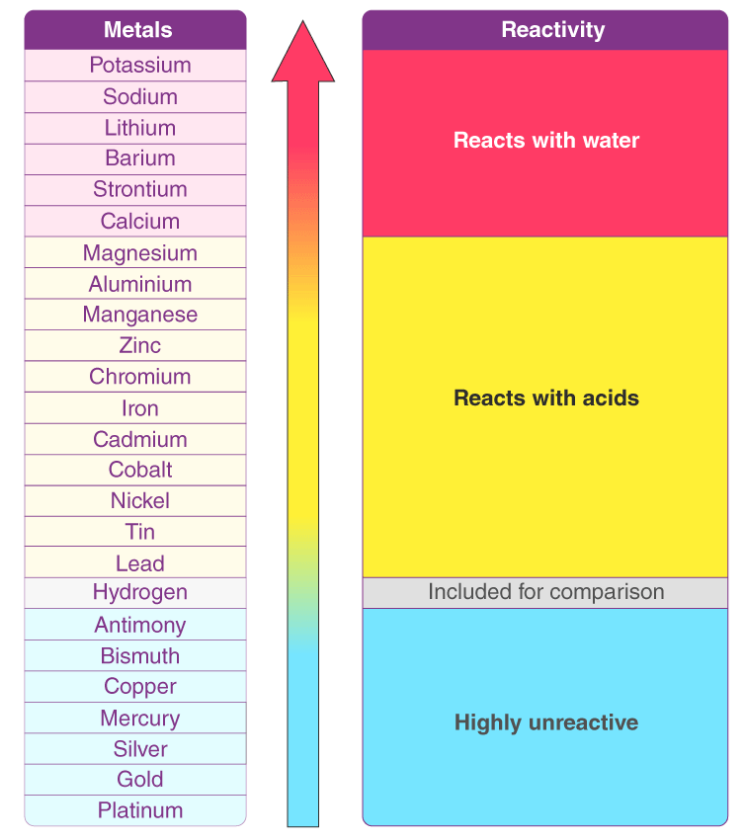
Use the following chart to check which of the following statements are true
Match the given reactants (which include the reaction type) to their correct, balanced products. The reactants in the image below match the reactant choices below. Not all of the products will be used.
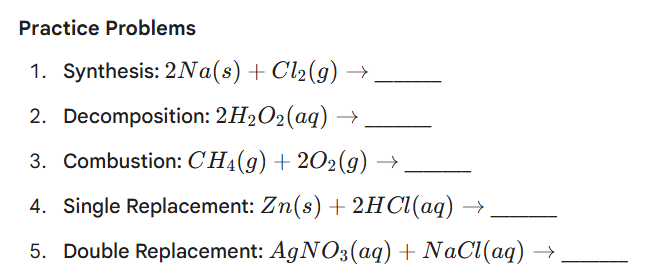
Sodium and Chlorine gas
Hydrogen Peroxide
Methane and Oxygen gas
Zinc and Hydrochloric Acid
Silver Nitrate and Sodium Chloride
2 H2O(g) + O2(g)
2 NaCl(s)
2 ZnH2(s) + Cl2(g)
CO2(g) + 2 H2O(g)
MtO(g)
AgCl(s) + NaNO3(s)
MgS(s) + CuO(s)
ZnCl2(s) + H2(g)
MgNa3(s) + C2PO4(s)
Match the given reaction to the reaction type. The reactions in the image below match the reactant choices below.
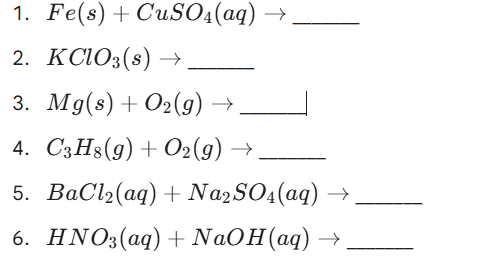
| Draggable emne | arrow_right_alt | Korresponderende emne |
|---|---|---|
Barium Chloride and Sodium Sulfate | arrow_right_alt | A. Single Replacement |
Magnesium and Oxygen gas | arrow_right_alt | B. Decomposition |
Propane and Oxygen gas | arrow_right_alt | C. Synthesis |
Iron and Copper (II) Sulfate | arrow_right_alt | D. Combustion (not synthesis) |
Nitric Acid and Sodium Hydroxide | arrow_right_alt | E. Double Replacement (not neutralization) |
Potassium Chlorate | arrow_right_alt | F. Double Replacement and neutralization |
Match the given reactants to their correct products. The reactants in the image below match the reactant choices below. Not all of the products will be used.
Reactants:
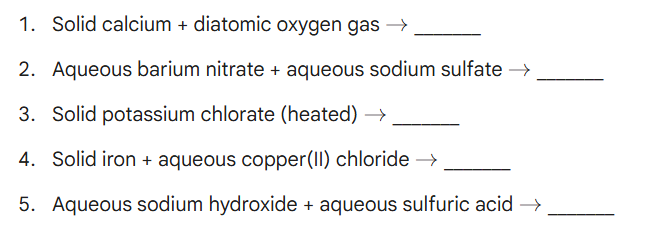
Ca + O2
BaNO3 + Na2SO4
KClO3
Fe + CuCl2
NaOH + H2SO4
Calcium Dioxide
Calcium Oxide
Barium Sulfate and Sodium Nitrate
Iron (II) Chloride and Copper
Sodium Sulfide and water
Sodium Sulfate and water
Potassium Chloride and Oxygen
Look at the following reaction and answer which of the following statements are true.