Week 28 ELA Quiz - The Acorn Woodpecker & The Great Zoo Debate
star
star
star
star
star
Last updated 23 days ago
20 Nsɛmmisa
The Acorn Woodpecker
by Stephanie Petrie
1 In the hills of the southeastern United States, it is not uncommon to see an unusual sight—trees or telephone poles filled with tiny holes. And it’s not just a few holes, but thousands of them. Inside the holes are . . . acorns! These holes represent the food storage area for an acorn woodpecker. Another name for such a food storage area is granary. A granary is similar to a pantry or cupboard for people. An acorn granary can have up to 50,000 holes! Each hole is filled with an acorn that can be brought back at a later date for a meal.
What Do Acorn Woodpeckers Look Like?
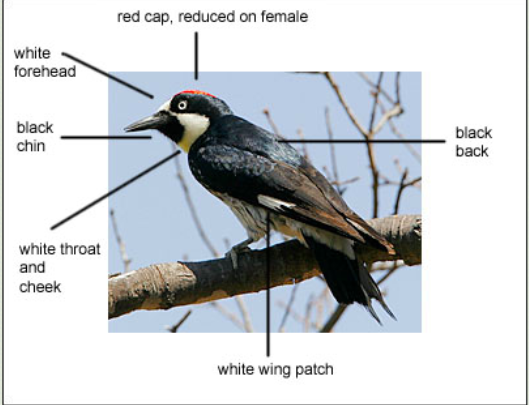
2 A female adult acorn woodpecker has a crown that is black and red. The male is a little different. Its crown is solid red. Both males and females have white eyes and a white forehead, throat, and belly. Their tail feathers are a striking black, and they have white wing patches. When the acorn woodpecker flies, thin white edges of a circle can be seen on the wings. The white and black pattern around its eyes and beak make the bird almost look as if it were wearing clown makeup.
How Do Acorn Woodpeckers Behave in the Wild?
3 One of the most interesting things about this bird is how it gathers acorns and stores them in a granary. Granaries can be built into any wooden structure. Some examples are fence posts, utility poles, and buildings. The bird drills a hole with its beak in one of these structures. Then it places an acorn in that hole. The acorn soon becomes smaller in size as it dries out. Then the bird moves the dried-out acorn to a smaller hole in the granary. An entire family or flock will guard its granary food store against invaders. Other types of birds would see this as an easy and delicious meal.
What Do Acorn Woodpeckers Eat?
4 True to its name, the acorn woodpecker enjoys . . . acorns! An acorn woodpecker can get over fifty percent of its diet from acorns. But, they also enjoy insects, sap, seeds, and flower nectar. For a tasty treat, they like to drill holes in fruit. These birds are generous with their food and will share with their family, but not with other birds.
What Are Acorn Woodpecker Families Like?
5 One of the more unusual habits of the acorn woodpecker is that it doesn’t “leave the nest,” in the way that other birds do. Acorn woodpeckers are social in a family-group way. They stay with their parents for many years. They even help their parents raise more young. Most like to live in extended family groups, and all share the task of storing and making carefully tended holes for their acorns. They build their nests in live or dead trees or tree limbs, and family members can reuse nests for years.
6 The acorn woodpecker’s process of gathering and storing food makes it most unusual. Not many animals are capable of creating such complex food storage systems! The acorn woodpecker is truly a unique member of the animal kingdom.
Part A Which of these is closest in meaning to the word “invaders” in paragraph 3?
Part B Which phrase from the passage best supports the answer to part A?
Read these sentences from the passage.
A female adult acorn woodpecker has a crown that is black and red. The male is a little different. Its crown is solid red. Both males and females have white eyes and a white forehead, throat, and belly.
Which of the following describes the text structure of these sentences?
Which two details best support the author’s point that acorn woodpeckers are SOCIAL birds?
Read the two sentences, which are part of a summary of the passage.
Acorn woodpeckers are black, red, and white birds. Acorn woodpeckers work together with their family to protect their food.
Which detail is best to add between the two sentences to complete the summary?
Which statement is best supported by details in the passage?
What new information can the reader get from looking at the diagram that follows the passage?
Which two phrases from paragraph 5 help the reader determine the meaning of the word social?
Part A: What point does the author make about acorn woodpeckers in the text?
Part B: Select one underlined quotation from paragraphs 4–5 that provides support for the answer in Part A.
What Do Acorn Woodpeckers Eat?
A. True to its name, the acorn woodpecker enjoys . . . acorns! An acorn woodpecker can get over fifty percent of its diet from acorns. But, they also enjoy insects, sap, seeds, and flower nectar. B. For a tasty treat, they like to drill holes in fruit. These birds are generous with their food and will share with their family, but not with other birds.
What Are Acorn Woodpecker Families Like?
One of the more unusual habits of the acorn woodpecker is that it doesn’t “leave the nest,” in the way that other birds do. C. Acorn woodpeckers are social in a family-group way. They stay with their parents for many years. They even help their parents raise more young. Most like to live in extended family groups, and all share the task of storing and making carefully tended holes for their acorns. D. They build their nests in live or dead trees or tree limbs, and family members can reuse nests for years.
The Great Zoo Debate
Character List:
Narrator – tells the story and gives background
Leo the Lion – proud and confident leader of the zoo animals
Zara the Zebra – thoughtful and fair
Milo the Monkey – energetic and sometimes mischievous
Ellie the Elephant – wise and patient
Perry the Parrot – talkative and dramatic
Scene 1: Morning at the Zoo
Narrator: The sun rises over the bustling city zoo. Animals stretch, yawn, and prepare for another day of visitors. But today, something unusual has happened. A shiny new feeding station has been placed in the center of the zoo. The animals soon gather to inspect it.
Milo the Monkey: Whoa! Look at this magnificent contraption! It’s overflowing with bananas, berries, and crunchy vegetables!
Zara the Zebra: It certainly appears generous, but I notice something troubling. There is only one feeding station for all of us.
Leo the Lion: Only one? That seems rather inconvenient. As the king of the animals, I should obviously eat first.
Perry the Parrot: First! First! The king eats first! Squawk! That’s the rule!
Ellie the Elephant: Now hold on, everyone. Let us deliberate before we argue. If only one animal eats at a time, this could cause quite a commotion.
Scene 2: The Argument
Narrator: The animals begin to debate who deserves the first meal.
Leo the Lion: I possess strength and courage. Clearly, I should have priority.
Milo the Monkey: But I’m the fastest! If speed matters, I should grab the food first!
Perry the Parrot: Fastest! Strongest! Loudest! Squawk! Everyone wants to be first!
Zara the Zebra: This disagreement will only escalate if we continue arguing.
Ellie the Elephant: Zara is correct. If we behave selfishly, we will create chaos instead of cooperation.
Scene 3: A Plan
Narrator: Ellie begins to ponder a sensible solution.
Ellie the Elephant: Perhaps we should establish a rotation system so everyone receives a fair opportunity.
Milo the Monkey: A rotation system? That sounds complicated.
Zara the Zebra: Not really. It simply means we take turns.
Leo the Lion: Hmm. Even a king can appreciate fairness.
Perry the Parrot: Take turns! Take turns! What an extraordinary idea!
Scene 4: Solving the Problem
Narrator: The animals quickly agree on a plan.
Zara the Zebra: Each day, a different animal begins the meal.
Milo the Monkey: Today could be Ellie! She came up with the idea.
Leo the Lion: I approve of this arrangement.
Ellie the Elephant: Thank you, but remember, this works only if we remain respectful and patient.
Perry the Parrot: Respectful and patient! Squawk! I’ll remember that!
Scene 5: The Lesson
Narrator: Soon, the animals gather peacefully around the feeding station. No pushing. No arguing. Just cooperation.
Leo the Lion: I must admit, working together was far more successful than arguing.
Milo the Monkey: And no one had to swing from the trees to grab food!
Zara the Zebra: Fairness prevented a disaster.
Ellie the Elephant: Indeed. When we listen to each other, solutions become clear.
Perry the Parrot: Listen! Cooperate! Share the food! Squawk!
Narrator: And from that day forward, the zoo animals remembered that cooperation is far more powerful than conflict.
All Characters: The End!
Based on Ellie’s actions during the feeding discussion, which choice best describes her?
Which two quotations support the inference that Ellie is a wise leader?
What is the meaning of the word commotion as it is used in Scene 1?
Which phrase from Scene 2 helps the reader determine the meaning of the word escalate?
What is the theme of the passage?
What can the reader infer about Leo?
How would the passage be different if it were written as a poem?
Which of the following make this selection a drama? (choose two)
Which detail from the passage best supports the idea that the animals learned to cooperate?
How does Milo’s behavior change from the beginning to the end of the passage?