Twa kɔ nsɛm atitiriw so
Log in
Sign up for FREE
arrow_back
Laabri

The Civil Rights Movement

star
star
star
star
star
Last updated about 2 hours ago
5 Nsɛmmisa

After the Civil War, many states tried to recreate the legal, economic, and social separation of the races that had existed under slavery. The system of laws and practices that enforced segregation, or separation of people of different races, from the 1870s to the 1960s is called Jim

Crow. In the 1896 legal case Plessy v. Ferguson, the Supreme Court allowed states to create separate public facilities—such as train stations, libraries, beaches, and schools—for white and African American people as long as they were "separate but equal." Look at the information about segregated schools under Jim Crow. Then answer the question.

Ɛhia
1

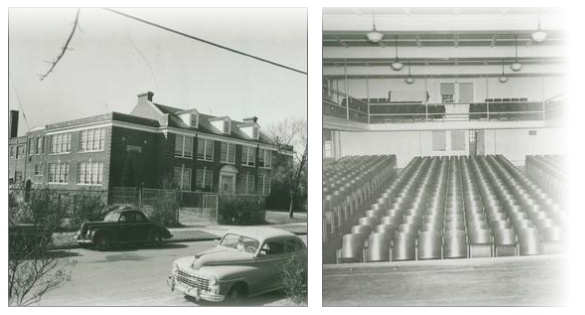
These images show the outside and auditorium at Farmville High School in Virginia, which was a school for white students. The building was well maintained, with a large fenced area in back, and it had an auditorium with fixed seats.

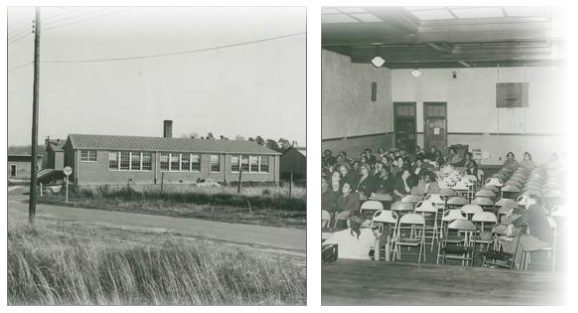
These images show the outside and auditorium at Moton High School in Virginia, which was a school for African American students. The school had no gymnasium, cafeteria, science laboratory, or athletic fields.

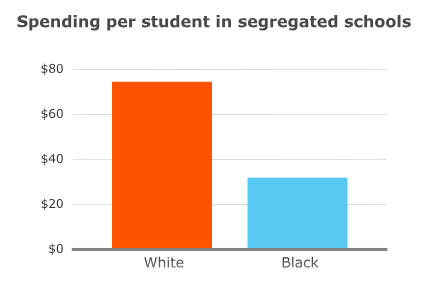
The graph below shows the average spending by states on Black and white students in segregated public schools during the 1944-1945 school year.

Asemmisa {{asɛmmisaAhyɛnsode}}
1.

Based on the above information, which statement describes results of Jim Crow segregation?

Who was considered Black under Jim Crow?

A person with any African American ancestry was legally classified as Black. This one-drop rule meant that even light-skinned African American people who looked white were treated as Black under the law.

Why are there so many terms for Black Americans?

During slavery and Jim Crow, many white Americans used insulting terms for African American people in order to enforce the social hierarchy. Terms for racial identity that were used during Jim Crow are considered insulting today, such as mulatto, an offensive term for mixed-race African American people, and colored, a broad term for African American and mixed-race people. During Jim Crow, many African American people embraced the term Negro to refer to themselves. This term fell out of popularity in the mid-1900s, when it became more common to identify as Black.

The National Association for the Advancement of Colored People (NAACP) was founded in 1909 to challenge segregation and promote civil rights for African American people. Read the passage about the NAACP. Then answer the question below.

The NAACP grew quickly after its founding, reaching about 90,000 members by 1919. The NAACP led protests and supported legislation that opposed lynching, which was mob violence that often targeted African American people. Despite the NAACP's advocacy, however, Congress never passed an anti-lynching bill.

The NAACP was more successful in challenging racial discrimination through the court system. Their legal arguments used the Fourteenth Amendment, which prevented the states from depriving anyone of equal protection of the laws. For example, in 1944, the NAACP successfully challenged a Texas law that permitted political parties to limit primary elections to only white voters.

The group also challenged restrictive covenants, which were agreements that prevented homeowners from selling their houses to anyone who was not white. The NAACP sued the state of Missouri for allowing restrictive covenants, and in 1947, the Supreme Court found the practice unconstitutional. These legal successes led more people to join the NAACP, which had about 600,000 members by 1946.

Ɛhia
1
Asemmisa {{asɛmmisaAhyɛnsode}}
2a.

Which of the following accurately describe the NAACP in the early 1900s? Select all that apply.

Civil rights lawyer and activist Thurgood Marshall became the leader of the NAACP in the 1930s and pushed the organization to directly challenge the doctrine of "separate but equal" in public education. The NAACP won several cases that led to limits on segregation in colleges and graduate schools, weakening the legal foundations of the Plessy v. Ferguson decision. Read the summaries of state segregation in education below. Then match each summary with the case that ended it.

Ɛhia
1
Asemmisa {{asɛmmisaAhyɛnsode}}
3a.
Draggable itemarrow_right_altCorresponding Item

Sweatt v. Painter (1950) ruled that separate graduate schools only for Black students could not be equal to older whites-only schools because the Black schools would have fewer resources and a worse reputation.

arrow_right_alt

An African American student in Missouri was denied admission to law school because the only public law school in the state did not admit Black students. Instead, the state offered to pay for his tuition at a law school in another state.

McLaurin v. Oklahoma (1950) ruled that Black students who were admitted to a state university must receive the same treatment as white students.

arrow_right_alt

The University of Texas Law School restricted admission to white students only. When an African American man applied for admission, the state decided to create a separate school for Black students to avoid integrating the flagship school.

Missouri ex rel. Canada (1938) ruled that if a state offered graduate-level education, it must provide those services to all qualified students.

arrow_right_alt

When a Black student was admitted to the University of Oklahoma Graduate School, he was required to sit in a separate section of every classroom, the library, and the cafeteria.

Who was Thurgood Marshall?

Thurgood Marshall grew up in Baltimore and attended a historically Black college in Pennsylvania, but was denied admission to the University of Maryland Law School because of his race. Marshall instead earned his law degree at Howard University, where he studied under a civil rights lawyer named Charles Houston. Houston inspired Marshall to fight racial segregation through the court system.

A few years later, Marshall joined the National Association for the Advancement of Colored People (NAACP), where he led many lawsuits to end segregation. He traveled throughout the South at great risk to his own safety to investigate lynchings, voting restrictions, housing discrimination, and unequal education that affected African American residents. Many of Marshall's NAACP lawsuits were reviewed by the Supreme Court, including the most important case of the civil rights era, Brown v. Board of Education. In 1967, Marshall was the first African American justice appointed to the Supreme Court, where he served until his retirement in 1991.

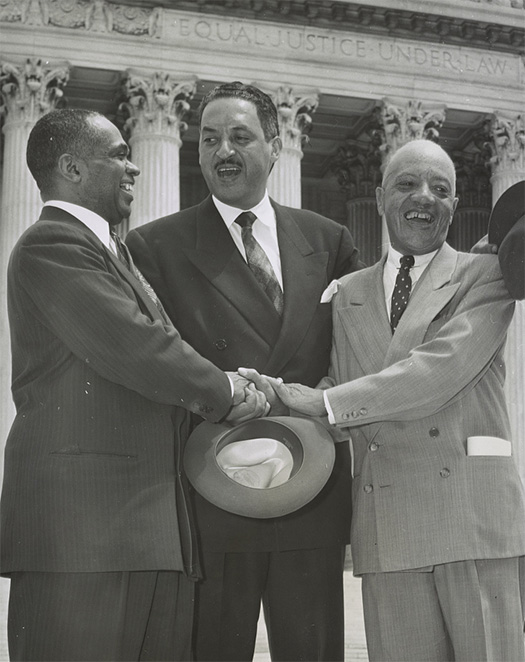
Thurgood Marshall (center) outside the Supreme Court building after winning the Brown v. Board of Education case in 1954. The other NAACP lawyers in the photo are George Hayes and James Nabrit.

Although the NAACP had several legal victories against segregation in graduate schools and universities, those did not affect elementary and secondary public schools. So the organization next turned its focus to K–12 schools. Read the following passage about Brown v. Board of Education, the most important legal win for the NAACP. Then answer the question below.

In the early 1950s, about forty percent of students attended segregated public schools, mostly but not always in the South. The 1896 Plessy v. Ferguson Supreme Court decision allowed states to create "separate but equal" schools for African American students, but Black families argued that their schools were underfunded and inferior.

With NAACP support, families in several states filed lawsuits against their local school districts to challenge school segregation. One plaintiff, Oliver Brown, filed a lawsuit because his eight-year-old daughter, Linda, had to attend a Black school twenty-one blocks away from their house rather than a white school just seven blocks away. Brown's lawsuit was combined with four others when it was considered by the Supreme Court.

The court decided in 1954 that segregation in public schools was unconstitutional. The decision emphasized that even if segregated schools had equal "tangible" factors, such as buildings, financial support, and qualified teachers, they created a feeling of social inferiority among African American students that "may affect their hearts and minds in a way unlikely ever to be undone." Therefore, the Court argued that segregated schools could never be equal, as required by the Fourteenth Amendment.
Ɛhia
1
Asemmisa {{asɛmmisaAhyɛnsode}}
4a.

Which of the following statements about Brown v. Board of Education are true? Select all that apply.

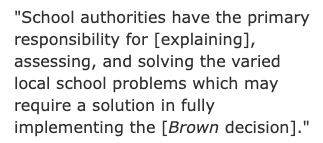
Brown v. Board of Education ruled that segregated schools were unconstitutional, but the Supreme Court did not explain how desegregation should occur. Education is handled by states and school districts, so it was unclear who would be in charge of enforcing Brown.

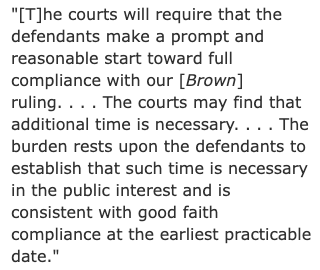
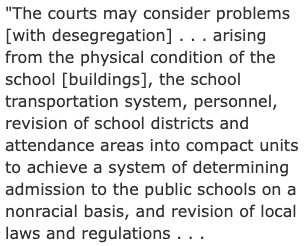
That guidance came one year later in a decision that legal historians call Brown II. The Supreme Court said that schools should admit Black students "on a racially nondiscriminatory basis with all deliberate speed" and provided several specific directions. Match each of the following directions from Brown II with the correct interpretation.

Ɛhia
1
Asemmisa {{asɛmmisaAhyɛnsode}}
5a.
Draggable itemarrow_right_altCorresponding Item

Desegregation can be delayed for many reasons, including the condition of school buildings, problems with school busing, and local laws that need to be revised.

arrow_right_alt

State and local school districts will be responsible for implementing desegregation in their communities.

arrow_right_alt

Desegregation should start as soon as possible, but courts can extend the process if local school districts request it.

arrow_right_alt