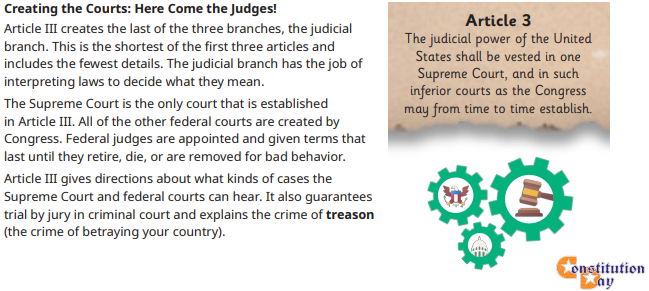
Use the reading to help you answer the questions.
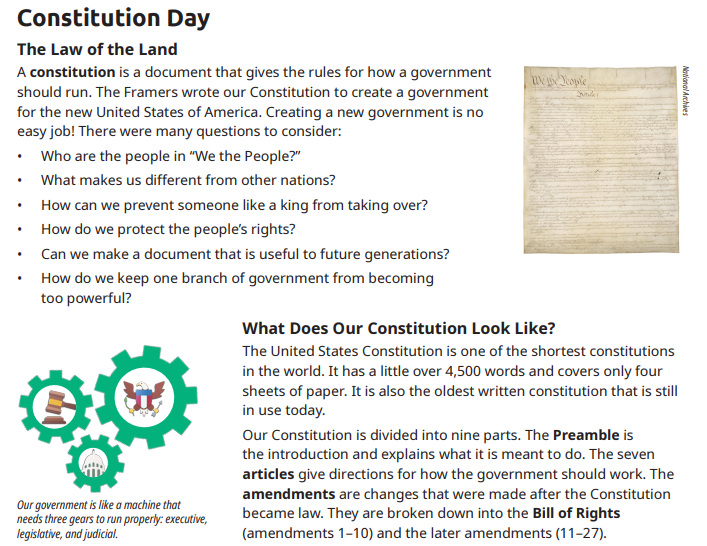
A BILL BECOMES A LAW Check out the ways the branches interact! Based on what you have learned about the jobs of each of the branches, label the gears Executive (E), Judicial (J), or Legislative (L).
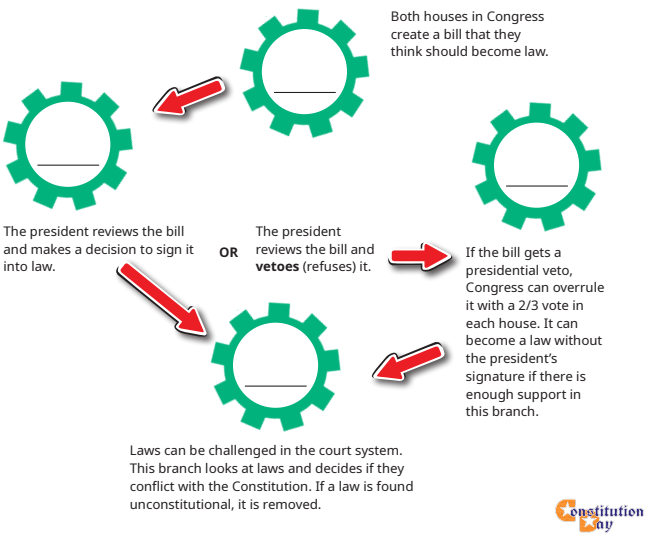
Executive (E)
Legislative (L)
Judicial (J)
SEPARATING POWERS & THE CHECKS AND BALANCE SYSTEM Place each action in the correct arrow to show what checks the three branches have on one another.
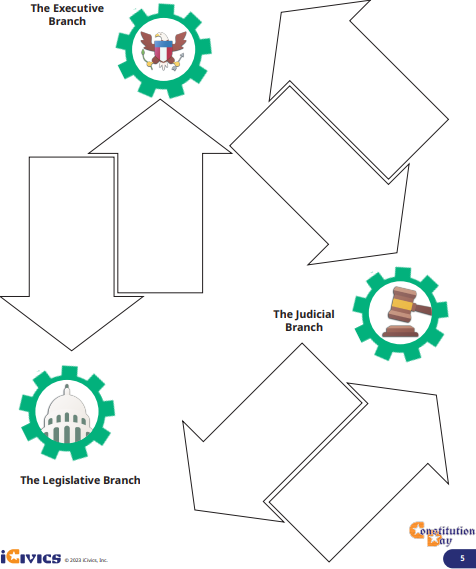
The President appoints Supreme Court justices and other federal judges.
The president can veto bills, call special sessions of Congress, recommend laws, and ask citizens to pressure Congress to act.
The Courts can declare laws made in Congress unconstitutional.
Congress creates the lower courts. It can remove judges through impeachments and must approve appointments to the federal courts.
Congress can override a presidential veto with 2/3 vote. It can also remove a president through the impeachment process. It also approves executive appointments.
Judges are appointed for life, free from influence by the president or the people. The Courts can declare executive actions unconstitutional.
A. Vocabulary. Match the definitions with the vocabulary term from the lesson.
| Draggable item | arrow_right_alt | Corresponding Item |
|---|---|---|
Bill of Rights | arrow_right_alt | The two houses that make up the legislative branch |
Preamble | arrow_right_alt | Citizens elect officials to represent them in the government |
Checks and Balances | arrow_right_alt | Dividing the government into parts and giving each specific jobs |
Congress | arrow_right_alt | When the three branches review each other to make sure they follow the Constitution |
Separation of Powers | arrow_right_alt | The introduction to the U.S. Constitution |
Representative Democracy | arrow_right_alt | The first ten amendments of the Constitution |
We write the bills that become laws.
The President selects someone that they think should become the next member of the
Supreme Court.
Whose Job Is It? Executive, Legislative, or Judicial
Coins money
Can declare laws unconstitutional
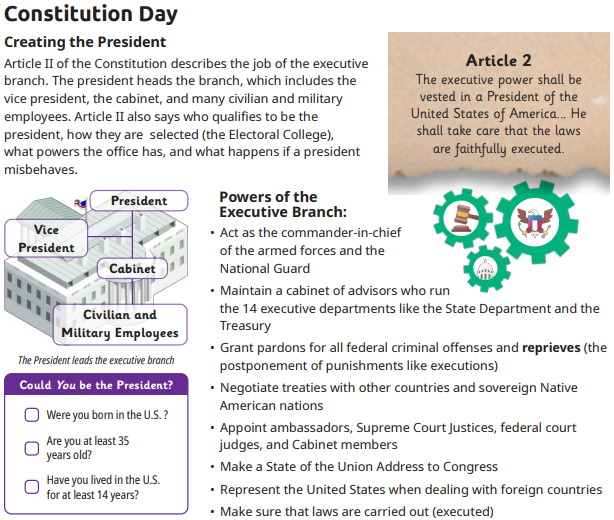
Makes a State of the Union address each year
Collect federal taxes
Declares war
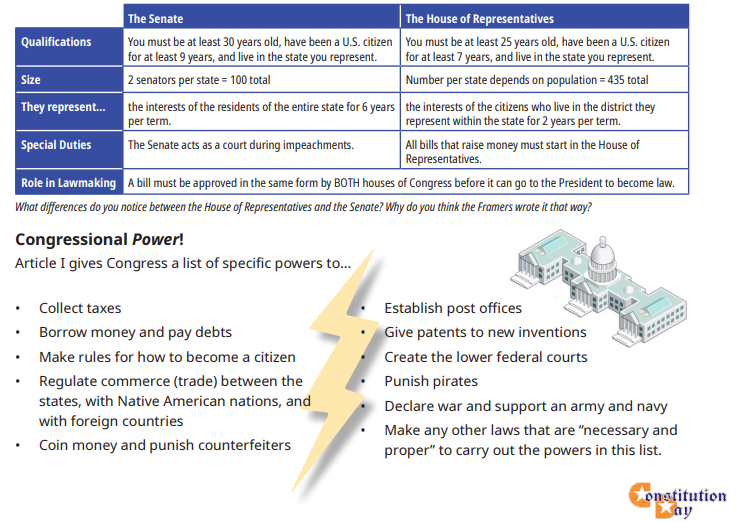
Divided into the House and Senate
Punishes pirates!
State representatives are elected by popular vote
Enforces the laws
Selected by the Electoral College
Makes treaties with other countries
Appoints Supreme Court Justices, federal judges, ambassadors and cabinet members
Includes the president, vice president, and the cabinet
Decides what a law means
Approves presidential appointments
Legislative
Executive
Judicial
Part 1: Match each definition with the correct amendment.
| Draggable item | arrow_right_alt | Corresponding Item |
|---|---|---|
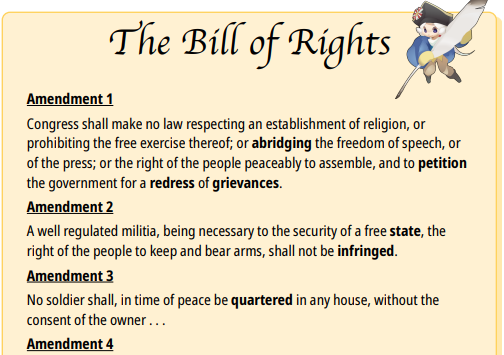
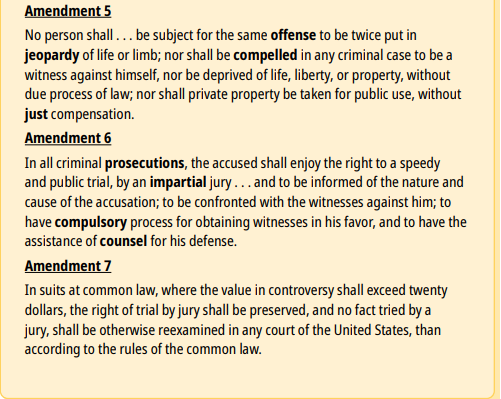
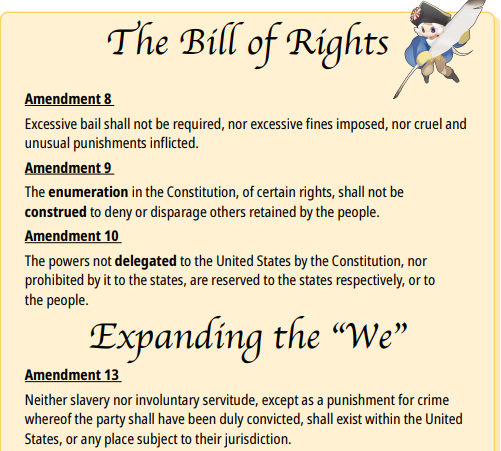
If a power isn't given to the federal government, it goes to the states or the people. | arrow_right_alt | 1 |
Bails, fines and punishments must not be excessive. | arrow_right_alt | 2 |
Citizens can keep and bear arms. | arrow_right_alt | 3 |
You don't have to house soldiers in your home during peacetime. | arrow_right_alt | 4 |
Did you find a right not listed in the Constitution? It still belongs to the people! | arrow_right_alt | 5 |
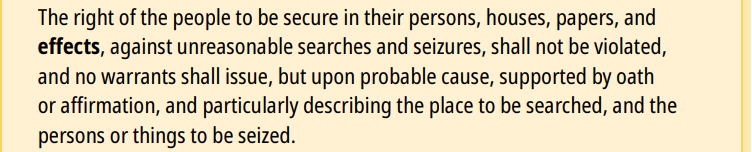
No unreasonable search & seizures. | arrow_right_alt | 6 |
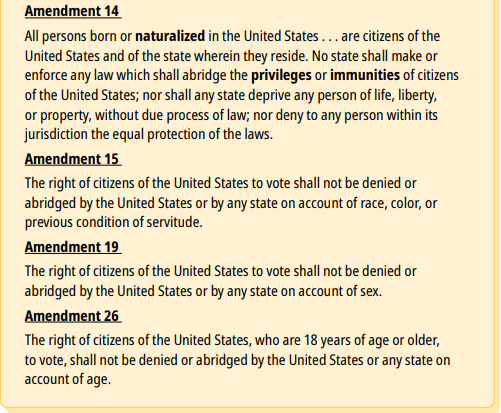
The government cannot deprive you of life, liberty, or property without due process of law. | arrow_right_alt | 7 |
The right to have a jury hear your case in most civil trials. | arrow_right_alt | 8 |
You have freedoms of religion, speech and press; and the right to assemble peacefully & petition the government. | arrow_right_alt | 9 |
The right to have a jury hear your case in a criminal trial. | arrow_right_alt | 10 |
13th Amendment
14th Amendment
A. Categorize. Below is a list of rights found in the Constitutional amendments. Complete the graphic organizer by placing the number of each right beneath its corresponding category. 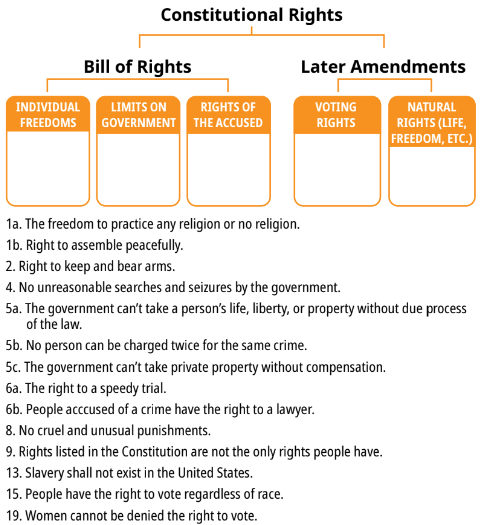
6b.
1a.
13.
5b.
8.
5c.
2.
19.
15.
4.
6a.
5a.
9.
1b.
Individual Freedoms
Limits on Government
Rights of the Accused
Voting Rights
Natural Rights (life, freedom, etc.)
A
B
C
D
E
F
G
H
Federalists
Anti-Federalists
Both
6th Amendment
4th Amendment
8th Amendment
We make sure the laws are carried out and enforced.
We hear cases about the laws and decide what the laws mean.
The appointment must be approved by a majority vote in the Senate before they can take
their seat on the court.
Once approved, the new justice takes their place on the Supreme Court and begins work.
15th Amendment
19th Amendment
26th Amendment
1st Amendment