Log in
Sign up for FREE
arrow_back
Library

Geologic Vocab Quiz

star
star
star
star
star
Last updated 2 months ago
18 questions
Required
1
Required
1
Required
1
Required
1
Required
1
Required
1
Required
1
Required
1
Required
1
Required
1
Required
1
Required
1
Required
1
Required
1
Required
1
Required
1
Required
3
Question 1
1.

Question 2
2.

Question 3
3.

Question 4
4.

Question 5
5.

Question 6
6.

Question 7
7.

Question 8
8.

Question 9
9.

Question 10
10.

Question 11
11.

Question 12
12.

Question 13
13.

Question 14
14.

Question 15
15.

Required
1
Question 17
17.

Question 18
18.
Draggable itemarrow_right_altCorresponding Item
arrow_right_alt
arrow_right_alt
arrow_right_alt
What is Cross-cutting relationships?
Layers of sediment initially extend laterally in all directions.
In an undisturbed stack of rock layers, the oldest layers will always be on the bottom and the youngest on the top.
geologic features that cut across, or disrupt another feature must be younger than the feature that is disrupted.
layers of sediment are originally deposited horizontally under the action of gravity.
What is the Law of Superposition?
Layers of sediment initially extend laterally in all directions.
geologic features that cut across, or disrupt another feature must be younger than the feature that is disrupted.
layers of sediment are originally deposited horizontally under the action of gravity.
In an undisturbed stack of rock layers, the oldest layers will always be on the bottom and the youngest on the top
What is Horizontality?
In an undisturbed stack of rock layers, the oldest layers will always be on the bottom and the youngest on the top.
layers of sediment are originally deposited horizontally under the action of gravity.
geologic features that cut across, or disrupt another feature must be younger than the feature that is disrupted.
Layers of sediment initially extend vertically in all directions.
What is Continuity?
geologic features that cut across, or disrupt another feature must be younger than the feature that is disrupted.
In an undisturbed stack of rock layers, the oldest layers will always be on the bottom and the youngest on the top.
Layers of sediment initially extend laterally in all directions.
The action of carrying something on over a period of time or the process of being carried on.
What is a rock strata?
The approximate age of a specific rock layer.
Assigning actual dates to rocks or geological events.
A layer of rock whose composition is more or less the same throughout.
An interruption in the series of the Earth’s rock layers, resulting from either erosion or failure of layers to be created.
What is Absolute Dating?
A layer of rock whose composition is more or less the same throughout.
The approximate age of a specific rock layer.
An interruption in the series of the Earth’s rock layers, resulting from either erosion or failure of layers to be created.
Assigning actual dates to rocks or geological events.
What is Relative Dating?
The approximate age of a specific rock layer.
Assigning actual dates to rocks or geological events.
An interruption in the series of the Earth’s rock layers, resulting from either erosion or failure of layers to be created.
A layer of rock whose composition is more or less the same throughout.
What is Unconformity?
The approximate age of a specific rock layer.
An interruption in the series of the Earth’s rock layers, resulting from either erosion or failure of layers to be created.
A layer of rock whose composition is more or less the same throughout.
Assigning actual dates to rocks or geological events.
What is the Fossil Record?
Music recorded on vinyl discs.
The preserved remains or traces of remains of ancient organisms.
a fossil usually with a narrow time range and wide spatial distribution that is used in the identification of related geologic formations.
A group of fossils which has been analyzed and arranged chronologically and in classification order.
What is an index fossil?
A group of fossils which has been analyzed and arranged chronologically and in classification order.
A fossil that points to another fossil in the same rock layer.
The preserved remains or traces of remains of ancient organisms.
a fossil usually with a narrow time range and wide spatial distribution that is used in the identification of related geologic formations.
What is a fossil?
The preserved remains or traces of remains of ancient organisms.
A mineral that forms when water evaporates from the ocean.
A fossil usually with a narrow time range and wide spatial distribution that is used in the identification of related geologic formations.
A group of fossils which has been analyzed and arranged chronologically and in classification order.
What is a geological fault?
A deep hole created by erosion
A layer of rock formed by cooled lava
A type of mineral found in granite
A fracture in the Earth’s crust along which movement has occurred.
Scientists use cosmic time to reference how old rocks are
True
False
What is the Geological Time scale?
Organizing Earth’s history based on major events and life forms.
Measuring the distance between continents.
A tool to measure the speed of rocks moving.
Measuring the depth of rocks.
What does the Law of Inclusion state?
The smaller pieces are younger than the surrounding rock.
The smaller pieces and the surrounding rock are the same age.
Fragments of rock found inside another rock are older than the rock surrounding them.
The oldest rocks are always found at the top layer.
Question 16
16.

What is subduction?
When two or more tectonic plates melt before they meet.
When one tectonic plate slides beneath another plate.
When two tectonic plates move away from each other.
When the wind pushes two or more tectonic plates together.
Sedimentary
Rock formed from the cooling and solidification of magma or lava
Igneous
Rocks that have become changed by intense heat or pressure while forming
Metamorphic
Formed from layers of sediment such as sand, silt, and dead organisms
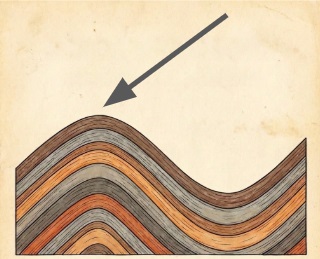
To what feature is the arrow pointing?
Igneous intrusion
Syncline
Unconformity
Anticline