Twa kɔ nsɛm atitiriw so
Log in
Sign up for FREE
arrow_back
Laabri

8.04: Which Suffrage Strategy Are You?

star
star
star
star
star
Last updated 3 months ago
9 Nsɛmmisa
Part 1: Which Suffrage Strategy Are You? Personality Quiz
0
0
0
0
0
0
7
Part 2: Which Suffrage Strategy Are You? Personality Quiz RESULTS!
Part 3: Reflection: Does your result seem accurate for your personality?
1
11
Asemmisa {{asɛmmisaAhyɛnsode}}
1.

If you want to create change, what sounds most like you?

Asemmisa {{asɛmmisaAhyɛnsode}}
2.

Which risk would you be most willing to take?

Asemmisa {{asɛmmisaAhyɛnsode}}
3.

What makes a movement powerful?

Asemmisa {{asɛmmisaAhyɛnsode}}
4.

If your first attempt fails, what do you do?

Asemmisa {{asɛmmisaAhyɛnsode}}
5.

Which role would you choose?

Asemmisa {{asɛmmisaAhyɛnsode}}
6.

Which statement do you agree with most?

Asemmisa {{asɛmmisaAhyɛnsode}}
7.

Tally Question

  1. Go back and Count your answers—what did you get the most of?

Which letter did you choose MOST often? (A, B, C, or D)

Type the letter (A, B, C, or D) answer below!

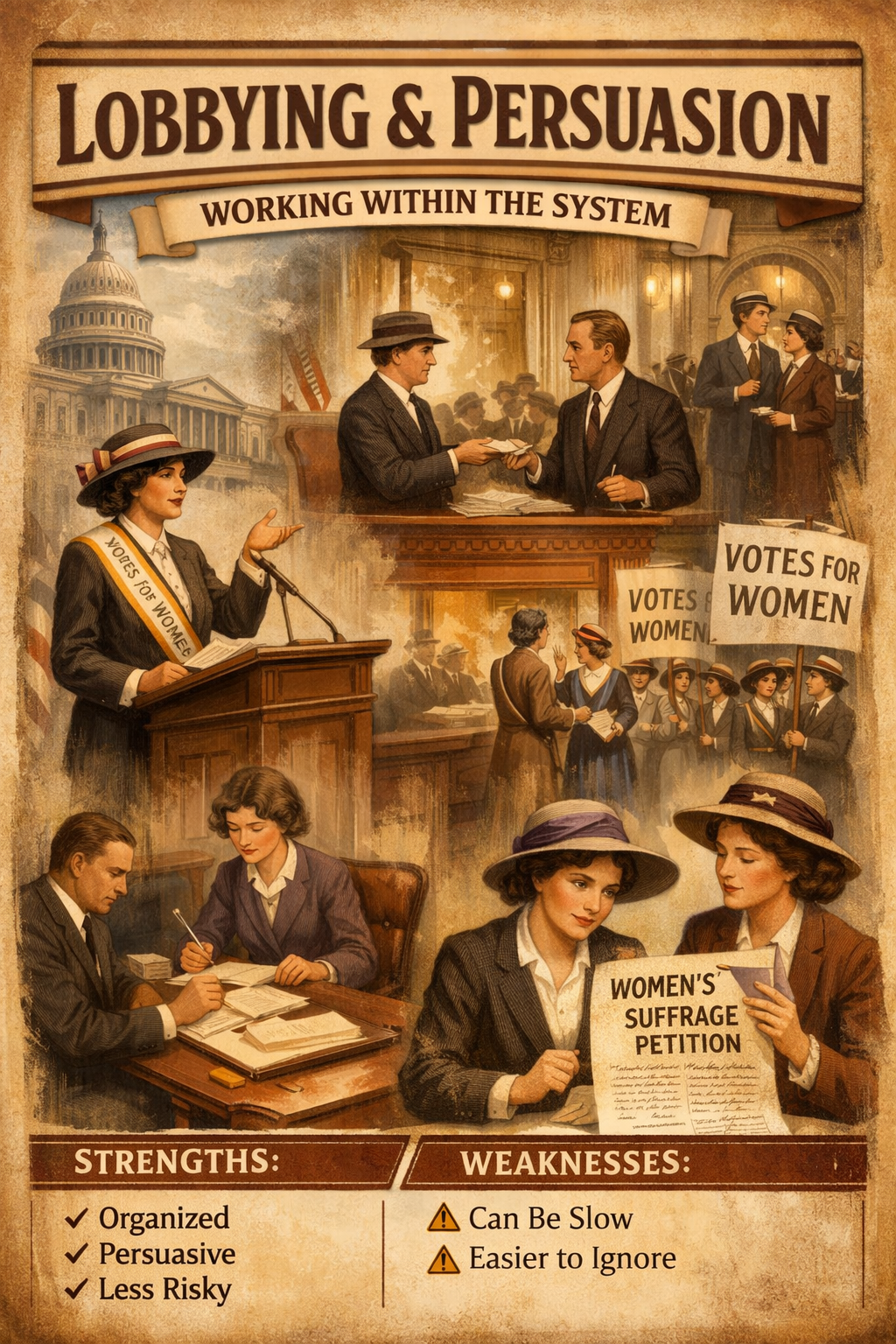
Mostly A: Lobbying / Persuasion

You believe change happens by convincing lawmakers, giving speeches, writing arguments, and working within the system.

Historical connection:
This strategy connects to suffragists who focused on petitions, speeches, lobbying Congress, and persuading political leaders. These leaders believed if they could persuade lawmakers, they could change the law.

Historical Examples:

  • Susan B. Anthony giving speeches and organizing petitions

  • NAWSA lobbying Congress for a constitutional amendment

  • Using the 14th Amendment argument (citizenship = voting rights)
Iron Jawed Angels Connection:
Carrie Chapman Catt and NAWSA’s approach (working within the system)

Strengths: organized, persuasive, less risky


Weaknesses: can be slow, easier for leaders to ignore

The bottom line: You believe if you can convince lawmakers, you can change the law.

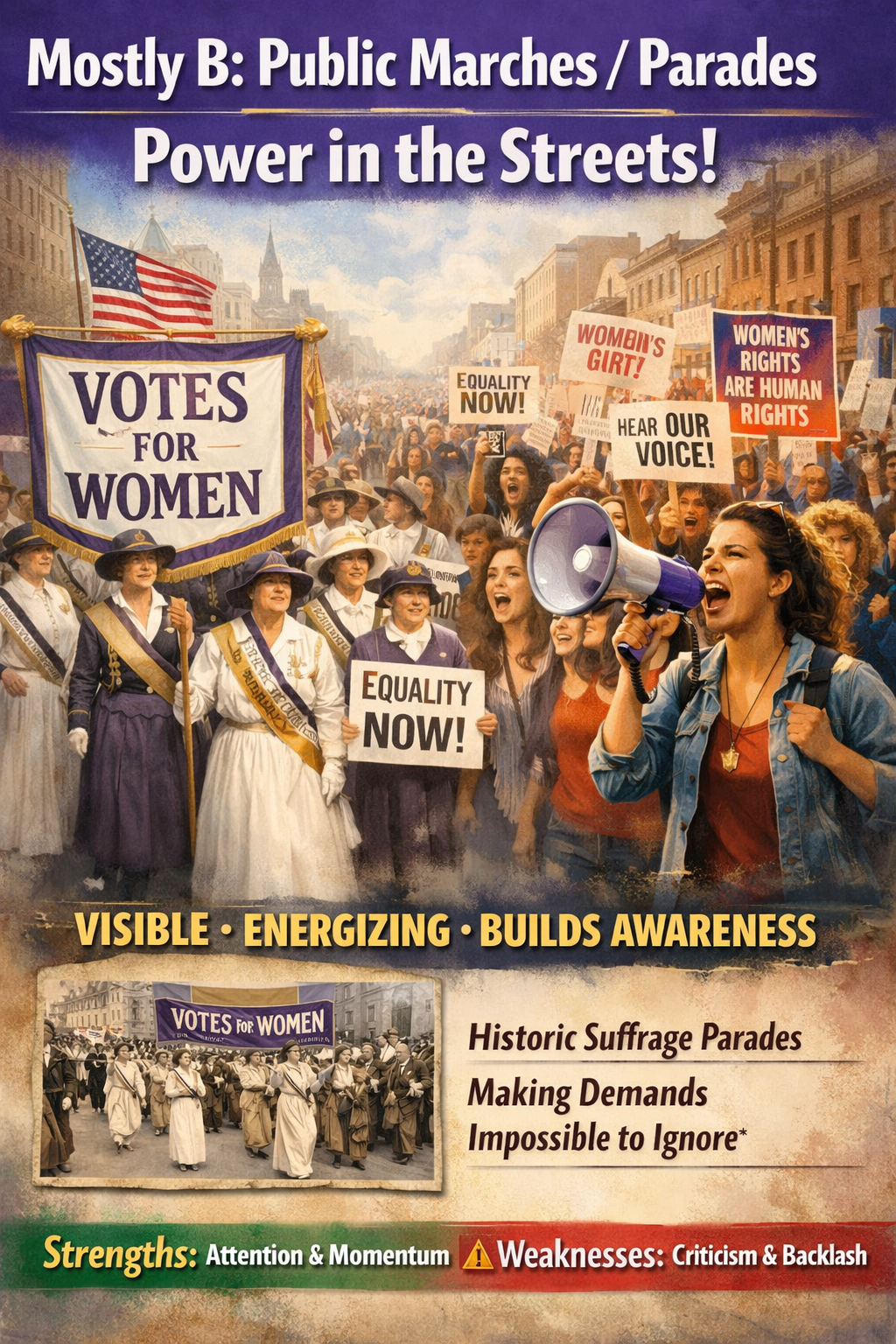
Mostly B: Public Marches / Parades

You believe movements gain power when people can see them. Public demonstrations create attention, energy, and momentum.

Historical connection:
This connects to major suffrage parades and public demonstrations that made women’s demands impossible to ignore.

Historical Examples:

  • 1913 Women’s Suffrage Parade in Washington, D.C.

  • Thousands marching to demand voting rights

  • Public attention, media coverage, and backlash

Iron Jawed Angels Connection:
Opening parade scenes and public demonstrations

Strengths: visible, energizing, builds awareness, inspires others


Weaknesses: can bring criticism or backlash, doesn’t always lead to immediate change

The bottom line: You believe change happens when people SEE it—large groups, visibility, and public attention— into something the whole country can't ignore.

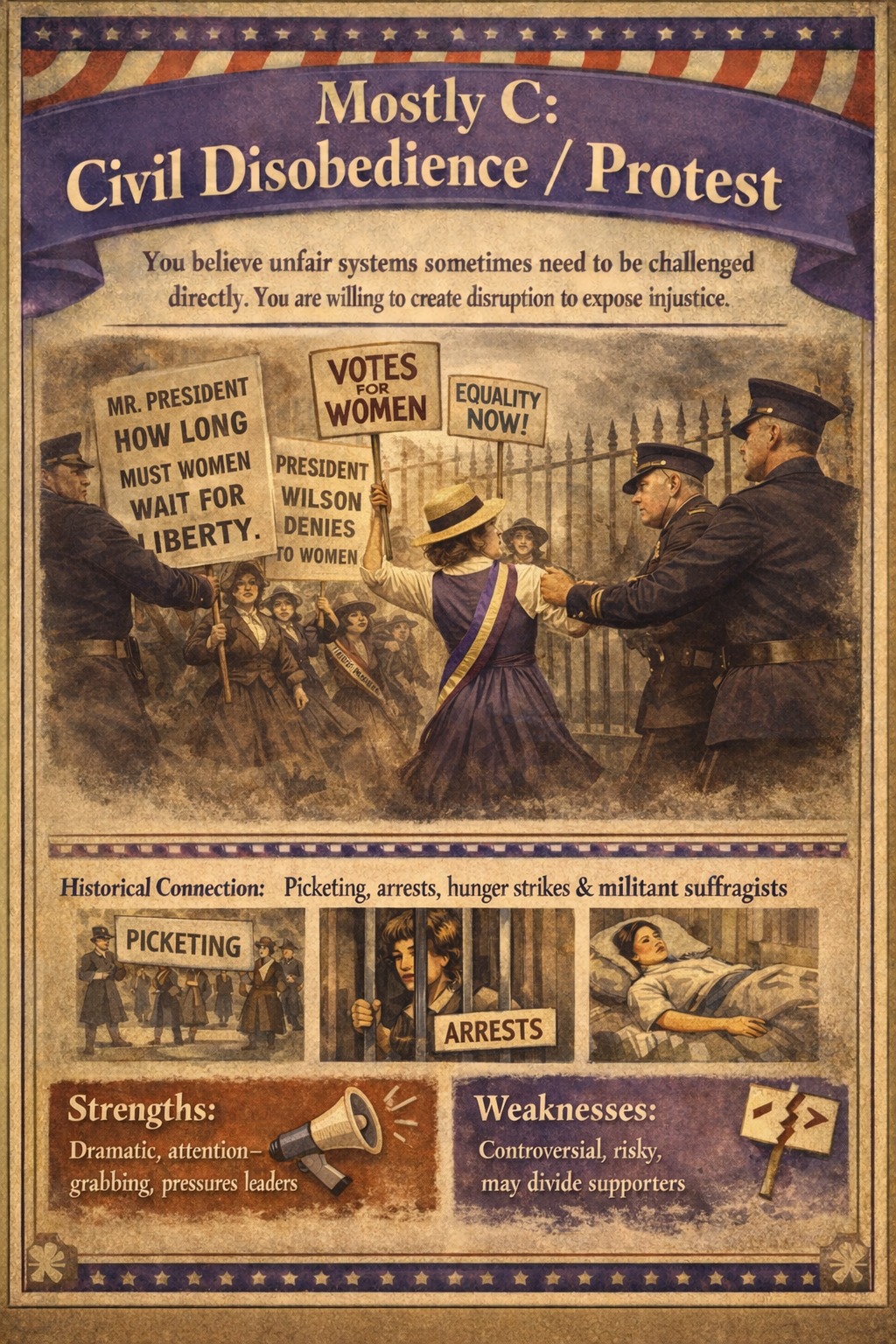
Mostly C: Civil Disobedience / Protest

You believe unfair systems sometimes need to be challenged directly. You are willing to create disruption to expose injustice.

Historical connection:
This connects to picketing, arrests, hunger strikes, and other protest tactics used by more militant suffragists.

Historical Examples:

  • Silent Sentinels picketing the White House

  • Arrests and jail time

  • Hunger strikes and force-feeding

Iron Jawed Angels Connection:
Alice Paul and Lucy Burns, jail scenes, hunger strikes

Strengths: dramatic, attention-grabbing, pressures leaders, gets attention quickly, forces action


Weaknesses: controversial, risky, may divide supporters

The bottom line: You believe change sometimes requires disruption—challenging unfair systems directly.

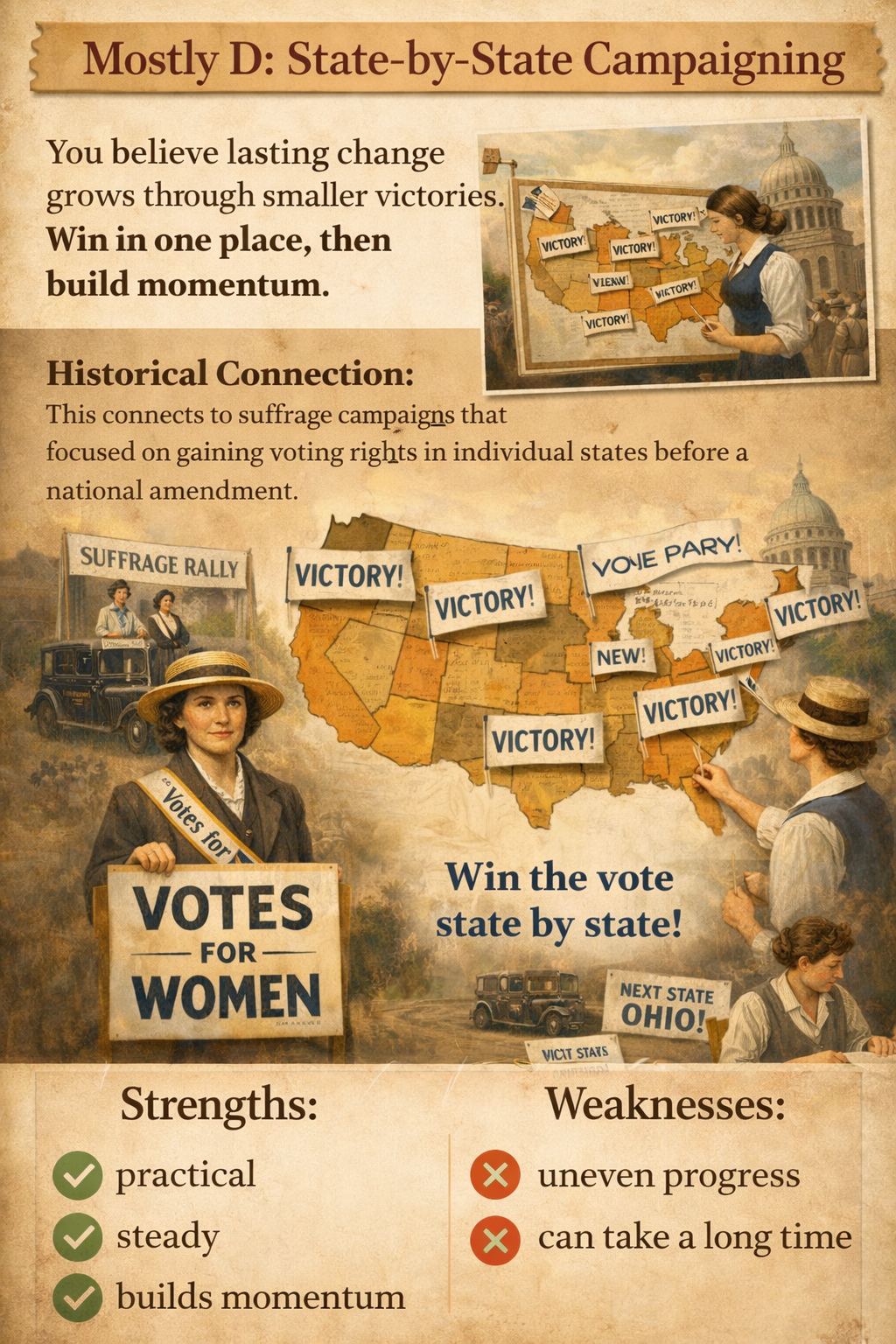
Mostly D: State-by-State Campaigning

You believe lasting change grows through smaller victories. Win in one place, then build momentum.

Historical connection:
This connects to suffrage campaigns that focused on gaining voting rights in individual states before a national amendment.

Historical Examples:

  • Western states granting women suffrage earlier

  • Expanding rights state by state before a national amendment

Iron Jawed Angels Connection:
Debates over state strategy vs national amendment

Strengths: practical, steady, builds long-term momentum


Weaknesses: uneven and slow progress, can take a long time, not equal everywhere

The bottom line: You believe change happens step by step—small victories that build over time.

Asemmisa {{asɛmmisaAhyɛnsode}}
8.

My result was: ___

(If you had a tie for #7, you can choose all that apply)

Asemmisa {{asɛmmisaAhyɛnsode}}
9.

In 5–7 complete sentences, answer the question below:

Does your result seem accurate for your personality? Why or why not?

Be sure to:

  1. Clearly state your result. ( Lobbying & Persuasion, Marches & Parades, Protest & Civil Disobedience, or State-by-State Strategy) --IF you had a tie, pick which one applies most to you to write about.

  2. Explain why it does or does not fit you

  3. Include at least one example to support your answer

    • Your example can be:

      • A real-life situation (school, sports, family, friends)
        OR

      • A moment from Iron Jawed Angels that connects to your thinking

Your goal is to show how your personality connects to your result—not just say yes or no.

OPTIONAL Sentence Starters

  • My result was…

  • This DOES / DOES NOT match my personality because…

  • This result is accurate because I usually…

  • This does not fit me because I tend to…

  • A real example of this is when I…

  • A moment from the movie that connects to this is when…

  • I don’t like attention…

  • I would speak up…

  • I avoid conflict…