Renewable Energy Cost-Benefit Analysis
Green power can offer organizations a variety of environmental, economic and stakeholder relations benefits. Green power purchases can also support the development of domestic renewable energy, which creates jobs, promotes resource diversity and provides grid resilience. This reading is intended to help buyers understand the benefits and costs associated with purchasing green power. The focus here is on the universal benefits and costs that are synonymous with all forms of green power. We will also compare the specific benefits and costs associated with different green power supply options.
The Benefits
Green power provides benefits both directly and indirectly to the buyer. The benefits listed here are grouped into four categories:
Environmental Benefits
Reduce organizational carbon footprint. Organizations that purchase low- or zero-emissions green power may claim to be reducing indirect emissions associated with purchased electricity - emissions that are owned and are the direct responsibility of the utility or other owner of the generating facility, but that are the indirect responsibility of the consumers of the electricity produced. Although consumers cannot directly control the generating facility that produces their electricity, they can influence the generator indirectly through their demand side choices. This is especially useful if the organization is accounting for its emissions through an inventory using the Greenhouse Gas (GHG) Protocol Corporate Reporting Standard.
Reduce air pollution. Conventional electricity generation from fossil fuels is one of the single largest industrial sources of air pollution (for sulfur dioxide, nitrogen oxides, mercury and certain types of particulate matter) in the United States. The emissions from conventional electricity generation contribute to a number of serious environmental problems. Green power generates fewer emissions than conventional power, helping to protect human health and the environment. According to a study by the Lawrence Berkeley National Laboratory and the National Renewable Energy Laboratory, emission reductions from each megawatt-hour of new renewable generation produced health and environmental benefits ranging from $26 to $101 per megawatt-hour (MWh).
Reduce water environmental impacts. Most green power technologies do not consume water and have a negligible impact on local aquatic ecosystems. Conventional power generation often requires water for fuel extraction, steam production and power plant cooling. The release of spent cooling water increases the temperature of local water resources, which can alter aquatic ecosystems. In contrast, most green power systems do not consume water or release it into the environment. A joint study by two national laboratories found that adding new renewable electricity to the grid resulted in water savings equivalent to 8,420 gallons of withdrawal and 270 gallons of consumption for each megawatt-hour produced.
Emissions and water benefits of renewable electricity generation for state renewable portfolio standard (RPS) programs through 2013 were examined in a recent Lawrence Berkeley National Laboratory study, with results shown in Figure 1.
Figure 1. Environmental Benefits and Impacts of New Renewable Electricity
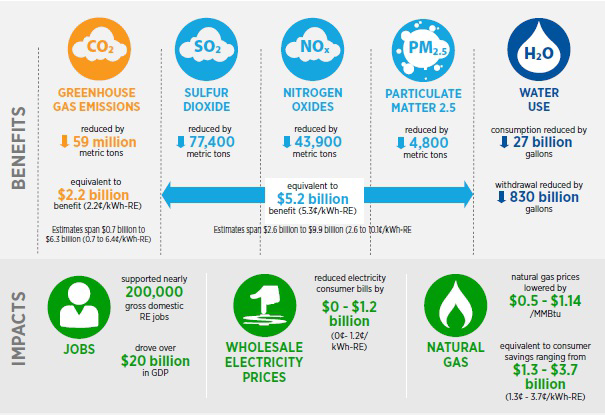
Note: This study evaluated a subset of the potential benefits and impacts of state RPS policies. We distinguish impacts from benefits because we do not estimate or claim any net social benefit from the impacts assessed here. We do not assess all potential benefits and impacts, for example land use and wildlife impacts, or job losses in the fossil industry. We also do not address the costs of state RPS programs, as that was the subject of an earlier study (Heeter et al. 2014).
Economic Benefits to Purchasing Organization
Reduced economic costs of green power projects. Technological innovations have led to dramatic declines in the cost of wind and solar technologies since 2000. These cost decreases have stimulated demand, contributing to higher sales volumes and larger economies of scale, which has further reduced production costs. This has allowed green power to become more affordable to more organizations. To illustrate the recent cost reductions, Figure 2 shows that the installed cost of solar has decreased from $8–$12/watt in 2000 to $2–$4/watt in 2016. Similar dramatic cost reductions have been seen for wind technologies. In some situations, wind and solar are now cost-competitive with conventional energy.
Manage electricity prices. Organizations can procure green power through long-term contracts to safeguard against expected electricity prices increases by locking in fixed costs for their electricity and the associated renewable attributes for several years at a time.
Mitigate fuel supply disruptions. Disruptions in fuel supply can hinder business processes and profitability. Green power resources can reduce the impact of fuel supply disruptions to power plants caused by transportation difficulties, accidents or natural disasters by lowering demand for fuels that are delivered by rail or pipeline. In addition, on-site self-generation or third-party owned generation, coupled with storage, can improve electricity supply reliability and resilience in response to local power outages.
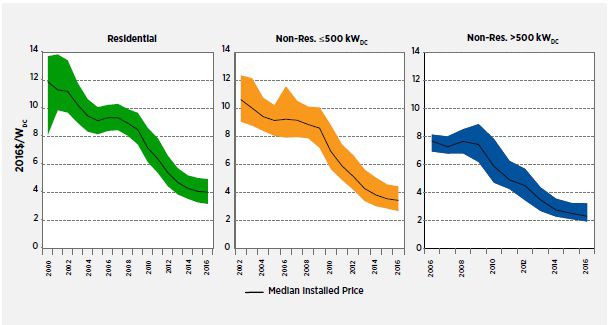
Figure 2. Cost of Installed Solar
Note: Solid lines represent median prices, while shaded areas show 20th-to-80th percentile range. Summary statistics shown only if at least 20 observations are available for a given year and customer segment.
Stakeholder Relations
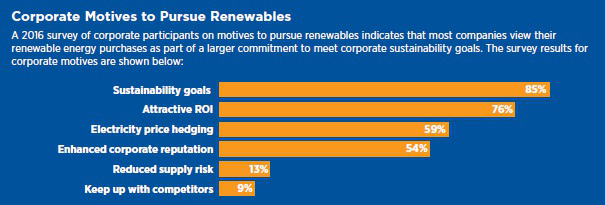
Meet organizational environmental objectives. Reducing an organization’s environmental impact is one of the main motivations for buying green power. This may be driven internally by employees and shareholder initiatives, and externally by a desire to improve brand image and perception of the organization among its stakeholders and customers.
Increase brand credibility through recognized initiatives. Participating in collaborative programs improves the environmental credibility of the organization and may help in attracting new investment.
Demonstrate civic leadership. Being among the first in a community to purchase green power is a demonstration of civic leadership. It makes a statement that an organization is willing to act on its stated environmental and social goals. Committing to green power can also demonstrate a company’s willingness to innovate and reduce long-term business risk.
Generate positive publicity. Buying green power affords an opportunity for and builds on existing public recognition and public relations activities. Companies that are in the public eye benefit from being responsive to the concerns of environmentally conscious customers, shareholders, regulators and other constituents.
Improve employee recruitment and retention. Leadership on renewable energy may improve employee morale, productivity, retention and talent acquisition. A Tandsberg-Ipsos MORI survey report of employees in 15 countries showed 80 percent of survey respondents (81 percent in the United States) preferred to work for organizations with an environmentally friendly reputation. A McKinsey survey found that company executives in the sustainability leaders’ group (companies that are more adept at capturing value through sustainability) were more confident that sustainability is important for attracting and retaining employees than respondents at other companies. A University of California - Los Angeles study found that for companies that voluntarily adopt green practices and standards, employees are 16 percent more productive than average.
Improve student recruitment and enrollment. In an annual survey of college applicants and their parents, the Princeton Review found that “a majority (61 percent) of respondents said having information about colleges’ commitment to environmental issues would contribute ’strongly,’ ’very much,’ or ’somewhat’ to their application/attendance decisions.”
Differentiate products or services. By purchasing green power, a company may be able to differentiate its products or services by offering them as “made with certified renewable energy.” For example, businesses and consumer goods recognized by the Center for Resource Solutions’ Green-e program can display the Green-e logo on their company websites and product packaging to indicate use of 100 percent certified green power in the manufacturing of the product. Some companies also find that producing their products with green power gives them an advantage in marketing to customers who are trying to “green” their supply chains.
Development of Domestic Energy Resources
Stimulate domestic economy. Manufacturing, installing and operating renewable technologies in the United States requires a trained energy workforce. By purchasing green power, organizations increase aggregate demand, leading to creation of high-quality, high-paying jobs that can help grow the local economy. Renewable energy facilities can also increase the local tax base and provide income to farmers and rural communities, who can benefit through landowner lease payments. Green power generation is an important growth sector that can simultaneously boost the nation’s economy and create jobs, while also meeting the nation’s energy requirements with renewable domestic resources.
Figure 3.
U.S. Jobs by Electric Power Generation Technology, Q2 2015 to Q1 2016
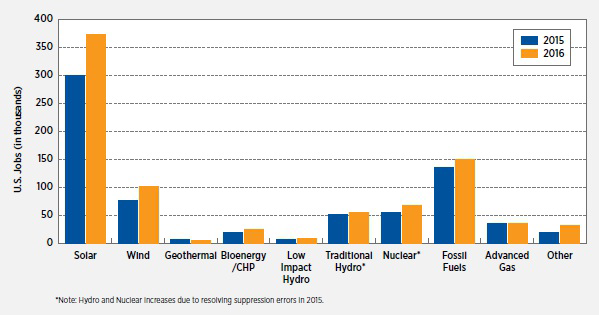
Note: The methodology was revised in 2016 to capture subcontractor employment in Nuclear and Traditional Hydro, employment totals are not reflective of growth year over year. Job figures in chart are only related to electric power generation and associated technologies.
The Costs
There are several factors that can affect green power costs; most of them depend on the choices an organization makes. These factors include the following:
Green power product option
Green power supplier (e.g., competitive bid or not)
Renewable resource and technology type (e.g., wind, solar, hydro, biomass)
Quantity of green power purchased
Duration and terms of contract
Available incentives for green power
Location of the generator or consumer
Figure 4 illustrates the levelized costs of renewable and fossil fuel technologies and shows that several clean energy technologies are now cost-competitive with conventional energy sources. Despite this progress, the product type an organization chooses can make a big difference in cost and in how that cost is incurred. For example, even if the extra cost is low, purchasing unbundled RECs still comes at a cost premium on top of the standard electricity cost to the consumer. The same is usually true for purchases of green power from a utility.
In contrast, the competitive costs for some renewable energy technologies shown in Figure 4 have made self-generation and long-term contracts or direct purchasing from generators more accessible to an increasing number of organizations.
For example, while self-generation can require a major capital outlay that varies significantly depending on the size of the installation, that cost can be recovered over time through stable and, in some cases, lower ongoing operating costs.
Long-term contracting for electricity supply avoids the upfront capital cost and may also provide competitive and predictable electricity costs depending on the contract terms. In some states, solar companies will capitalize, own and install a solar project at an organization’s site with a commitment from the host organization to purchase the output over a period of years. Alternatively, creditworthy large energy consumers may be good candidates for long-term contracts for off-site green power supply from the utility grid. The risk with long-term contracts is that future electricity prices may turn out to be lower than expected, and the organization is locked in to the higher price specified in the contract. Some contracts can specify which party accepts the market risk for higher electricity prices.
These procurement or product options may allow for cost savings over the life of the project or contract.
Levelized cost of electricity (LCOE) is used to compare the relative cost of energy produced by different energy-generating sources, regardless of the project’s scale or operating time frame. LCOE is a calculation accounting for all of a system’s expected lifetime costs (including construction, financing, fuel, maintenance, taxes, insurance and incentives), which are then divided by the system’s lifetime expected power output (in kilowatt-hours). All cost and benefit estimates are adjusted for inflation and discounted to account for the time-value of money.
Figure 4.
Levelized Cost of New Power Generation Technologies in 2016
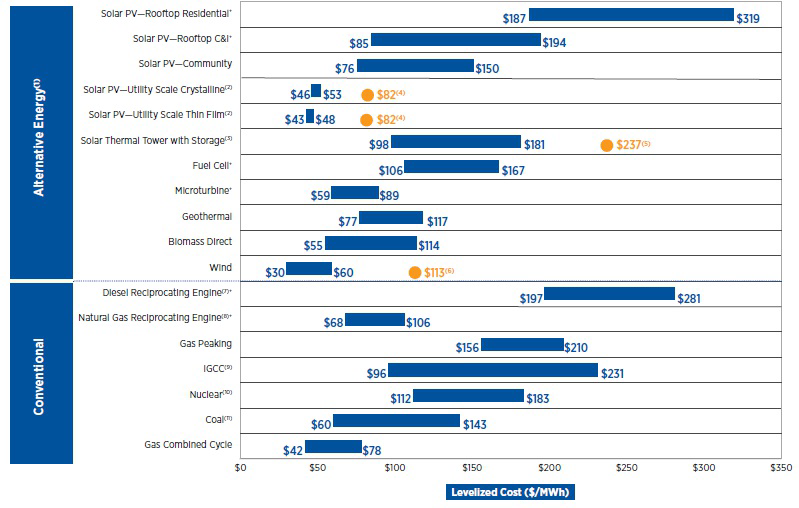
Note: Here and throughout this presentation, unless otherwise indicated, analysis assumes 60% debt at 8% interest rate and 40% equity at 12% cost for conventional and Alternative Energy generation technologies. Reflects global, illustrative costs of capital, which may be significantly higher than OECD country costs of capital.