Sustainable Development Goals: Affordable and Clean Energy
The Sustainable Development Goals Report 2023
Special Edition provides a powerful call to action, presenting a candid assessment of the SDGs based on the latest data and estimates. While highlighting the existing gaps and urging the world to redouble its efforts, the report also emphasizes the immense potential for success through strong political will and the utilization of available technologies, resources, and knowledge. Together, the global community can reignite progress towards achieving the SDGs and create a brighter future for all.
According to the report, the impacts of the climate crisis, the war in Ukraine, a weak global economy, and the lingering effects of the COVID-19 pandemic have revealed weaknesses and hindered progress towards the Goals. The report further warns that while lack of progress is universal, it is the world’s poorest and most vulnerable who are experiencing the worst effects of these unprecedented global challenges. It also points out areas that need urgent action to rescue the SDGs and deliver meaningful progress for people and the planet by 2030.
About this Report
The Sustainable Development Goals Report 2023: Special Edition is the only UN official report that monitors global progress on the 2030 Agenda for Sustainable Development. Using the latest available data and estimates, the report provides a comprehensive midpoint assessment of the 2030 Agenda, highlighting not only impacts of multiple crises affecting people's lives and livelihoods, but also areas of progress where acceleration is needed. This annual SDG Report is prepared by UN DESA, in collaboration with the entire UN Statistical System, consisting of more than 50 international and regional agencies, based on data from over 200 countries and territories.
GOAL 7 - Affordable and Clean Energy
Considerable strides have been made in achieving sustainable energy targets. The number of people lacking access to electricity dropped from 958 million in 2015 to 685 million in 2022. The number without clean cooking fuels declined from 2.8 billion to 2.1 billion over the same period. Global capacity to generate electricity from renewable energy has begun expanding at an unprecedented rate, a trend expected to continue.
Recent events, such as the COVID-19 pandemic and the war in Ukraine, have disrupted progress, including by exacerbating already insufficient international financial flows for clean energy in developing countries. Without a change in course, an estimated 660 million people will still lack electricity access and around 1.8 billion will go without clean cooking fuels and technologies by 2030.
To achieve universal access to clean energy by 2030, robust policies are needed to accelerate electrification, enhance energy efficiency and increase investments in renewable energy. These efforts, coupled with fostering innovative solutions and creating supportive regulatory frameworks, are pivotal to advance towards Goal 7 and meet climate objectives.
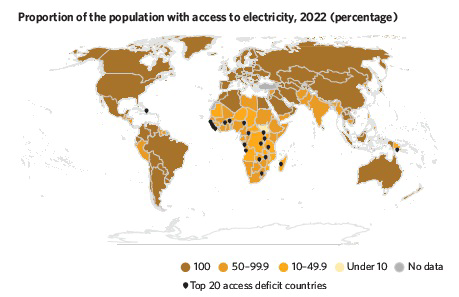
The number of people lacking electricity access grew for the first time in a decade
In 2022, although the global electricity access rate held steady at 91 per cent, 685 million people still lacked electricity, 10 million more than in 2021 due to population growth. This marked the first such increase in a decade. The setback is largely attributed to the disruptions of the COVID-19 pandemic and Ukraine conflict, which affected energy prices and markets. Those without access to electricity are predominantly in low-income households or located in remote areas.
Progress varies by region. Central and Southern Asia reduced the regional gap from 235 million people in 2015 to 33 million in 2022. Sub-Saharan Africa had a growing share of the global access deficit, at 83 per cent (or 570 million people) in 2022, up from 50 per cent in 2010. While access to electricity grew globally at 0.77 per cent annually on average from 2010 to 2020, the rate slowed to 0.43 per cent from 2020 to 2022. With projections indicating that 660 million people globally will remain unserved by 2030, achieving universal electricity access will require a 1.08 per cent annual increase. Investing in decentralized renewable energy, including stand-alone off-grid solar and mini-grids, together with electricity-as-a-service models holds significant potential to bridge the access gap.
Figure 1.
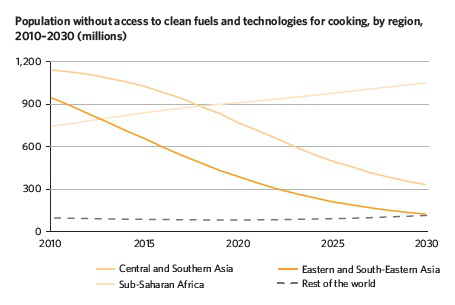
Without faster progress, by 2030, around 1.8 billion people will still prepare meals using polluting stoves and fuels
In 2022, 74 per cent of the global population had access to clean cooking. The global access deficit fell to 26 per cent, down from 36 per cent in 2015. This still leaves around 2.1 billion people relying on polluting fuels and technologies, such as wood, charcoal, dung and crop waste, as their primary energy source for cooking. Without stepped-up interventions, around 1.8 billion people or 21 per cent of the world’s population could lack access to clean cooking by 2030.
Among the regions, Eastern and South-Eastern Asia and Central and Southern Asia have seen consistent improvements. By contrast, sub-Saharan Africa remains the only region where the deficit is rising; it could exceed 1 billion people without access by 2030. Globally, urban-rural disparities are stark, with 88 per cent of urban households compared to 54 per cent of rural households having access to clean cooking solutions. A reliance on traditional stoves and polluting fuels worsens health and environmental risks, particularly for women and children, who bear the brunt of cooking and fuel collection burdens.
Figure 2.
Electricity is at the forefront in the shift to global renewable energy; hurdles remain in heating and transport
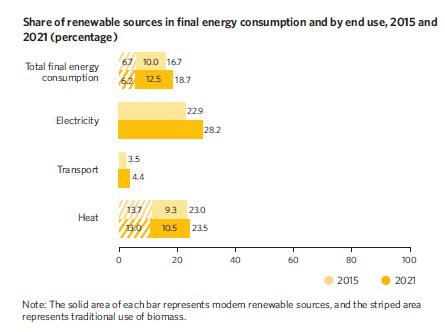
The share of renewable energy in the world’s total final energy consumption rose from 16.7 per cent in 2015 to 18.7 per cent in 2021. Excluding traditional forms of biomass, the share of modern renewable sources climbed gradually from 10 per cent in 2015 to 12.5 per cent in 2021. Traditional uses of biomass accounted for slightly over a third of total renewable energy consumption.
The electricity sector has emerged as a frontrunner in adopting wind and solar technologies due to their declining costs. Renewables constituted over 28.2 per cent of total final energy consumption for electricity in 2021, up from 22.9 per cent in 2015. This signals how the world’s capacity to generate renewable power is expanding at an unprecedented rate, presenting a tangible opportunity to triple global capacity by 2030, as agreed at the twenty-eighth session of the Conference of the Parties to the United Nations Framework Convention on Climate Change in 2023. Yet increases in renewable energy use remain constrained in the heating and transport sectors, which account for four fifths of total final energy consumption.
Figure 3.
Impressive overall average gains in electricity generated with renewables obscure slow progress in some places
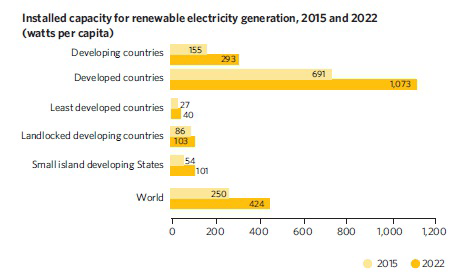
Globally, per capita installed capacity for generating electricity with renewable energy nearly doubled from 250 watts in 2015 to 424 watts in 2022. The past five years saw an all-time high compound annual growth rate of 8.1 per cent. Developing countries witnessed substantial expansion from 155 to 293 renewable watts per capita. Developed countries saw a milder rise from 691 to 1,073 watts per capita, even as they have 3.7 times more installed capacity than developing nations. Disparities are more evident for the LDCs, LLDCs and small island developing States, which in 2022 achieved 40, 103 and 101 watts per capita, respectively. At current rates of expansion, LDCs would require nearly 41 years, LLDCs 38 years and small island developing States 11 years to match the 2022 levels in developing countries. This wide divide indicates an urgent need to bridge gaps in achieving equitable access to sustainable energy.
Figure 4.
Global investment needs to triple to rectify marginal gains in energy efficiency
Global primary energy intensity improved from 4.9 megajoules per dollar (2017 purchasing power parity) in 2015 to 4.6 in 2021. The energy intensity improvement rate for 2021 was only 0.8 per cent, however, influenced by a robust economic recovery after the pandemic and a shift towards energy-intensive industries. The rate has remained under the 1.2 per cent average observed during the last five years.
To meet the Goal 7 energy efficiency target by 2030, annual improvements must now average around 4 per cent. Key actions include switching to more efficient fuels, such as by electrifying final uses and providing universal access to clean cooking. Improving the technical efficiency of equipment and processes and using energy and materials more efficiently are also important. Further, global investment in energy efficiency would need to triple by 2030. High interest rates pose a challenge as financing new projects has become more expensive, particularly in emerging markets and developing economies.
International public financial flows for clean energy rebounded in 2022 but remain insufficient
In 2022, international public financial flows supporting clean energy in developing countries rebounded to $15.4 billion, an increase of 25 per cent over 2021 yet still around half the 2016 peak of $28.5 billion. This declining trend could impede progress towards Goal 7, especially for the LDCs, LLDCs and small island developing States.
Financing commitments have become marginally more widely distributed. In 2021, 80 per cent of commitments went to 19 countries, a figure rising to 25 in 2022. Trends in technology over the last decade have shifted investments from hydropower to solar energy and multiple/other renewables. In 2022, almost half of flows went to multiple/other renewables. Solar energy received 35 per cent, wind energy 11 per cent and hydropower 7 per cent.