Log in
Sign up for FREE
arrow_back
Library

A way to freedom

star
star
star
star
star
Last updated about 3 hours ago
41 questions
U8.SQ3 (Part 2) -Civil Rights movements (Day #1)
U8.SQ3 - Civil Rights movements (Day #2)
U8.SQ3 - Civil Rights movements(Day #3)
1
U8.SQ3 - Civil Rights movements (Day #4)
Required
1

Compelling Question: What tactics did individuals or groups use to gain freedom, and how successful were those efforts?


DO-NOW: Predict 🧐 Look at the picture.
Required
1
Question 1
1.

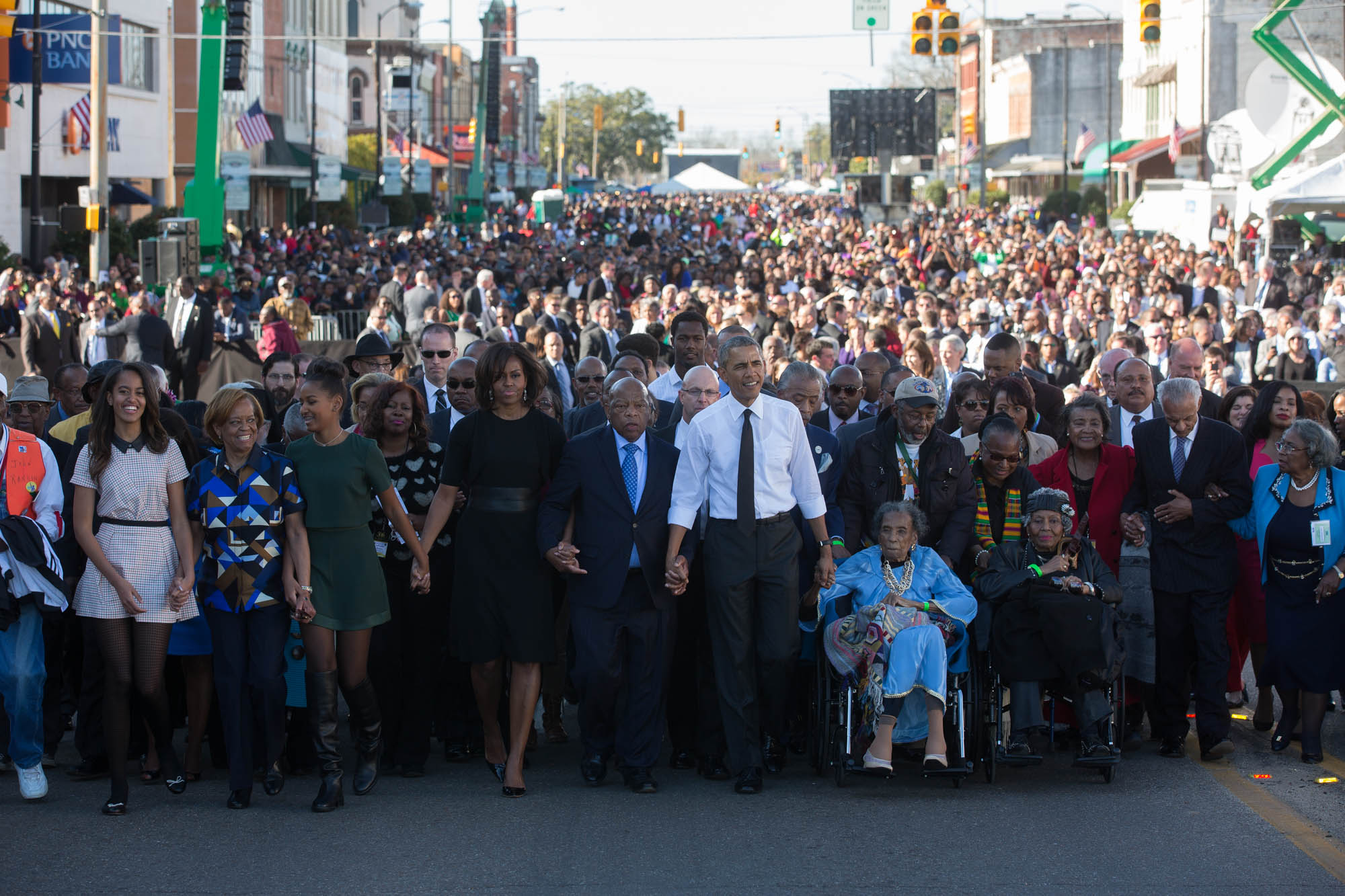
Why do you think these people are gathered?

Required
1
Required
1
Required
1
Required
1
Required
1
Required
1
Source 2: New York Times Newspaper in New York, (August 29, 1963)


Engage Sources 📜
Required
1
Required
1
Required
1
Source 3: 2o2o Virtual March on Washington, NAACP(August 22, 2020)


Required
1
Question 9
9.

Required
1
Exit Ticket:
In 1–2 sentences, explain how the March on Washington helped individuals or groups gain freedom or rights.
Required
1
Question 11
11.

END OF DAY #1

U8.SQ3 (Part 1) - Civil Rights movements
To be continued tomorrow...

Compelling Question: What tactics did individuals or groups use to gain freedom, and how successful were those efforts?

DO-NOW: Predict 🧐
1
Question 12
12.

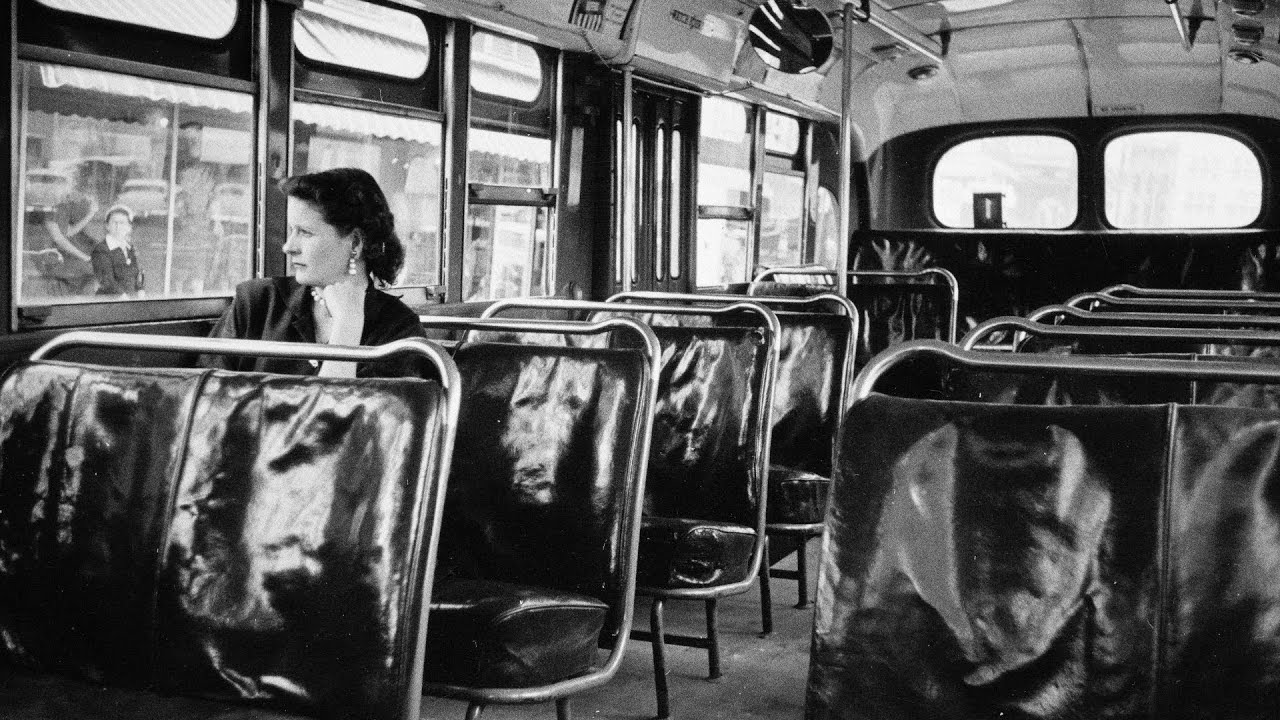
What do you notice about this image? What do you think might be happening?

Contextualize 🔍️
1
Question 13
13.

Source 5: "Pies from Nowhere: How Georgia Gilmore Sustained the Montgomery Bus Boycott"

By: Dee Romito | Illustrated by: Laura Freeman

Engage Sources 📜
"Pies From Nowhere" Graphic Organizer

Directions: As you listen to the story of Georgia Gilmore during the Montgomery Bus Boycotts, fill in each slice of the "pie" with a form of nonviolent protest that you see or hear mentioned.

Pull up the full book by clicking on the file below:
4
Question 14
14.
Credit for Completing Graphic Organizer (On Paper): __________
Georgia Gilmore adjusts her hat for photographers in 1956 during the bus boycott trial of Rev. Martin Luther King Jr. in Montgomery, Alabama
1
Question 15
15.

Reflect: Which of the nonviolent forms of protest from the story do you think was the most successful? Explain your reasoning.

END OF DAY #2

U8.SQ3 (Part 1) - Civil Rights movements
To be continued tomorrow...

Compelling Question: What tactics did individuals or groups use to gain freedom, and how successful were those efforts?

DO-NOW: Predict 🧐
1
Question 16
16.

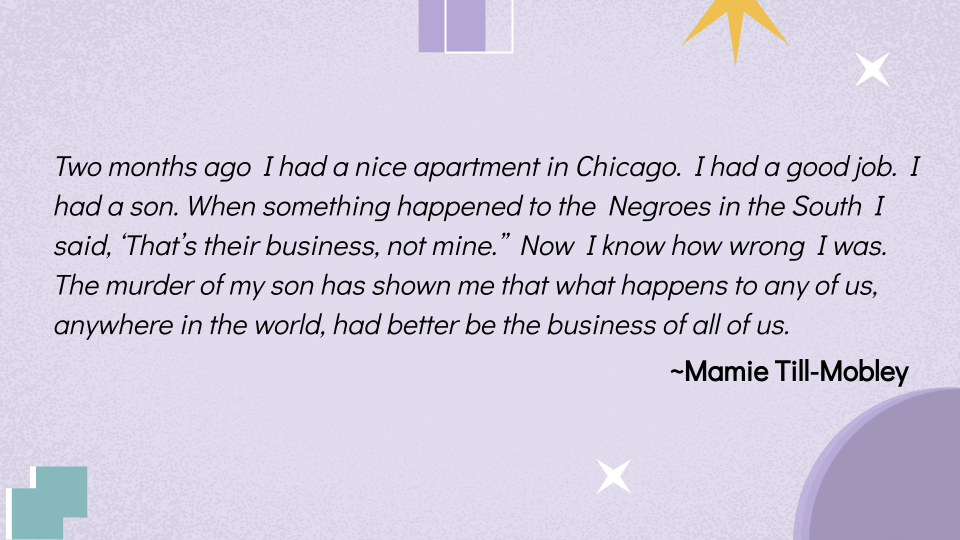
What do you think Mamie Till-Mobley meant when she said “What happens to any of us... had better be the business of all of us"?

Contextualize 🔍️
1
1
Source 6: Photo by Chicago Sun-Times
Caption: Mamie Till-Mobley at her son’s funeral on Sept. 6, 1955 in Chicago

Source 7: Photo by Chicago Sun-Times
Caption: Pallbearers carry the casket of Emmett Till through a large crowd gathered outside Roberts Temple Church of God in Christ on Sept. 6, 1955
Engage Sources 📜
1
Question 19
19.

What sort of emotions do you think the published photos (Source 6 & 7) of Emmett Till's funeral evoked in the public? Explain your reasoning.

Source 8: Quote by Mamie Till-Mobley on why she chose to have an open-casket funeral (2003)

"There were so many people there. So many people who had known Emmett, so many more people who would come to know him only like this... On the one hand, as a mother, I couldn’t bear the thought of people being horrified by the sight of my son. He had always been such a fine young boy and I was so very proud of him. But, on the other hand, I felt that the alternative was even worse. After all, we had averted our eyes far too long, turning away from the ugly reality facing us as a nation... People had to face my son and realize just how twisted, how distorted, how terrifying, race hatred could be."

Engage Sources 📜
1
Question 20
20.

Based on Source 8, why was Mamie Till-Mobley's decision to pursue nonviolence through media coverage such an important moment for the Civil Rights Movement?

Source 9: Joyce Ladner, Excerpt from Keynote Speech at SNCC Conference (2000)

"Ours was the Emmett Till generation. No other single incident had a more profound impact on so many people who came into SNCC. We had seen the JET magazine cover of Emmett Till’s disfigured and bloated face with one eye missing. It was just an awful picture... We were his age and could identify with him. I felt that if they had killed a fourteen-year-old, they could also kill me or my brothers. We knew that men were lynched, but we’d never known of a child being lynched before. On a profound, personal level, this reality had a strong, galvanizing effect on all of us. The image is with me still. It became etched in my generation’s consciousness."

Engage Sources 📜
1
Question 21
21.

According to Source 9, how did the media coverage of Emmett Till impact young people of the time? Use specific evidence from the source to explain your reasoning.

Question 22
22.

Communicate Conclusions 📢
Directions: Match each Civil Rights movent with the nonviolent tactic they used.

Draggable itemarrow_right_altCorresponding Item
March on Washington
arrow_right_alt
rally and march
Georgia Gilmore
arrow_right_alt
boycotting
Mamie Till-Mobley
arrow_right_alt
media coverage
Exit Ticket:
Which Civil Rights tactic is most relevant today? Explain how it could be used in a modern movement and evaluate how successful it would be compared to the past.

Choose the tactic __________. People today could use it by __________. I think it would be (effective/not effective) because __________.”

Compelling Question: What tactics did individuals or groups use to gain freedom, and how successful were those efforts?

DO-NOW: Predict 🧐 look at the picture.
1
Question 23
23.

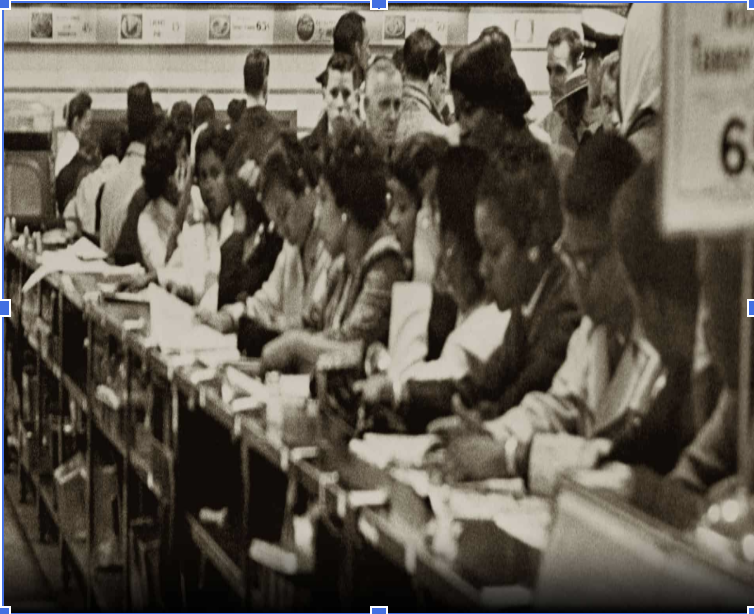
What do you these students are thinking?

Required
1
Required
1
Required
1
Required
1
Source 2:
Required
1
Question 28
28.

How woud you feel if you lived during this time?

Source 3:
Freedom riders
  • The CORE Freedom RidesInitiated by the Congress of Racial Equality (CORE), the Freedom Rides involved a group of racially diverse college students, including seven blacks and six whites, who rode public transportation buses from Washington, DC, to New Orleans, Louisiana.
  • Their purpose was to challenge Jim Crow laws and test compliance to the 1906 Supreme Court ruling in Boynton v. Virginia where segregated transportation facilities were deemed unconstitutional.
  • From South Carolina and further South, riders faced extreme resistance.
  • They were beaten and their buses were even firebombed.

Much of the violence occurred due to the lack of local and state police protection.
Engage Sources 📜
Required
1
Required
1
Required
1
Source 4:

Lyrics

Freedom Summer

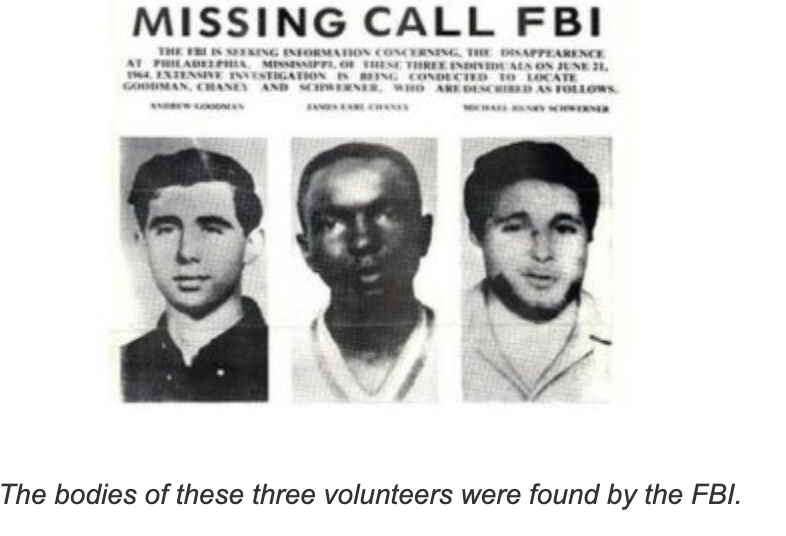
The Song of the Freedom Singers was first used at the Mississippi Freedom Summer Project when three civil rights workers were reported missing in June 1964. The FBI found their bodies in early August.

They say that freedom is a constant struggle, They say that freedom is a constant struggle, They say that freedom is a constant struggle, O Lord, we’ve struggled so long, We must be free, we must be free.
They say that freedom is a constant crying, They say that freedom is a constant crying, They say that freedom is a constant crying, O Lord, we’ve cried so long, We must be free, we must be free.
They say freedom is a constant sorrow, They say freedom is a constant sorrow, They say freedom is a constant sorrow, O Lord, we’ve sorrowed so long, We must be free, we must be free.
They say freedom is a constant moaning, They say freedom is a constant moaning, They say freedom is a constant moaning, O Lord, we’ve moaned so long, We must be free, we must be free.
They say freedom is a constant dying, They say freedom is a constant dying, They say freedom is a constant dying, O Lord, we’ve died so long, We must be free, we must be free.
Required
1
Required
1
Required
1
Required
1
Engage Sources 📜
Required
1
Required
1
Required
1
Question 39
39.

Draggable itemarrow_right_altCorresponding Item
arrow_right_alt
arrow_right_alt
arrow_right_alt
Exit Ticket: Pick one tactic. How could people use it today, and would it work? Why?

I choose __________. People today could use it to __________. I think it would be (effective/not effective) because __________

END OF U8.SQ3

U8.SQ3 (Part 1) - Civil Rights movements
Don't forget - Click SUBMIT! 🥳
Source1: March on Washington for jobs and freedom:
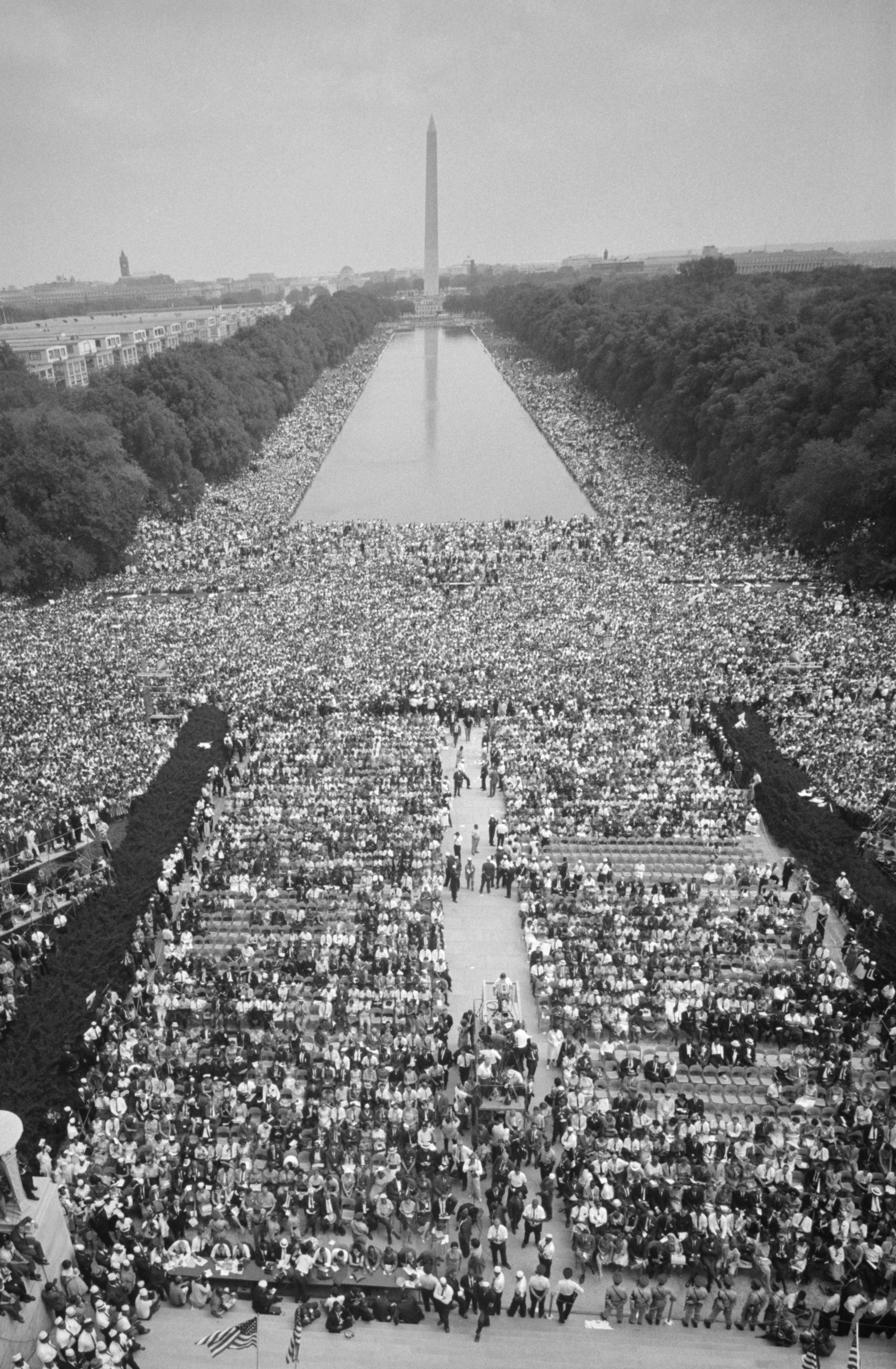
  • On 28 August 1963, more than 200,000 demonstrators took part in the March on Washington for Jobs and Freedom in the nation’s capital.
  • The march was successful in pressuring the administration of John F. Kennedy to initiate a strong federal civil rights bill in Congress.
  • The 1963 March on Washington had several precedents.
  • In the summer of 1941 A. Philip Randolph, founder of the Brotherhood of Sleeping Car Porters, called for a march on Washington, D.C., to draw attention to the exclusion of African Americans from positions in the national defense industry.
  • The threat of 100,000 marchers in Washington, D.C., pushed President Franklin D. Roosevelt to issue Executive Order 8802, which mandated the formation of the Fair Employment Practices Commission to investigate racial discrimination charges against defense firms.
  • In response, Randolph cancelled plans for the march.
  • Civil rights demonstrators did assemble at the Lincoln Memorial in May 1957 for a Prayer Pilgrimage for Freedom.
  • The March on Washington was not universally embraced. It was condemned by the Nation of Islam and Malcolm X who referred to it as “the Farce on Washington.”
  • The diversity of those in attendance was reflected in the event’s speakers and performers. They included singer Bob Dylan; actors Ossie Davis and Ruby Dee and march organizer Bayard Rustin.
  • The day’s high point came when King took the podium toward the end of the event and moved the Lincoln Memorial audience and live television viewers with what has come to be known as his “I Have a Dream” speech.
  • After the march, King and other civil rights leaders met with President Kennedy and Vice President Lyndon B. Johnson at the White House, where they discussed the need for bipartisan support of civil rights legislation.
  • Though they were passed after Kennedy’s death, the provisions of the Civil Rights Act of 1964 and Voting Rights Act of 1965 reflect the demands of the march.
Contextualize 🔍️
Question 2
2.

Question 3
3.

Question 4
4.

Question 5
5.

Question 6
6.

Question 7
7.

Question 8a
8a.

Question 8b
8b.

Question 8c
8c.

Question 10
10.

REVIEW:
  • Over 200,000 people participated in the 1963 March on Washington, making it a major peaceful demonstration that drew national attention to civil rights issues.
  • The march was successful in pressuring the federal government, helping lead to the Civil Rights Act of 1964 and the Voting Rights Act of 1965.
  • It brought together diverse leaders and voices, highlighted by Martin Luther King Jr.’s “I Have a Dream” speech, though some critics like Malcolm X questioned its effectiveness.
Claudette Colvin:
  • In March, 1955, a 15-year-old Black high school honor roll student named Claudette Colvin refused to give her seat up to a white passenger
  • When the bus driver told her to move, she responded by saying, "It's my constitutional right to sit here as much as that lady. I paid my fare, it's my constitutional right". The bus driver called the police and had Colvin arrested
  • Her church pastor bailed her out of jail that evening, and the NAACP considered using Colvin’s case to attack the bus segregation laws, but ending up not taking the case
  • Claudette Colvin went to court and pled not guilty - The court ruled against her and sentenced her to probation

Montgomery Bus Boycotts:
  • NAACP passes on Colvin’s case but takes up the case of Rosa Parks nine months later - taking the opportunity to challenge the bus companies legally and economically
  • 50,000 leaflets get the word out to boycott Montgomery’s buses and most black people, who had been the majority of bus riders, refuse to ride
  • One-day protest so successful that many want to keep it going until demands met and the Montgomery Bus Boycott lasts from December 5, 1955, until December 20, 1956
  • For over a year, tens of thousands of African Americans refused to ride the buses and either walked, cycled, drove, or carpooled with other protesters
  • By November of 1956, the U.S. Supreme Court ruled (Browder v. Gayle) that bus segregation was unconstitutional and struck down laws requiring segregated seating on public buses
What did the Montgomery Bus Boycott protest against?
Employment opportunities for Black Americans
Segregation on public transportation in Montgomery, Alabama
All public transportation fares
Racial discrimination in schools
Review:
  • Claudette Colvin’s early resistance (1955): At just 15, Claudette Colvin refused to give up her bus seat, asserting her constitutional rights. Although her case was not taken up by the NAACP, her actions helped lay the groundwork for future legal challenges.
  • Montgomery Bus Boycott as a mass nonviolent tactic: Following Rosa Parks’ arrest, African Americans organized a year-long boycott of city buses, using economic pressure and collective action to protest segregation.
  • Successful outcome through sustained protest and legal action: The boycott led to the Browder v. Gayle Supreme Court decision, which declared bus segregation unconstitutional, marking a major victory for the Civil Rights Movement.

Emmett Till:
  • August, 1955 - Over a year since the Supreme Court decision in Brown v. Board of Education and a few months after Claudette Colvin was arrested on a Montgomery bus
  • A man named Moses Wright takes his 16-year-old nephew and his 14-year-old cousin, Emmett Till, from Chicago to visit family in Mississippi
  • After a hot, August, Mississippi day helping in the fields - Emmett, his cousins, and some other friends went to the store for drinks and snacks
  • The store was run by a white husband and wife named Roy and Carolyn Bryant. 21-year-old Carolyn was working as the cashier that Wednesday evening when Emmett purchased a pack of gum
  • The accounts of what really happened vary, but Emmett Till breached “southern etiquette” and angers racist whites

Turning Point in Mississippi:
  • White men came to the home of Emmett‘s family and kidnapped him. Three days later, Till’s body was found in the Tallahatchie River - beaten, shot, disfigured
  • His mother, Mamie, insisted on an open casket funeral and allowed photographers from Jet Magazine to come take photographs of Till’s body. The photos quickly became famous in the mainstream press as well. Soon, the entire world knew about what had happened to the 14-year-old at the hands of racists in Mississippi
  • Over 100,000 people visited his casket over a four-day period and news coverage as well as pictures of the funeral were published in newspapers and magazines around the world
  • Just a couple weeks later, the murderers of Emmett Till went on trial. The evidence against the murderers was overwhelming and there were numerous eyewitnesses to the kidnapping that led to the murder. Yet the killers were still found “not guilty.” The justice system doesn’t always deliver justice.
Question 17
17.

What significant action did Emmett Till's mother take after her son's death?

Question 18
18.

What was the outcome of the murderers' trial?

Review:
  • Emmett Till’s murder exposed the brutality of racism (1955): Emmett Till, a 14-year-old from Chicago, was kidnapped and murdered in Mississippi after allegedly violating racist social norms, highlighting the extreme violence Black individuals faced in the South.
  • Public awareness became a powerful catalyst for change: His mother, Mamie Till-Mobley, held an open-casket funeral, and widely published images of his body shocked the nation and brought global attention to racial injustice.
  • Failure of the justice system fueled the Civil Rights Movement: Despite strong evidence, an all-white jury acquitted the killers, demonstrating systemic racism and motivating increased activism and demand for civil rights protections.

Source 1: Sit-Ins
  • Greensboro, North Carolina The sit-in at the lunch counter of Woolworth’s department store in Greensboro on February 1, 1960, was the impetus for the larger sit-in movement that spread across the country.
  • Four Black students from Agricultural & Technical College of North Carolina (now North Carolina A&T State University) – Joseph McNeil, Franklin McCain, Ezell Blair Jr. and David Richmond – sat down at the lunch counter inside the store and were refused service when they each asked for a cup of coffee. Even though they were not served, the four men stayed at the counter until the store closed that night.
  • The next day, the sit-in grew to include more than 20 participants, including women from neighboring Bennett College.
  • The students were harassed and heckled by white patrons, but they remained at the counter and did not fight back.
  • The following day, more than 60 people joined the sit-in, and local newspapers and news stations came to Woolworth’s to report on the event.
  • On February 4, more than 300 students participated in the sit-in, which expanded to the lunch counter at Kress, a nearby store.
  • Students in other North Carolina cities, including Winston-Salem, Durham, Raleigh and Charlotte, also organized their own sit-ins at segregated businesses, and the movement spread to other states, such as Kentucky, Tennessee, Virginia and Mississippi. In locations where sit-ins were taking place, segregated businesses were losing money.
  • Woolworth’s in Greensboro lost a reported $200,000 due to boycotts, and on July 25, 1960, store manager Charles Harris decided to desegregate the store.
  • He requested that four of his Black employees change out of their uniforms and order at the counter.
  • That day, the four employees became the first Black customers to be served at any Woolworth’s lunch counter.
Question 24
24.

What event sparked the larger sit-in movement in the U.S. ?

Question 25
25.

How many students initiated the sit-in at Woolworth's?

Question 26
26.

What was the initial reaction of patrons towards the sit-in participants?

Question 27
27.

What was the financial impact of the sit-ins on Woolworth's?

Question 29
29.

Who initiated the Freedom Rides?

Question 30
30.

What was the primary aim of the Freedom Riders?

Question 31
31.

What did the Freedom Riders face in southern states?

Engage Sources 📜
Question 32
32.

What does the song mainly express about freedom?

Question 33
33.

According to the lyrics, how do people feel about their struggle for freedom?

Question 34
34.

Which of the following phrases is repeated in the lyrics?

Question 35
35.

What emotion is NOT expressed in the lyrics?

Source 5:

Voter Education Project African American Civil Rights.(2017).

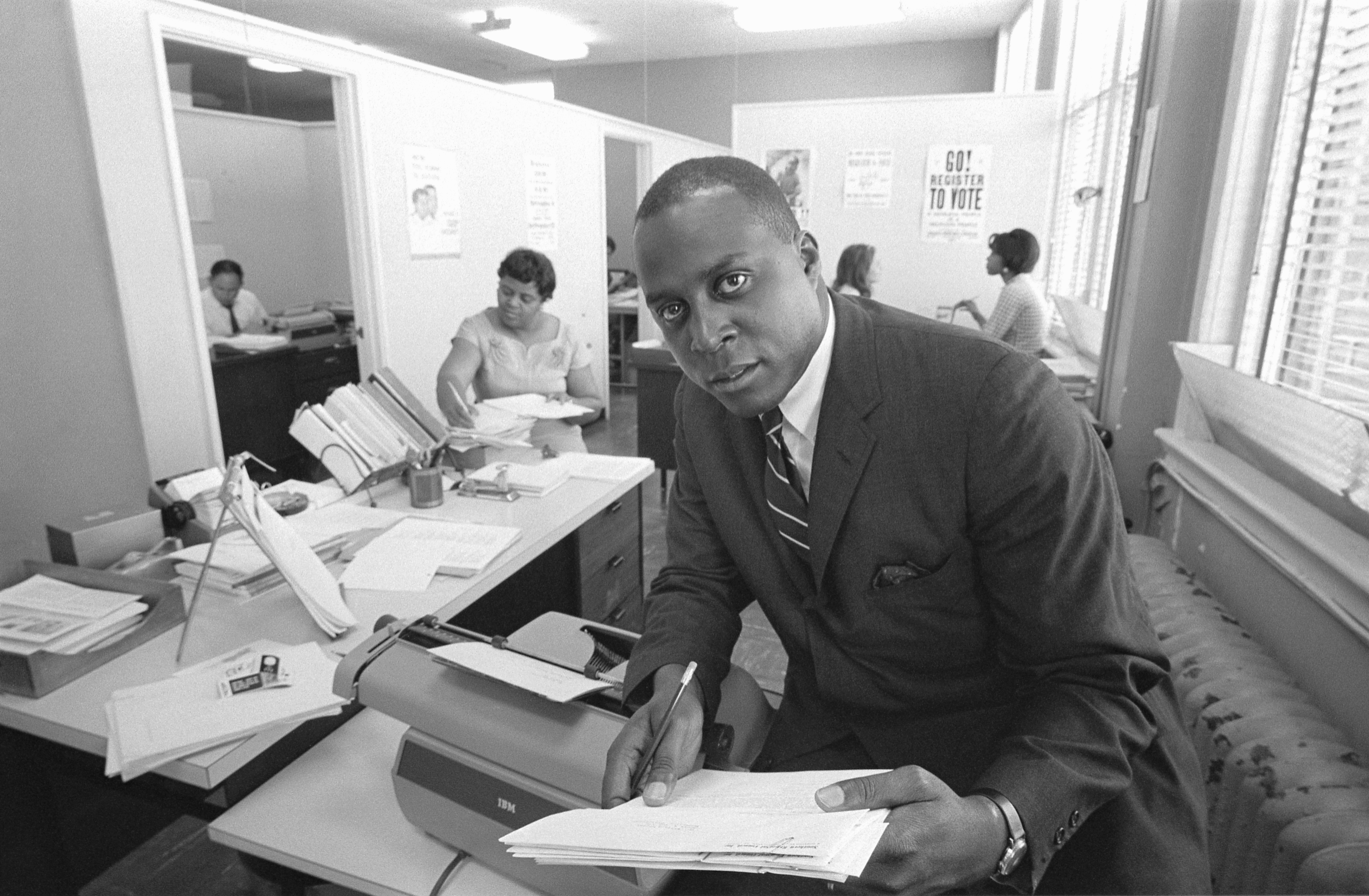
  • In 1962 the Voter Education Project (VEP) was founded with the financial support of the Federal government.
  • Its objective was to increase voter registration in the African American community.
  • In two years across the South over 38.6% of those eligible were registered to vote which was considered a great achievement.
  • The only state where voter registration was low and discouraging was in Mississippi where only 3,871 out of 394,000 African American adults registered.
  • Consequently, in 1963 VEP decided to concentrate its efforts in Mississippi.
  • Members of the NAACP, CORE, SCLC and other organizations organized the Council of Federated Organizations (COFO) out of which the Mississippi Freedom Democratic Party was born.

Student volunteers

  • The Mississippi Freedom Summer Project involved hundreds of student volunteers, black and white, who came from different parts of the country to educate and encourage registration and support for the Freedom Democratic Party candidates.
  • Most were middle class and came from northern colleges.
  • By June 1964 about 700 students attended a two-week training session at the Western College for Women at Oxford, Ohio; they were mostly white and lived with local African American families.
  • On June 21th a group of three young men disappeared , Andrew Goodman, 21, student from Queens College; Michael Schwerner, 24, New York social worker; and James Chaney, 21, CORE worker from Mississippi.
  • They were sent to investigate a burned out church in the outskirts of Meridian and they were arrested for speeding.
  • The last time they were seen was when they were released from jail that night.
  • Their bodies were found by the FBI in early August. The wave of intimidation and fear against students sent only a few back home while the majority of them stayed.
  • The Freedom Summer Project was successful at establishing 50 Freedom Schools to provide remedial education for the young and programs at community centers where adults got educated about voting.
Question 36
36.

What was the main goal of the Voter Education Project?

Question 37
37.

Where was the Voter Education Project's focus in 1963?

Question 38
38.

Who were involved in the Mississippi Freedom Summer Project?