Which of the following are true about the 1963 protests in Birmingham? Select all that apply.
What were conditions like for African American people in Birmingham?
In the 1950s and 1960s, African American people in Birmingham were treated as second-class citizens and frequently subjected to violent attacks. Segregation laws affected all parts of life, making it illegal for Black and white people to share housing or space in restaurants, concert halls, or bus stations. The homes of civil rights activists were often bombed by the Ku Klux Klan (KKK), earning the city the nickname "Bombingham."
The Birmingham commissioner of public safety, Eugene "Bull" Connor, was responsible for much of the police violence against African American residents. King called Connor "a racist who prided himself on knowing how to handle the [African American person] and keep him in his 'place.'" In 1961, a bus full of activists rode through the South as part of the "Freedom Rides" to challenge segregation. When the bus stopped in Birmingham, Connor gave the local KKK fifteen minutes to assault the passengers before instructing the police to intervene.
King rejects the clergy's use of the "outside agitator" idea. Which of the following statements best explain his reasoning? Select all that apply.
King was criticized by the clergy for using direct action instead of negotiating more with city leaders. In response, he wrote about direct action and its effects. Read the following excerpt. Select one section that defines the purpose of direct action.
King describes the following scenarios in his letter. Which scenarios provide evidence of discrimination? Select all that apply.
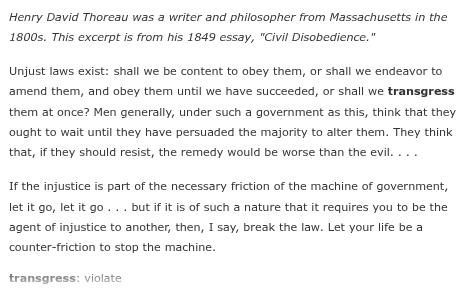
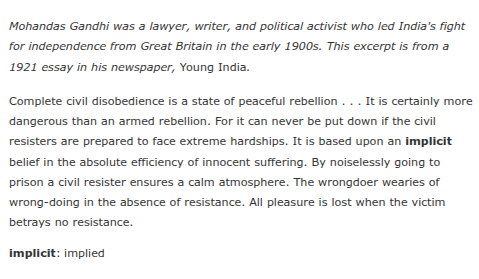
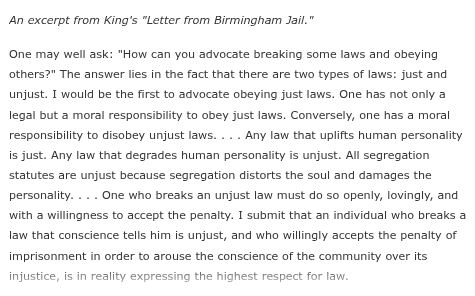
Based on the excerpts, which of the following accurately describe civil disobedience? Select all that apply.
Why does King argue that the white moderates were a "stumbling block" to Black equality?
Decide whether each statement summarizes an argument from the clergy letter or from King's letter.
Clergy Letter | King's Letter | |
|---|---|---|
The police attacked unarmed protesters, including young children. | ||
The police should be congratulated for protecting the city from violence. | ||
The police do not deserve praise because they acted violently toward protesters. | ||
The police acted calmly when dealing with the protests. |
What does King mean when he says civil rights workers are the South's "real heroes"?
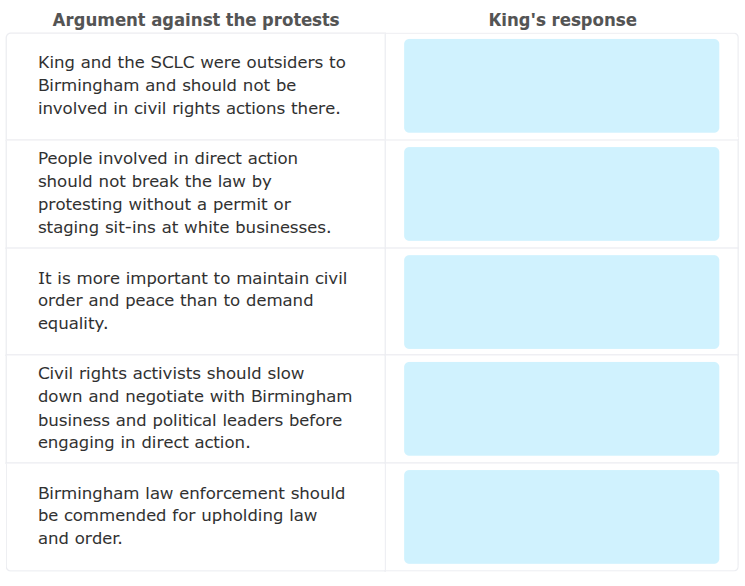
Use what you have learned to match each argument against the Birmingham protests to King's response.

People who believe in justice have a moral responsibility to disobey unjust laws such as segregation ordinances.
King's movement was coordinated by Birmingham civil rights activists who invited SCLC to join their efforts.
Birmingham police have violently suppressed dissent and attacked African American residents during their protests and in the past.
It's worth temporarily disrupting the peace in order to fight for racial equality.
African American people have waited long enough for desegregation, so activists must start protesting immediately.
According to the excerpt, which of the following describe the goals of King's nonviolent direct action? Select all that apply