Wk 32 EOL 8.2
star
star
star
star
star
Last updated 4 months ago
15 Nsɛmmisa
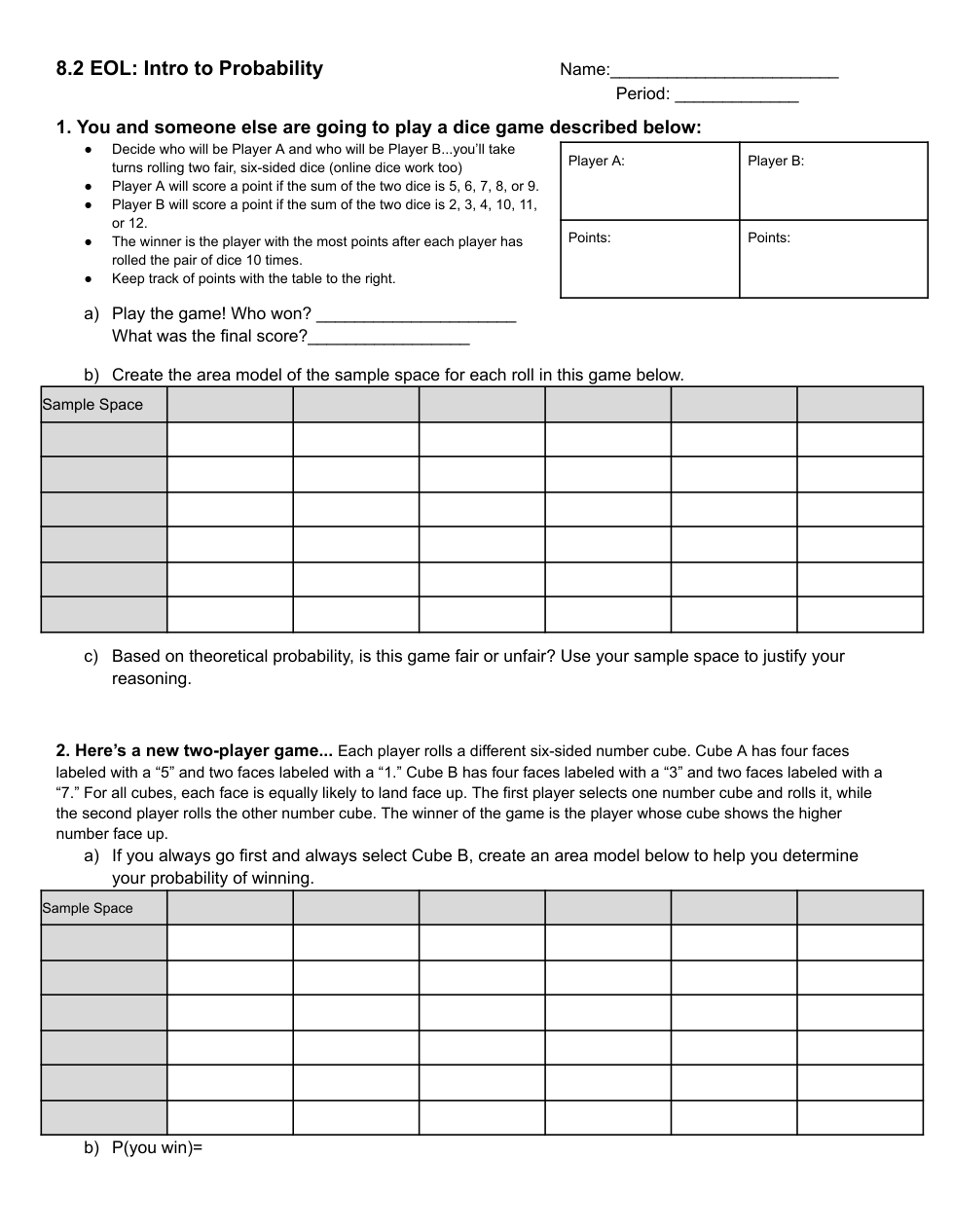
1a. Play the Game. Who won?
What was the final score?
1b. Create the area model of the sample space for each roll in this game below.
1c. Based on theoretical probability, is this game fair or unfair? Use your sample space to justify your
2. Here’s a new two-player game... Each player rolls a different six-sided number cube. Cube A has four faces labeled with a “5” and two faces labeled with a “1.” Cube B has four faces labeled with a “3” and two faces labeled with a “7.” For all cubes, each face is equally likely to land face up. The first player selects one number cube and rolls it, while the second player rolls the other number cube. The winner of the game is the player whose cube shows the higher number face up.
a) If you always go first and always select Cube B, create an area model below to help you determine your probability of winning.
2b. P(you win)=
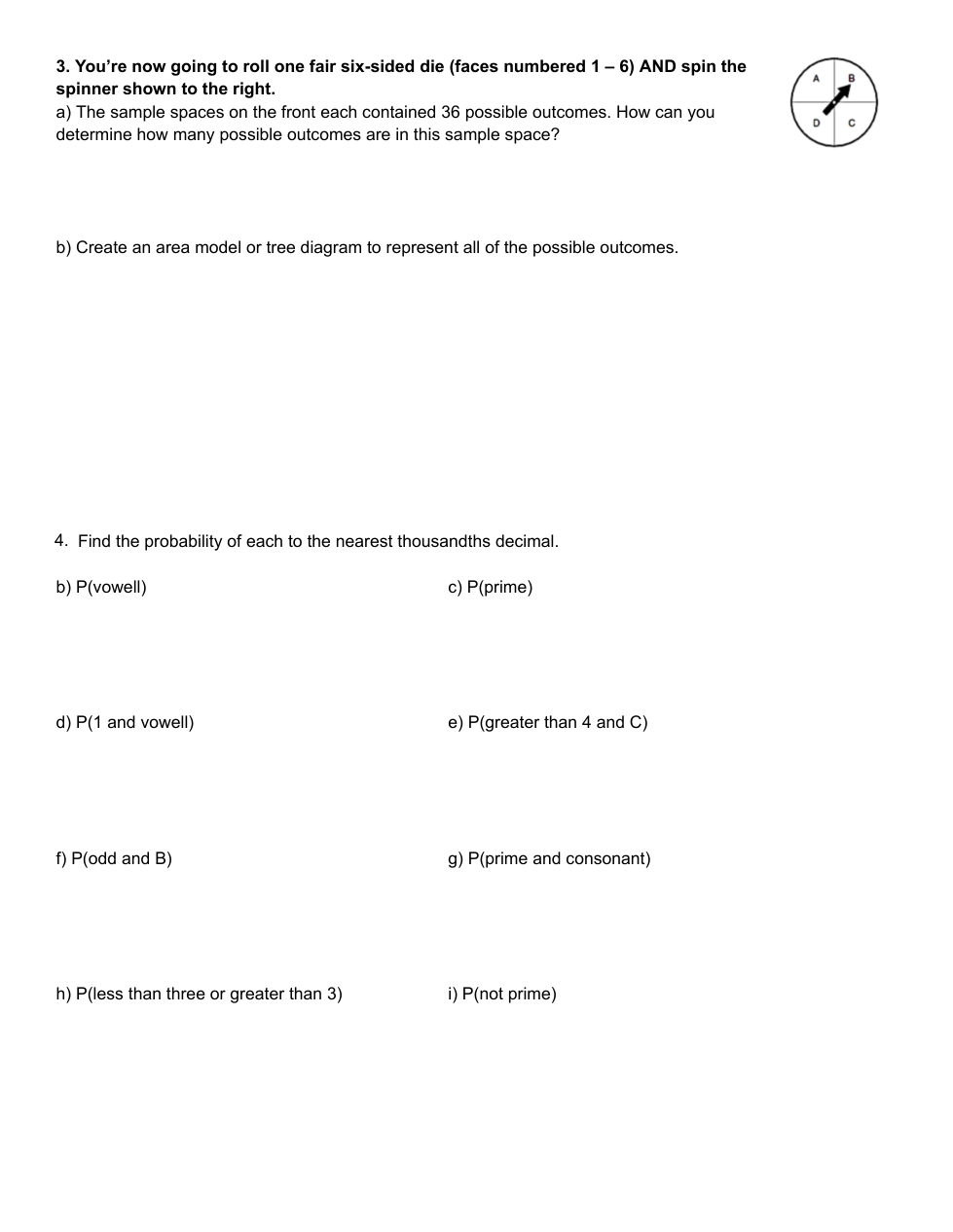
3 You’re now going to roll one fair six-sided die (faces numbered 1 – 6) AND spin the spinner shown to the right.
a) The sample spaces on the front each contained 36 possible outcomes. How can you determine how many possible outcomes are in this sample space?
3b. Create an area model or tree diagram to represent all of the possible outcomes.
3. Find the probability of each using the fair six-sided die and spinner above to the nearest thousandths decimal. *The number 1 is not considered a prime number.
c1) P(vowell)
3. Find the probability of each using the fair six-sided die and spinner above to the nearest thousandths decimal. *The number 1 is not considered a prime number.
c2) P(prime)
3. Find the probability of each using the fair six-sided die and spinner above to the nearest thousandths decimal. *The number 1 is not considered a prime number.
c3) P(1 and vowell)
3. Find the probability of each using the fair six-sided die and spinner above to the nearest thousandths decimal. *The number 1 is not considered a prime number.
c4) P(greater than 4 and C)
3. Find the probability of each using the fair six-sided die and spinner above to the nearest thousandths decimal. *The number 1 is not considered a prime number.
c5) P(odd and B)
3. Find the probability of each using the fair six-sided die and spinner above to the nearest thousandths decimal. *The number 1 is not considered a prime number.
c6) P(prime and consonant)
3. Find the probability of each using the fair six-sided die and spinner above to the nearest thousandths decimal. *The number 1 is not considered a prime number.
c7) P(less than three or greater than 3)
3. Find the probability of each using the fair six-sided die and spinner above to the nearest thousandths decimal. *The number 1 is not considered a prime number.
c8) P(not prime)