AA Studies WARM-UP (4/6)
star
star
star
star
star
Last updated 2 months ago
1 Asɛmmisa
Ɛhia
1
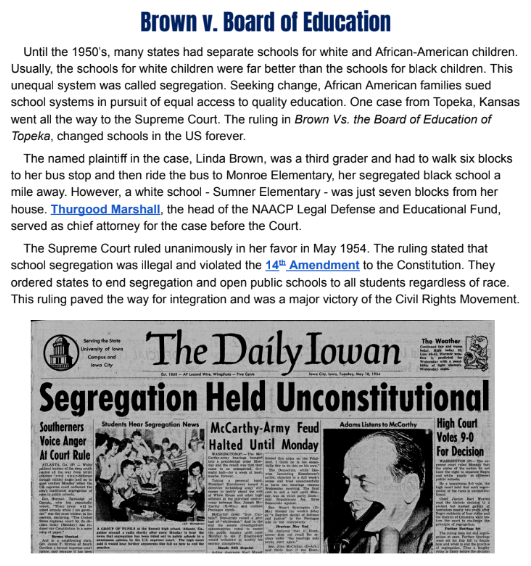
After the Brown v. Board of Education decision, some school districts moved quickly to desegregate. Many politicians in the South, however, united to oppose school desegregation in their states. Senator James Eastland of Mississippi said that "the South would not abide by, or obey," the Brown v. Board of Education decision. Senator Harry Byrd of Virginia called for "massive resistance" to the order to desegregate public schools. In 1956, over one hundred Southern members of Congress signed what they called the Southern Manifesto, which expressed support for states who opposed the Brown decision by "lawful means."
Many Southerners saw the Brown decision as an attack on the entire system of segregation in the South. While politicians and school boards passed laws and ordinances to avoid complying with the decision, groups of white residents organized to pressure African American people who promoted desegregation and civil rights:
The Ku KluxKlan, which had been active after the Civil War and in the 1920s, was revived by white supremacists in the 1950s to oppose African American equality. The Klan, which was primarily composed of lower- and middle-class white people, increased its activities after the Brown decision by using violence to intimidate desegregation activists through mob attacks, lynchings, and acts of terror, such as cross-burning.
White Citizens' Councils (WCC), which formed after the Brown decision, consisted mainly of well-educated professionals, such as lawyers, bankers, and business owners, who organized to oppose desegregation. WCCs intimidated African American activists who promoted desegregation by threatening to fire them from jobs or deny them loans from banks.
According to the above information, which of the following was true about backlash against the Brown decision in the 1950s? Select all that apply.
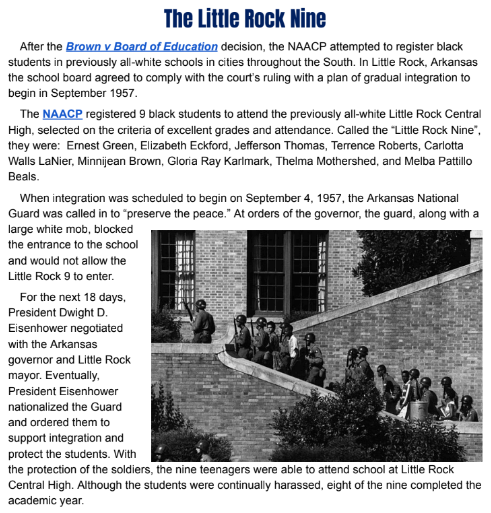
What happened to the Little Rock Nine?
The nine students who desegregated Central High School faced constant harassment from their classmates. They were verbally and physically attacked in the hallways, classrooms, and bathrooms. One student, Minnijean Brown, was expelled after she cursed at a girl who had hit her with a purse. The other eight students finished the year at Central High, and the one senior graduated. The next year, the city closed all high schools to prevent further desegregation.