Sustainable Development Goals: Life on Land
The Sustainable Development Goals Report 2023
Special Edition provides a powerful call to action, presenting a candid assessment of the SDGs based on the latest data and estimates. While highlighting the existing gaps and urging the world to redouble its efforts, the report also emphasizes the immense potential for success through strong political will and the utilization of available technologies, resources, and knowledge. Together, the global community can reignite progress towards achieving the SDGs and create a brighter future for all.
According to the report, the impacts of the climate crisis, the war in Ukraine, a weak global economy, and the lingering effects of the COVID-19 pandemic have revealed weaknesses and hindered progress towards the Goals. The report further warns that while lack of progress is universal, it is the world’s poorest and most vulnerable who are experiencing the worst effects of these unprecedented global challenges. It also points out areas that need urgent action to rescue the SDGs and deliver meaningful progress for people and the planet by 2030.
About this Report
The Sustainable Development Goals Report 2023: Special Edition is the only UN official report that monitors global progress on the 2030 Agenda for Sustainable Development. Using the latest available data and estimates, the report provides a comprehensive midpoint assessment of the 2030 Agenda, highlighting not only impacts of multiple crises affecting people's lives and livelihoods, but also areas of progress where acceleration is needed. This annual SDG Report is prepared by UN DESA, in collaboration with the entire UN Statistical System, consisting of more than 50 international and regional agencies, based on data from over 200 countries and territories.
GOAL 15 - Life on Land
Global trends underscore persistent challenges to biodiversity and forests, despite their critical roles as planetary life-support systems. Global forest area continues to decline, primarily due to agricultural expansion, despite notable progress in sustainable forest management. Alarmingly, species are silently becoming extinct, the protection of key biodiversity areas has stalled and global illicit wildlife trafficking has steadily increased, posing serious threats to biodiversity and the benefits it provides to people.
Efforts are under way to tackle these challenges, with countries advancing implementation of access and benefit-sharing instruments and integrating biodiversity values into national accounting systems. There’s also a growing global commitment to biodiversity conservation, reflected in increased funding and the adoption of the Kunming-Montreal Global Biodiversity Framework.
Urgent action is imperative. Addressing pressing environmental challenges and their underlying drivers and interconnections – including climate change, biodiversity loss, pollution, desertification and deforestation – demands intensified, accelerated efforts, and a comprehensive and integrated approach at local, national and global levels.
Reducing deforestation depends on improving food security, income and land rights
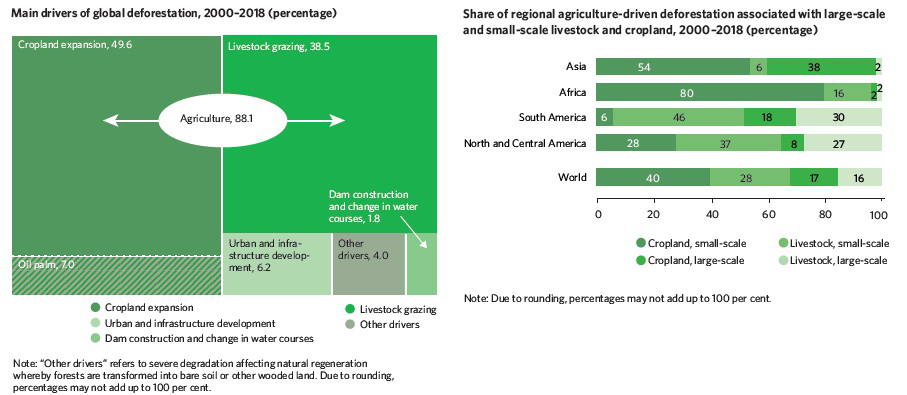
Between 2000 and 2020, the proportion of forest cover decreased from 31.9 to 31.2 per cent of total land area, resulting in net forest area losses of nearly 100 million hectares. Agricultural expansion drove almost 90 per cent of global deforestation; cropland accounted for 49.6 per cent and livestock grazing for 38.5 per cent. Globally, small-scale farming caused 68 per cent of agriculture-driven deforestation, while large-scale farming contributed to 32 per cent. In Africa, small-scale farming was responsible for 97 per cent of agriculture-driven deforestation. Forest losses due to large-scale farming were highest in South America at 48 per cent (mainly linked to livestock grazing), followed by Asia at 38 per cent (primarily due to large-scale crop production, particularly for oil palm plantations).
These findings suggest that efforts to reduce deforestation must tackle production system weaknesses while addressing critical needs such as food security, income and land tenure rights for local communities. Stemming deforestation also demands a comprehensive approach blending regulatory measures, market incentives and stakeholder collaboration to promote sustainable land management and preserve forest ecosystems.
Figure 1.
Risks to species continue to escalate globally
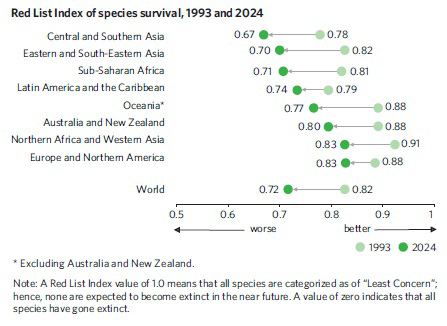
Global biodiversity faces ongoing threats, evidenced by a 12 per cent deterioration in the Red List Index between 1993 and 2024. Over 44,000 species, or 28 per cent of almost 160,000 assessed species, are currently threatened. They include 70 per cent of cycads and 41 per cent of amphibians. The latter are particularly impacted by climate change, habitat conversion and invasive fungal disease. For example, Buckley’s glass frog, assessed as Critically Endangered and found only in the Ecuadorian Andes, faces increased extinction risk due to habitat loss from expanding agriculture and livestock grazing, fungal disease and climate change. Regionally, severe biodiversity declines across all species groups are evident in Central and Southern Asia as well as in Eastern and South-Eastern Asia. Stopping the ongoing decline in biodiversity is an urgent race against time, making accelerated conservation efforts imperative to safeguard the irreplaceable and intricate web of life on the planet.
Figure 2.
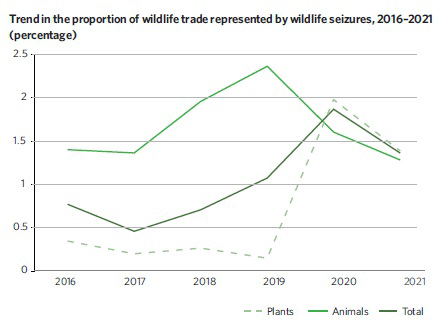
The share of illegally traded wildlife has been on the rise since 2017 peaking during the COVID-19 pandemic
Illegal wildlife trade persists worldwide despite two decades of concerted action at international and national levels and poses a significant threat to global biodiversity, endangering a wide range of terrestrial and marine species. Illegal trade has affected around 4,000 plant and animal species in 162 countries and territories from 2015 to 2021. This exploitation jeopardizes the survival of species and undermines ecosystem functions, especially when compounded by other pressures, such as habitat loss and climate change.
Recent estimates indicate that the intercepted illegal wildlife trade as a proportion of all wildlife trade (legal and illegal) has been on the rise since 2017, peaking during the COVID-19 pandemic. Wildlife seizures comprised over 1.9 and 1.4 per cent of global wildlife trade in 2020 and 2021, respectively. Trends likely reflect a disproportionate reduction in legal trade during the pandemic and an increase in enforcement efforts for certain wildlife commodities. For instance, more wildlife seizures were primarily attributed to new regulations targeting high-value timber species from South America, alongside intensified enforcement actions.
Figure 3.
Detrimental land cover changes are impacting mountain ecosystems
Between 2015 and 2019, at least 100 million hectares of productive land were degraded annually, adversely impacting global food and water security. This degradation, driven by changes in land use and coverage, significantly contributes to biodiversity loss, including in fragile mountain ecosystems. The widespread transformation of mountain ecosystems is due to various natural and human-induced factors, such as climate change, natural hazards, unplanned agriculture and urbanization, timber extraction and recreation. Globally, only about a third of mountain key biodiversity areas are safeguarded by protected areas or other effective area-based conservation measures.
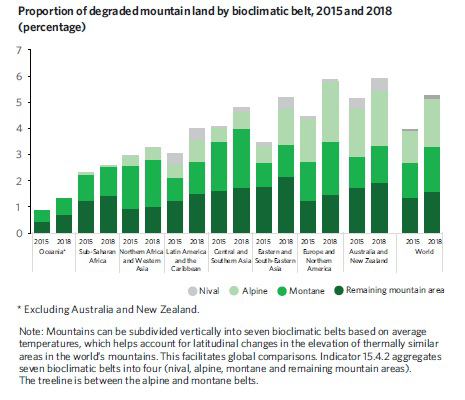
Global data from 2000 to 2018 indicate that degradation affects about 1.6 per cent of the world’s mountainous areas. The highest proportion of degraded mountain land is in the alpine areas of Europe and Northern America
(2.29 per cent), followed by the montane areas of Central and Southern Asia (2.22 per cent) and the lower mountain belts of Eastern and South-Eastern Asia (2.17 per cent). Mountain ecosystem degradation threatens downstream water provision, through reduced glacial coverage, as well as biodiversity and other ecosystem services, thereby undermining efforts to protect terrestrial and freshwater ecosystems. Furthermore, diminished forest and vegetation coverage increase soil erosion, heightening the risk of downstream landslides and flooding.
Figure 4.