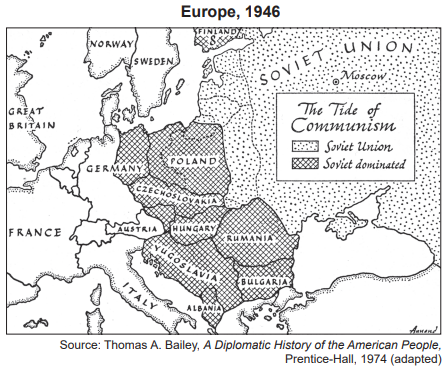
 What was the United States' response to the situation shown on this map?
What was the United States' response to the situation shown on this map?
What was the United States' response to the situation shown on this map?
"...I have here in my hand a list of 205 - a list of names that were made known to the Secretary of State as being members of the Communist Party and who nevertheless are still working and shaping policy in the State Department..."
Source: Joseph McCarthy, Address in Wheeling, West Virginia, February 9, 1950
This quote is an example of...
... I believe that it must be the policy of the United States to support free peoples who are resisting attempted subjugation [domination] by armed minorities or by outside pressures.
I believe that we must assist free peoples to work out their own destinies in their own way. I believe that our help should be primarily through economic and financial aid which is essential to economic stability and orderly political processes. . . .
The seeds of totalitarian regimes are nurtured by misery and want. They spread and grow in the evil soil of poverty and strife. They reach their full growth when the hope of a people for a better life has died. We must keep that hope alive.
The free peoples of the world look to us for support in maintaining their freedoms.
If we falter in our leadership, we may endanger the peace of the world— and we shall surely endanger the welfare of this Nation.
Great responsibilities have been placed upon us by the swift movement of events. I am confident that the Congress will face these responsibilities squarely.
Source: President Harry S. Truman, Message to Congress, March 12, 1947
President Harry Truman made this statement in response to...
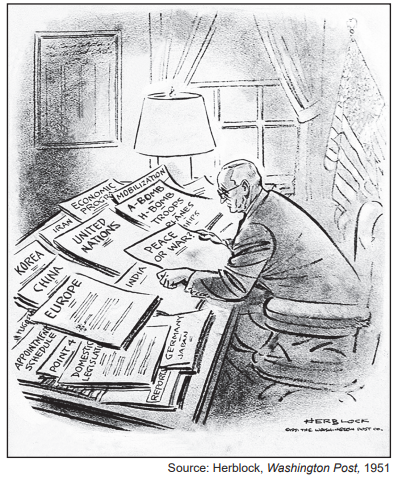 What is causing the problems faced by Truman in this cartoon?
In [South] Korea the Government forces, which were armed to prevent border raids and to preserve internal security, were attacked by invading forces from North Korea. The Security Council of the United Nations called upon the invading troops to cease hostilities and to withdraw to the 38th parallel. This they have not done, but on the contrary have pressed the attack. The Security Council called upon all members of the United Nations to render every assistance to the United Nations in the execution of this resolution. In these circumstances I have ordered United States air and sea forces to give the Korean Government troops cover and support.
The attack upon Korea makes it plain beyond all doubt that Communism has passed beyond the use of subversion to conquer independent nations and will now use armed invasion and war. It has defied the orders of the Security Council of the United Nations issued to preserve international peace and security. In these circumstances, the occupation of Formosa [Taiwan] by Communist forces would be a direct threat to the security of the Pacific area and to United States forces performing their lawful and necessary functions in that area. . . .
I know that all members of the United Nations will consider carefully the consequences of this latest aggression in Korea in defiance of the Charter of the United Nations. A return to the rule of force in international affairs would have far-reaching effects. The United States will continue to uphold the rule of law. . . .
Source: President Truman, statement on the situation in Korea, June 27, 1950
What was a major reason for President Harry Truman's June 27, 1950 statement?
. . . It is logical that the United States should do whatever it is able to do to assist in the return of normal economic health in the world, without which there can be no political stability and no assured peace. Our policy is directed not against any country or doctrine but against hunger, poverty, desperation and chaos. Its purpose should be the revival of a working economy in the world so as to permit the emergence of political and social conditions in which free institutions can exist. Such assistance, I am convinced, must not be on a piece-meal basis as various crises develop. Any assistance that this Government may render in the future should provide a cure rather than a mere palliative [relief]. Any government that is willing to assist in the task of recovery will find full cooperation, I am sure, on the part of the United States Government. Any government which maneuvers to block the recovery of other countries cannot expect help from us. Furthermore, governments, political parties or groups which seek to perpetuate human misery in order to profit therefrom politically or otherwise will encounter the opposition of the United States. . . .
Source: Secretary of State George C. Marshall, Harvard University, June 1947
Which foreign policy supported the goals expressed in this passage?
. . . Those of us who shout the loudest about Americanism in making character assassinations are all too frequently those who, by our own words and acts, ignore some of the basic principles of Americanism:
The right to criticize.
The right to hold unpopular beliefs.
The right to protest.
The right of independent thought.
The exercise of these rights should not cost one single American citizen his reputation or his right to a livelihood nor should he be in danger of losing his reputation or livelihood merely because he happens to know someone who holds unpopular beliefs. Who of us does not? Otherwise none of us could call our souls our own. Otherwise thought control would have set in.
The American people are sick and tired of being afraid to speak their minds lest they be politically smeared as “Communists” or “Fascists” by their opponents. Freedom of speech is not what it used to be in America. It has been so abused by some that it is not exercised by others. . . .
Source: Senator Margaret Chase Smith, Declaration of Conscience Speech, June 1, 1950
In this passage, Senator Smith argues that those who question an individual's loyalty to the United States should be reminded that...
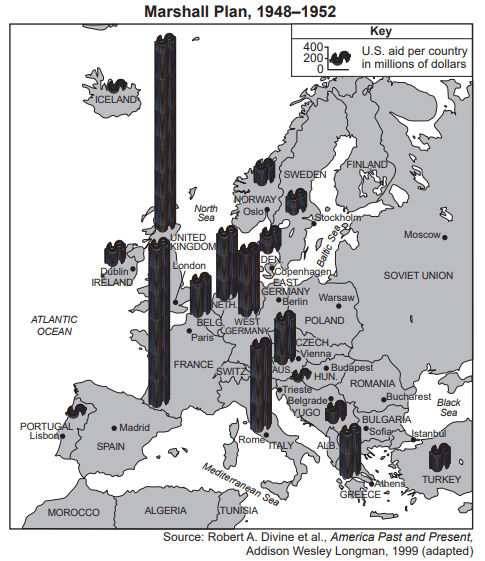
One major goal of the Marshall Plan was to...
Which of the following best explains the goals of the United States in the early years of the Cold War?
Which of the following is a factor that led to increased tensions between the United States and Soviet Union?
How did the CIA support the U.S. policy of containment?
NATO was formed primarily as a _____________ alliance
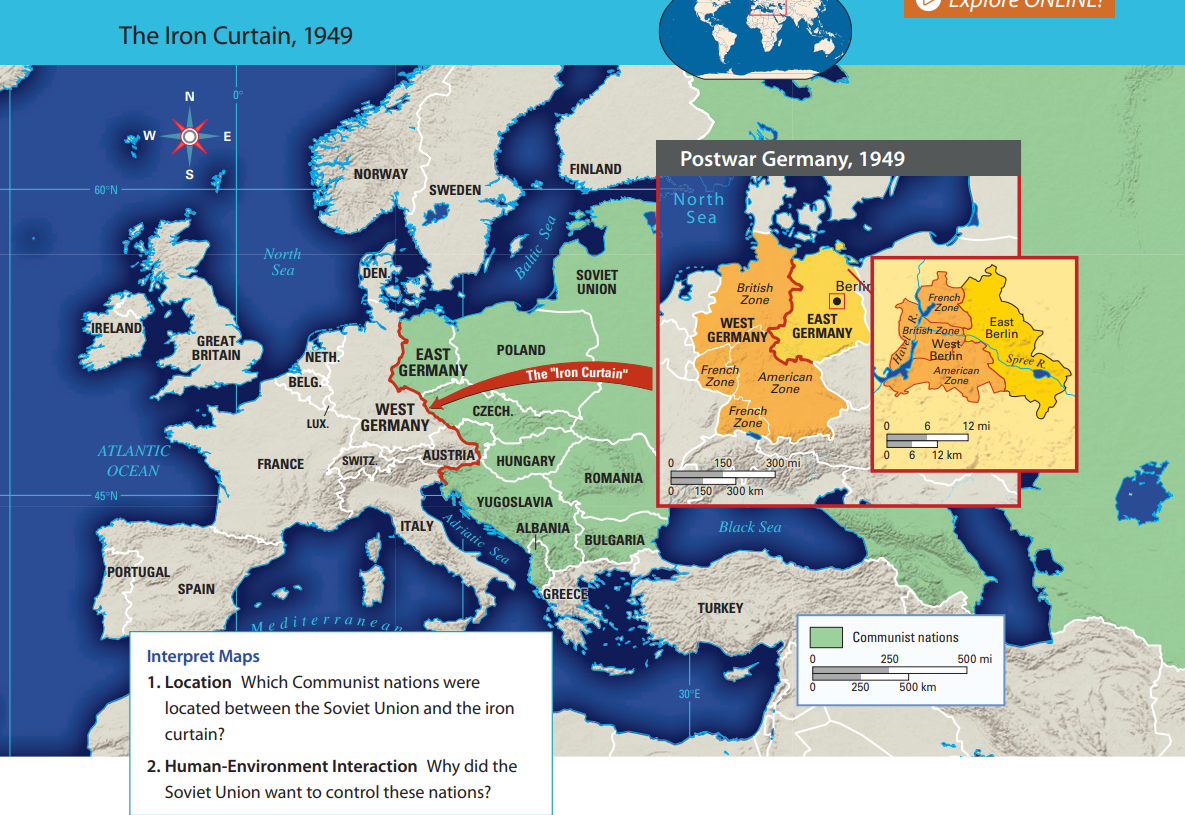 Poland, Czechoslovakia, Hungary, and Romania are examples of…
The "iron curtain" was...
Countries on the Eastern side of the "iron curtain" were…
The United Nations was created to…
Why was the UN ineffective
The Truman Doctrine and Marshall Plan are two methods the United States used to pursue its policy of...
Why did the United States support Chiang Kai-Shek's nationalist movement in China, despite his brutality against his own citizens?
In May 1949 Chiang and the remnants of his demoralized government fled to the island of Taiwan, which Westerners called Formosa. There, about 100 miles from the Chinese mainland, the United States helped set up a Nationalist government – the Republic of China. From 1949 through the 1960s, the United States poured millions of dollars of aid into the Taiwanese economy. However, Chiang had not attained his goal. After more than 20 years of struggle, the Communists ruled all of mainland China. They established a new government, the People's Republic of China, which the United States refused to accept as China's true government.
Based on this paragraph, it can be concluded that...
North Korea was backed by China and the Soviet Union. With this in mind, the North Korean government was most likely...
What issue between General Douglas MacArthur and President Truman ultimately cost MacArthur his job?
The Korean War ended with...
"The Cold War was an ideological conflict between American democracy and Soviet communism."
In this context, ideological most nearly means...
What was the widespread fear of Communism called?
The Red Scare can best be described as...
How was the fear of communist influence reflected in government policy?
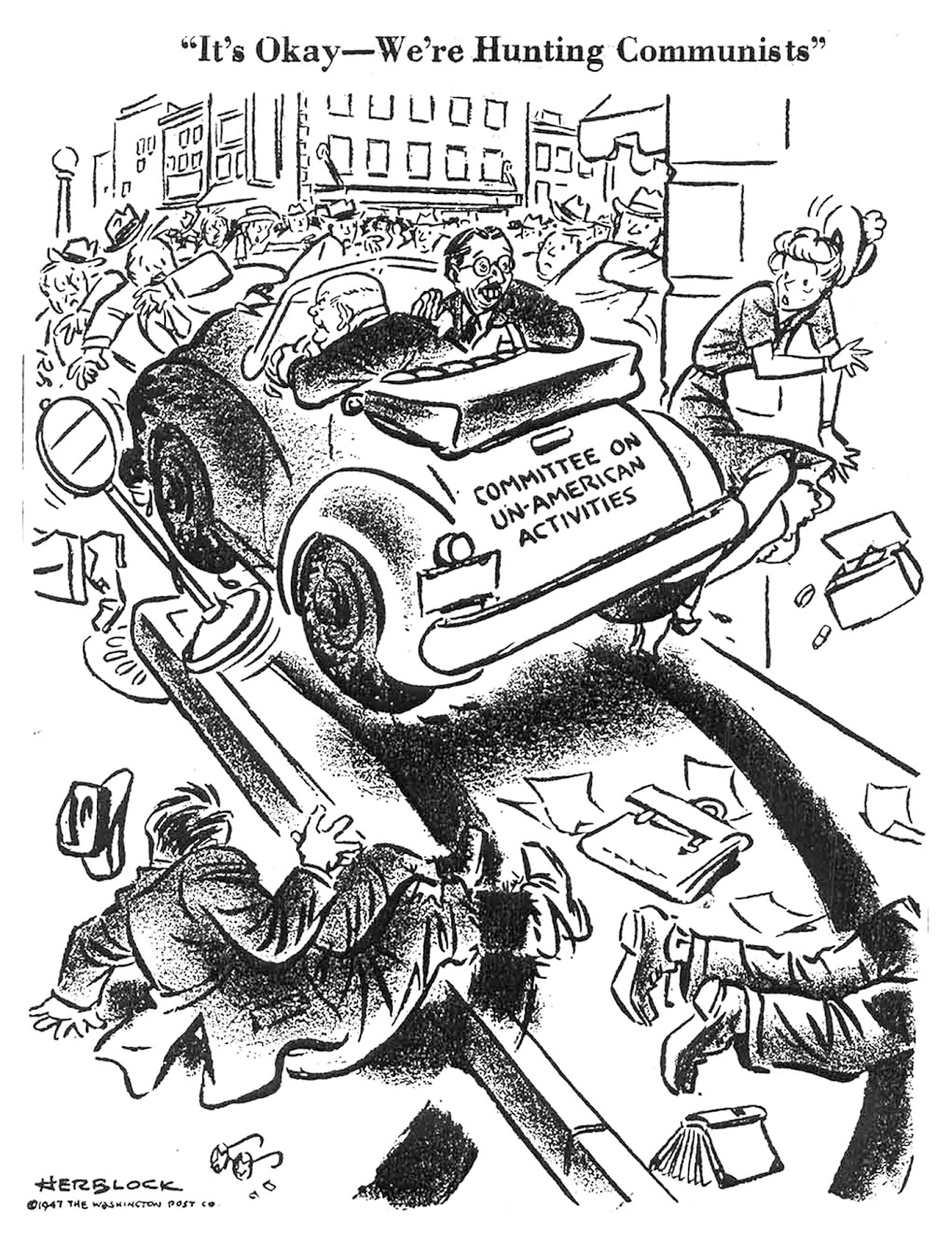
Which of the following best explains the message of this cartoon?
HARRY TRUMAN'S VETO OF THE MCCARRAN ACT
The basic error of these sections is that they move in the direction of suppressing opinion and belief. This would be a very dangerous course to take, not because we have any sympathy for communist opinions, but because any governmental stifling of the free expression of opinion is a long step toward totalitarianism.
There is no more fundamental axiom of American freedom than the familiar statement: In a free country, we punish men for the crimes they commit, but never for the opinions they have. And the reason this is so fundamental to freedom is not, as many suppose, that it protects the few unorthodox from suppression by the majority. To permit freedom of expression is primarily for the benefit of the majority, because it protects criticism, and criticism leads to progress.
We can and we will prevent espionage, sabotage, or other actions endangering our national security. But we would betray our finest traditions if we attempted, as this bill would attempt, to curb the simple expression of opinion. This we should never do, no matter how distasteful the opinion may be to the vast majority of our people. The course proposed by this bill would delight the communists, for it would make a mockery of the Bill of Rights and of our claims to stand for freedom in the world.
HARRY S. TRUMAN
Which of the following most accurately summarizes this message?
HARRY TRUMAN'S VETO OF THE MCCARRAN ACT
The basic error of these sections is that they move in the direction of suppressing opinion and belief. This would be a very dangerous course to take, not because we have any sympathy for communist opinions, but because any governmental stifling of the free expression of opinion is a long step toward totalitarianism.
There is no more fundamental axiom of American freedom than the familiar statement: In a free country, we punish men for the crimes they commit, but never for the opinions they have. And the reason this is so fundamental to freedom is not, as many suppose, that it protects the few unorthodox from suppression by the majority. To permit freedom of expression is primarily for the benefit of the majority, because it protects criticism, and criticism leads to progress.
We can and we will prevent espionage, sabotage, or other actions endangering our national security. But we would betray our finest traditions if we attempted, as this bill would attempt, to curb the simple expression of opinion. This we should never do, no matter how distasteful the opinion may be to the vast majority of our people. The course proposed by this bill would delight the communists, for it would make a mockery of the Bill of Rights and of our claims to stand for freedom in the world.
HARRY S. TRUMAN
Despite Harry Truman's veto message, Congress passed the McCarran Act. The veto message, then, could be represented by which of the following parts of the "It's Okay -- We're Hunting Communists" cartoon?
What effect did HUAC have on the film industry?
What was the ultimate fate of Julius and Ethel Rosenberg?
Americans reacted to a fear of Communism in all of the following ways EXCEPT?
The unfair tactic of accusing people of disloyalty without providing evidence
Why did Senator Joseph McCarthy accuse people of disloyalty without actually providing any evidence?
Which of the following was a major factor in the arms race?
The arms race resulted in U.S.-Soviet relations being based upon the principle of...
The willingness of the United States under President Eisenhower to go to the edge of all-out war became known as...
"This conjunction of an immense military establishment and a large arms industry is new in the American experience. The total influence—economic, political, and even spiritual—is felt in every city, every statehouse, and every office of the federal government. We recognize the imperative need for this development. Yet we must not fail to comprehend its grave implications .... The potential for the disastrous rise of misplaced power exists and will persist."
-Dwight D. Eisenhower, from his Farewell Address, January 17, 1961
In his farewell address, President Eisenhower warns against the dangers of...
Which of the following best explains the purpose of the Warsaw Pact?
The Eisenhower Doctrine said that the United States would defend the Middle East against an attack by any Communist country. It was issued in January of 1957 in response to which crisis?
Which of the following best describes the Soviet response to the Hungarian Uprising?
Which of the following events worsened U.S.-Soviet relations just before a 1960 summit conference?
Which United States foreign policy is supported by Truman's message to Congress?
Secretary of State George C. Marshall's plan was a response to the...
This 1950 "Declaration of Conscience" speech by Senator Smith was written in response to...