Sustainable Development Goals: No Poverty
The Sustainable Development Goals Report 2023
Special Edition provides a powerful call to action, presenting a candid assessment of the SDGs based on the latest data and estimates. While highlighting the existing gaps and urging the world to redouble its efforts, the report also emphasizes the immense potential for success through strong political will and the utilization of available technologies, resources, and knowledge. Together, the global community can reignite progress towards achieving the SDGs and create a brighter future for all.
According to the report, the impacts of the climate crisis, the war in Ukraine, a weak global economy, and the lingering effects of the COVID-19 pandemic have revealed weaknesses and hindered progress towards the Goals. The report further warns that while lack of progress is universal, it is the world’s poorest and most vulnerable who are experiencing the worst effects of these unprecedented global challenges. It also points out areas that need urgent action to rescue the SDGs and deliver meaningful progress for people and the planet by 2030.
About this Report
The Sustainable Development Goals Report 2023: Special Edition is the only UN official report that monitors global progress on the 2030 Agenda for Sustainable Development. Using the latest available data and estimates, the report provides a comprehensive midpoint assessment of the 2030 Agenda, highlighting not only impacts of multiple crises affecting people's lives and livelihoods, but also areas of progress where acceleration is needed. This annual SDG Report is prepared by UN DESA, in collaboration with the entire UN Statistical System, consisting of more than 50 international and regional agencies, based on data from over 200 countries and territories.
GOAL 1 - No Poverty
The COVID-19 pandemic and subsequent shocks from 2020 to 2022 have hampered global efforts to eradicate extreme poverty. The global extreme poverty rate increased in 2020 for the first time in decades, setting back progress by three years. Since then, recovery has been uneven, with low-income countries lagging behind. By 2030, 590 million people may still live in extreme poverty if current trends persist. Without a substantial acceleration in poverty reduction, fewer than 3 in 10 countries are expected to halve national poverty by 2030. Despite increasing efforts and commitments to expand social protection programmes, significant coverage gaps left 1.4 billion children uncovered in 2023.
Climate change is hindering poverty reduction, and disasters result in millions of households becoming poor or remaining trapped in poverty.
Ending poverty requires a wide-ranging approach that combines comprehensive social protection systems, inclusive economic policies,
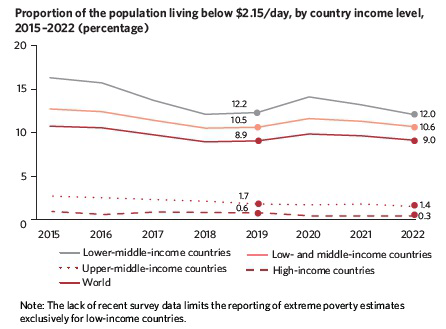
Extreme poverty rates have returned to pre-pandemic levels except in low-income countries
The COVID-19 pandemic caused extreme poverty to rise in 2020 for the first time in decades, reversing global progress by three years. The share of the world’s population living in extreme poverty rose from 8.9 per cent in 2019 to 9.7 per cent in 2020, driven by increases in low- and lower-middle-income countries. In contrast, extreme poverty continue to decline in upper-middle- and high-income countries, attributed to swift fiscal support for vulnerable groups. By 2022, extreme poverty had returned to pre-pandemic levels in most countries, except low-income ones. In 2022, 712 million people (or 9 per cent of the world’s population) lived in extreme poverty, an increase of 23 million people over 2019. Projections suggest that by 2030, 590 million people, or 6.9 per cent of the global population, may remain in extreme poverty if current trends persist.
In the 75 most vulnerable countries, which qualify for concessional lending from the World Bank’s International Development Association, one in four people live on less than $2.15$ a day – more than eight times the extreme poverty rate in the rest of the world. One in three of these countries are now poorer on average than before the pandemic.
Figure 1.
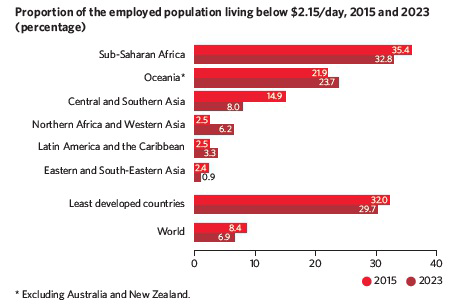
Working poverty has declined but still afflicts 241 million workers
The global working poverty rate slightly increased to 7.7 per cent in 2020 before declining to 6.9 per cent in 2023. This indicates a consistent downward trend in working poverty worldwide since 2015. Despite progress, nearly 241 million workers globally still lived in extreme poverty in 2023. Little positive change is expected in 2024.
There are wide regional disparities amid the overall positive global trend. Despite a falling working poverty rate, more than half of workers living in extreme poverty were still in sub-Saharan Africa (145 million). Central and Southern Asia notably reduced working poverty by 6.9 percentage points between 2015 and 2023. Conversely, Northern Africa and Western Asia saw an increase in the rate from 2.5 per cent in 2015 to 6.2 per cent in 2023.
Working poverty disproportionately affects some groups. Globally, youth are twice as likely as adults to be in working poverty. Women typically experience higher working poverty rates than men, with the most pronounced gender gap observed in the least developed countries (LDCs).
Figure 2.
Despite improvement, 7 in 10 children worldwide still lack social protection coverage
In 2023, only 28.2 per cent of children aged 0 to 15 globally received child cash benefits, up from 22.1 per cent in 2015. This left 1.4 billion children without social protection coverage. Significant regional variations were evident, and despite a near doubling of coverage from 4.5 per cent in 2015 to 8.7 per cent in 2023, low-income countries were still far from universal coverage. During the same period, lower-middle-income and upper-middle-income countries raised coverage from 15.0 to 23.5 per cent and from 21.8 to 27.8 per cent, respectively. High-income countries maintained a continued progression towards universal coverage, with rates rising from 76.8 to 80.5 per cent.
Achieving universal coverage will require closing a major financing gap. To guarantee at least basic social security for all children, upper- and lower-middle-income countries would need to invest an additional $98.1$ billion and $88.8$ billion, respectively. Low-income countries would require an additional $59.6$ billion.
Figure 3.
Government spending on essential services is ticking up but with a chronic gap between advanced and developing economies
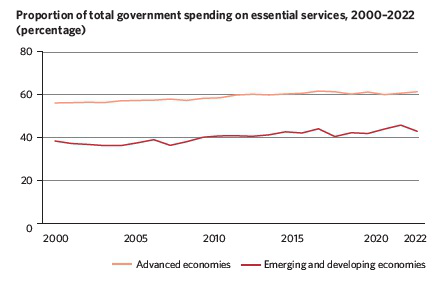
Based on recent data from about 100 countries, worldwide government spending on essential services – encompassing education, health and social protection – averages around 50 per cent of total government expenditure. Among advanced economies, this figure rises to 60 per cent, while in emerging market and developing economies, it stands at 40 per cent. Over the past two decades, both groups have seen a slight uptick in their shares, maintaining a consistent 20-percentage-point gap between them.
On the components of essential services, advanced economies notably outpace emerging market and developing economies in social protection spending by roughly 15 percentage points on average, largely due to broader pension coverage. Health spending accounts for about 5 percentage points of this difference. The pandemic temporarily skewed these trends, with increased spending on social protection and health and a decline in education expenditure due to school closures. While these measures are expected to be short-lived, prolonged health issues and educational losses among individuals could potentially have long-term impacts on human capital.
Figure 4.