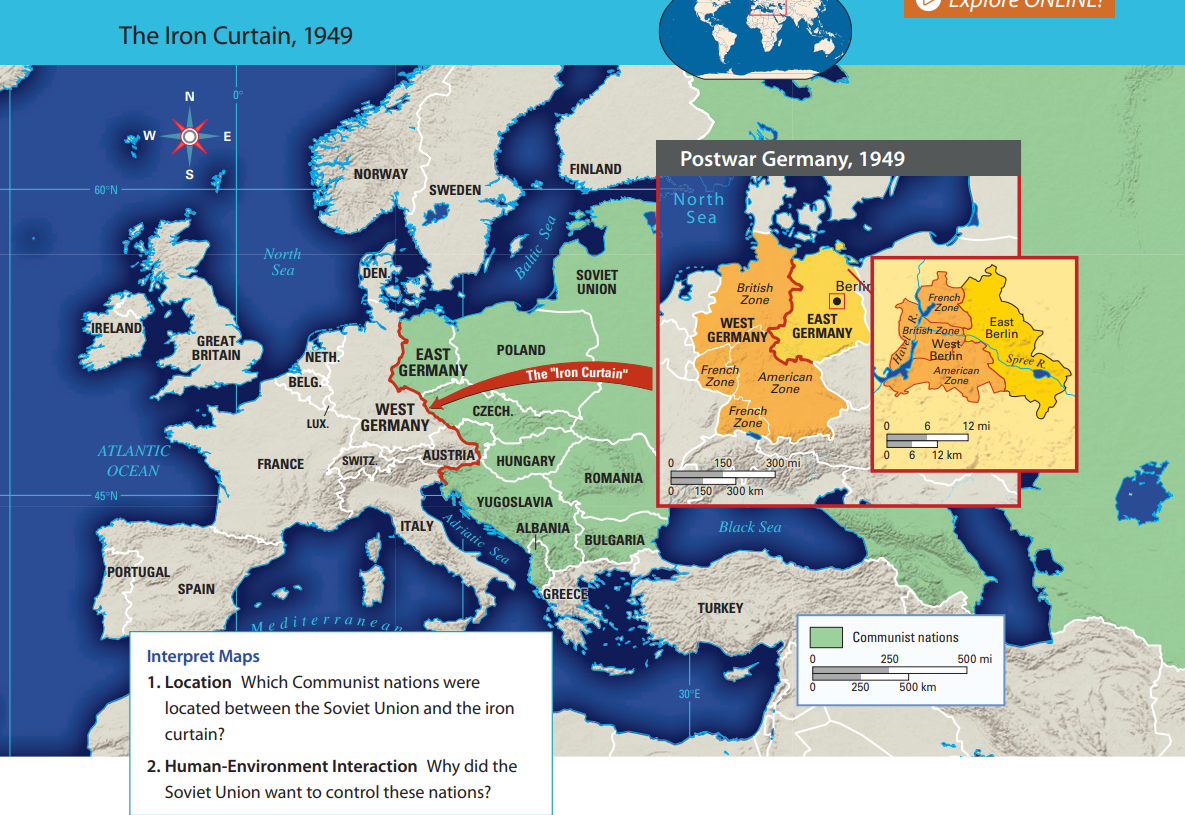
 Poland, Czechoslovakia, Hungary, and Romania are examples of…
Poland, Czechoslovakia, Hungary, and Romania are examples of…
. . . It is logical that the United States should do whatever it is able to do to assist in the return of normal economic health in the world, without which there can be no political stability and no assured peace. Our policy is directed not against any country or doctrine but against hunger, poverty, desperation and chaos. Its purpose should be the revival of a working economy in the world so as to permit the emergence of political and social conditions in which free institutions can exist. Such assistance, I am convinced, must not be on a piece-meal basis as various crises develop. Any assistance that this Government may render in the future should provide a cure rather than a mere palliative [relief]. Any government that is willing to assist in the task of recovery will find full cooperation, I am sure, on the part of the United States Government. Any government which maneuvers to block the recovery of other countries cannot expect help from us. Furthermore, governments, political parties or groups which seek to perpetuate human misery in order to profit therefrom politically or otherwise will encounter the opposition of the United States. . . .
Source: Secretary of State George C. Marshall, Harvard University, June 1947
Which foreign policy supported the goals expressed in this passage?
. . . Those of us who shout the loudest about Americanism in making character assassinations are all too frequently those who, by our own words and acts, ignore some of the basic principles of Americanism:
The right to criticize.
The right to hold unpopular beliefs.
The right to protest.
The right of independent thought.
The exercise of these rights should not cost one single American citizen his reputation or his right to a livelihood nor should he be in danger of losing his reputation or livelihood merely because he happens to know someone who holds unpopular beliefs. Who of us does not? Otherwise none of us could call our souls our own. Otherwise thought control would have set in.
The American people are sick and tired of being afraid to speak their minds lest they be politically smeared as “Communists” or “Fascists” by their opponents. Freedom of speech is not what it used to be in America. It has been so abused by some that it is not exercised by others. . . .
Source: Senator Margaret Chase Smith, Declaration of Conscience Speech, June 1, 1950
In this passage, Senator Smith argues that those who question an individual's loyalty to the United States should be reminded that...
Which of the following best explains the goals of the United States in the early years of the Cold War?
How did the CIA support the U.S. policy of containment?
NATO was formed primarily as a _____________ alliance
Poland, Czechoslovakia, Hungary, and Romania are examples of…
The "iron curtain" was...
Countries on the Eastern side of the "iron curtain" were…
Why was the UN ineffective
Why did the United States support Chiang Kai-Shek's nationalist movement in China, despite his brutality against his own citizens?
North Korea was backed by China and the Soviet Union. With this in mind, the North Korean government was most likely...
The Red Scare can best be described as...
What was the ultimate fate of Julius and Ethel Rosenberg?
Americans reacted to a fear of Communism in all of the following ways EXCEPT?
The arms race resulted in U.S.-Soviet relations being based upon the principle of...
The Eisenhower Doctrine said that the United States would defend the Middle East against an attack by any Communist country. It was issued in January of 1957 in response to which crisis?
Which of the following events worsened U.S.-Soviet relations just before a 1960 summit conference?
HARRY TRUMAN'S VETO OF THE MCCARRAN ACT
The basic error of these sections is that they move in the direction of suppressing opinion and belief. This would be a very dangerous course to take, not because we have any sympathy for communist opinions, but because any governmental stifling of the free expression of opinion is a long step toward totalitarianism.
There is no more fundamental axiom of American freedom than the familiar statement: In a free country, we punish men for the crimes they commit, but never for the opinions they have. And the reason this is so fundamental to freedom is not, as many suppose, that it protects the few unorthodox from suppression by the majority. To permit freedom of expression is primarily for the benefit of the majority, because it protects criticism, and criticism leads to progress.
We can and we will prevent espionage, sabotage, or other actions endangering our national security. But we would betray our finest traditions if we attempted, as this bill would attempt, to curb the simple expression of opinion. This we should never do, no matter how distasteful the opinion may be to the vast majority of our people. The course proposed by this bill would delight the communists, for it would make a mockery of the Bill of Rights and of our claims to stand for freedom in the world.
HARRY S. TRUMAN
Despite Harry Truman's veto message, Congress passed the McCarran Act. The veto message, then, could be represented by which of the following parts of the "It's Okay – We're Hunting Communists" cartoon?
Secretary of State George C. Marshall's plan was a response to the...
This 1950 "Declaration of Conscience" speech by Senator Smith was written in response to...