Big Bang Evidence
The Big Bang Theory
How and when did the universe begin?
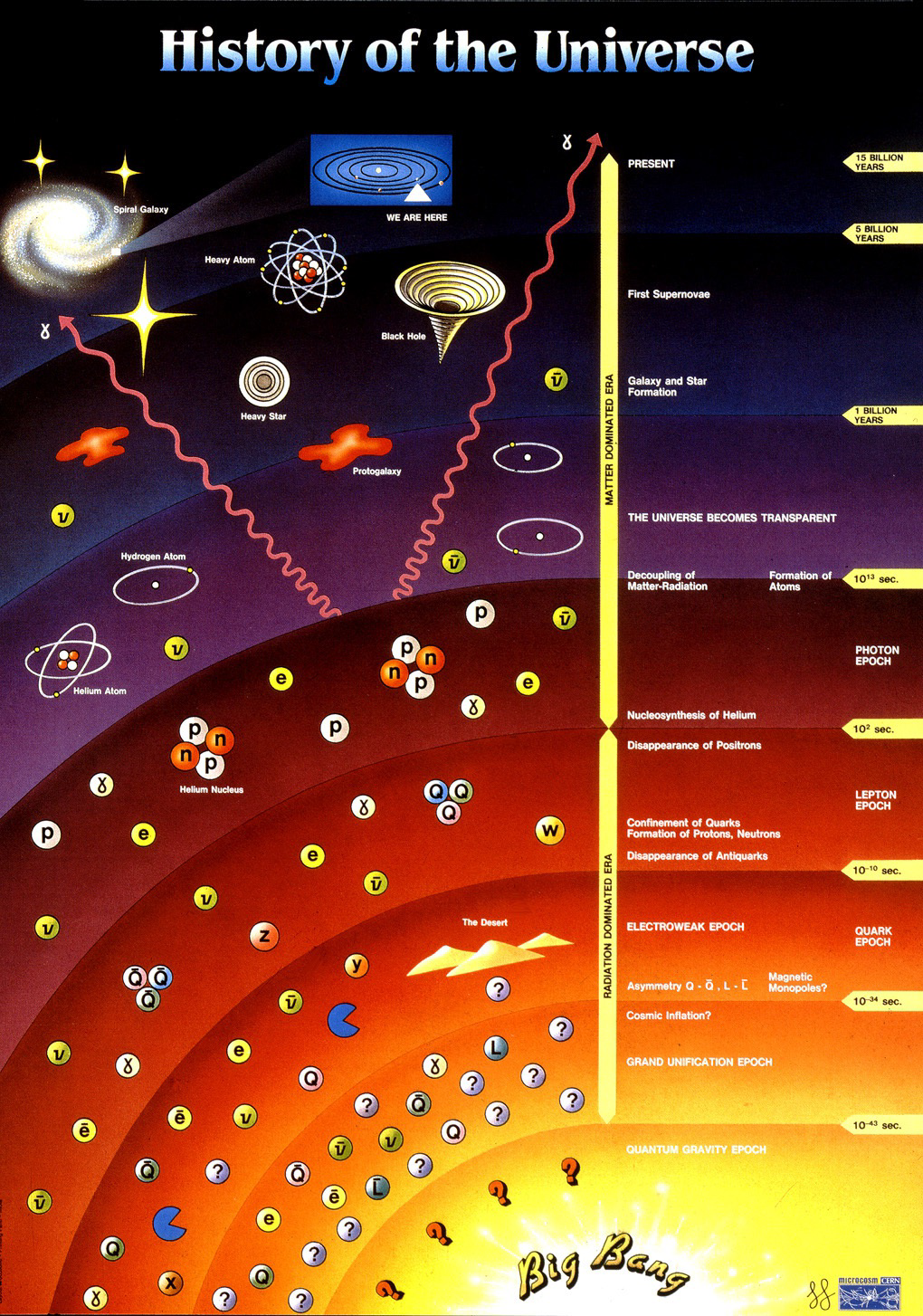
Approximately 13.7 billion years ago, all the matter and energy in the universe were created in an enormous explosion known as the “Big Bang”.
Figure 1.
Source: https://louisville.edu/planetarium/research/implementation/visualization-scripts/high-school/hs-module-1
Evidence, Inference, and Theory
What is the compelling evidence that supports the Big Bang Theory?
Cosmic Background Radiation
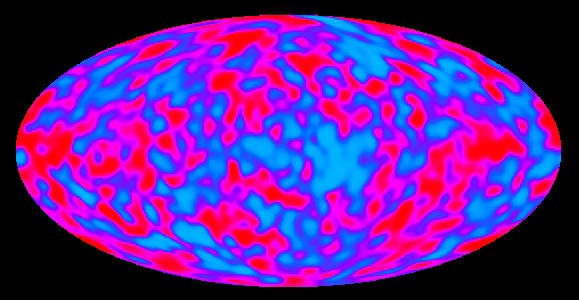
Cosmic Background Radiation (CBR) is the energy released as matter and antimatter annihilated each other, during the Big Bang.
The CBR is a nearly uniform radiation received from all regions of the sky.
The evidence is apparent as a radio signal with a temperature of $2.7\text{ K}$ and is thought to be the cooled afterglow of the Big Bang.
Amazing Fact Alert: $2.7\text{ K}$ doesn’t seem to represent that much energy but in fact the total energy in the CBR is greater than all the energy generated by all the stars in the universe since the formation of galaxies and stars!
The Elemental Composition of the Universe
Using powerful telescopes, scientists have made extensive spectroscopic surveys of distant stars and galaxies. The data indicates that hydrogen and helium make up nearly all of the nuclear matter in the universe. The most abundant element, hydrogen, accounts for 74% of the mass while helium contributes 25%. Heavier elements comprise less than 1% of the total.
The observed 3:1 ratio of hydrogen to helium along with the relative scarcity of heavier elements yield critical clues about the density, temperature, and expansion rate of the early universe. The correlations between these observations and the predictions of the Big Bang model are striking pieces of evidence in support for the theory.
Figure 2.
Doppler Red-Shift Evidence
Figure 3.
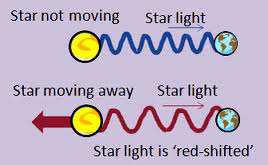
Figure 4.
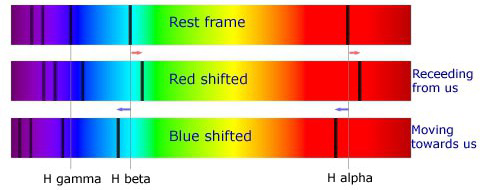
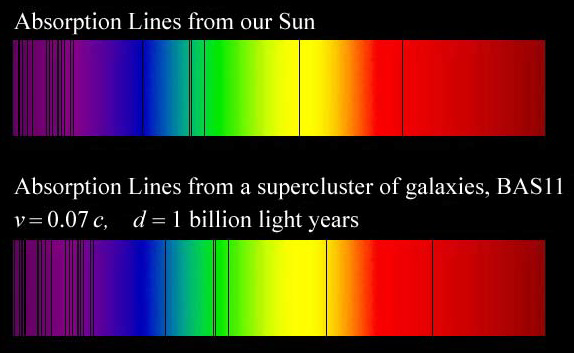
As the light moves away from an object the distance between its waves becomes greater. This is displayed by red light, where the waves are further apart (longer).
The opposite is evidence of blue light, where the waves become compressed as the object moves closer.
When spectroscopic information is processed, an object that displays a red-shift is moving away (receding) from the viewer; and an object that displays a blue-shift is moving towards the viewer.
Figure 5.
Matter vs. Antimatter
In the smallest of fractions of the first second after the Big Bang, what was once a complete vacuum began to evolve into what we now know as the Universe.
In the very beginning there was nothing except for a plasma soup, a single point of infinite energy. Science has devised a theory of what happened, based on inferences determined by the evidence found in the universe of today.
Immediately after the Big Bang, the universe was tremendously hot as a result of particles of matter and antimatter rushing apart in all directions. As it began to cool, at around $10^{-43}$ seconds after the “bang”, there existed an almost equal yet asymmetrical amount of matter and antimatter. As these two materials are created together, they collide and destroy one another creating pure energy. Fortunately, there was an asymmetry in favor of matter. As a direct result of an excess of about one part per billion, the universe was able to mature in a way favorable for matter to persist. As the universe first began to expand, this discrepancy grew larger. The particles which began to dominate were those of matter. They were created and they decayed without an equal creation or decay of antimatter.
As the universe expanded further, and thus cooled, common particles began to form. These particles called baryons that include photons, neutrinos, electrons and quarks. These would become the building blocks of life as we know it. During the baryon genesis period there were no recognizable heavy particles such as protons or neutrons because of the still intense heat. At this moment, there was only a quark soup.
After the universe had cooled to about 3000 billion degrees Kelvin, a radical transition began which has been likened to the phase transition of water turning to ice. Composite particles such as protons and neutrons, called hadrons, became the common state of matter after this transition.
Still, no more of complex matter could form at these temperatures.
Although lighter particles, called leptons, also existed, they were prohibited from reacting with the hadrons to form more complex states of matter. These leptons, which include electrons, neutrinos and photons, would soon be able to join their hadron kin in a union that would define present-day common matter.
After about one to three minutes had passed since the creation of the universe, protons and neutrons began to react with each other to form deuterium, an isotope of hydrogen.
Deuterium, or heavy hydrogen, soon collected another neutron to form tritium. Rapidly following this reaction was the addition of another proton which produced a helium nucleus. Scientists believe that there was one helium nucleus for every ten protons within the first three minutes of the universe.
After further cooling, these excess protons would be able to capture an electron to create common hydrogen. Consequently, the universe today is observed to contain one helium atom for every ten or eleven atoms of hydrogen.
While it is true that much of this information is speculative, as the universe ages we are able to become increasingly confident in our knowledge of its history. By studying the way in which the universe exists today it is possible to learn a great deal about its past. Through finding answers studying the formation of simple atoms in the laboratory we can make some educated guesses as to how they formed originally. Only through further research and discovery will it be possible to completely understand the creation of the universe and its first atomic structures, however, maybe we will never know for sure.