Size and Period of Revolution
Jupiter, Saturn, Uranus and Neptune collectively make up the group known as the jovian planets. The general structures of the jovian planets are opposite those of the terrestrial planets. Rather than having thin atmospheres around relatively large rocky bodies, the jovian planets have relatively small, dense cores surrounded by massive layers of gas. Made almost entirely of hydrogen and helium, these planets do not have solid surfaces.
Figure 1.
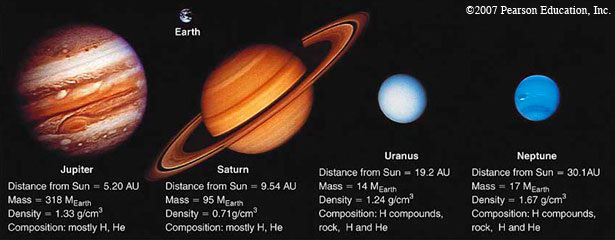
Unlike the spherical shapes of terrestrial planets, the jovian planets are all slightly oblong. The jovian planets rotate much faster than any of the terrestrial worlds. Gravity by itself would make a planet spherical, but their rapid rotation flattens out their spherical shapes by flinging material near the equator outward.
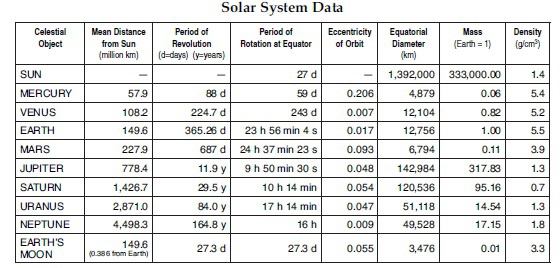
Observations of clouds at different latitudes suggest that the jovian planets rotate at different speeds near their equators than near their poles.
Table 1.
Source:
NYS Earth Science Reference Table, 2011