Sun’s Daily Motion
The Sun's Daily Motion
On any given day, the sun moves through our sky in the same way as a star. It rises somewhere along the eastern horizon and sets somewhere in the west. If you live at a mid-northern latitude (most of North America, Europe, Asia, and northern Africa), you always see the noon sun somewhere in the southern sky.
But as the weeks and months pass, you'll notice that the sun's motion isn't quite the same as that of any star. For one thing, the sun takes a full 24 hours to make a complete circle around the celestial sphere, instead of just 23 hours, 56 minutes. For obvious reasons, we define our day based on the motion of the sun, not the stars. Moreover, the location of the sun's path across the sky varies with the seasons.
Figure 1.
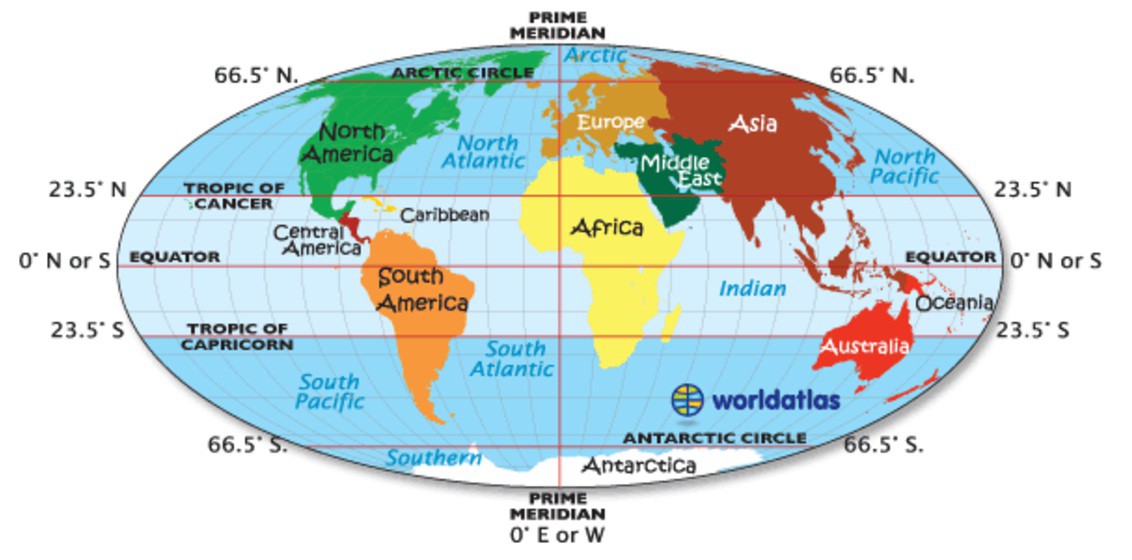 Source: https://www.katrinaaxford.com/the-world-map.html
The sun appears to move along with the celestial sphere on any given day, but follows different circles at different times of the year: most northerly at the June solstice and most southerly at the December solstice. At the equinoxes, the sun's path follows the celestial equator.
You may have noticed two special lines of latitude on a globe of the world: One in the Northern Hemisphere called the Tropic of Cancer at $+23.5^\circ$ latitude and one in the Southern Hemisphere called the Tropic of Capricorn at $-23.5^\circ$ latitude. At these latitudes, the sun is directly overhead around noon on the solstices.