Cyclic Patterns
Constructing an explanation using evidence shows that the phases of the moon, eclipses, tides, and seasons change in a predictable, cyclic manner. The moon's phases result from its orbit around Earth, causing it to appear differently from our viewpoint. Eclipses occur in predictable cycles due to the alignment of the Earth, moon, and sun. Tides follow a regular pattern driven by the gravitational pull of the moon and sun. Seasonal changes are caused by Earth's tilt and orbit around the sun, leading to variations in sunlight and temperature throughout the year. This cyclical behavior is supported by observational evidence and astronomical principles.
Phases of the Moon:
The moon goes through eight distinct phases that repeat in a cyclic pattern. These phases are caused by the changing positions of the Moon, Earth, and Sun relative to each other. As the Moon orbits around Earth, the amount of sunlight that reflects off its surface changes, creating the different phases. The eight phases are: new moon, waxing crescent, first quarter, waxing gibbous, full moon, waning gibbous, third quarter, and waning crescent.
Eclipses:
There are two types of eclipses, solar and lunar, which occur when the Sun, Earth, and Moon are aligned in a specific way. Solar eclipses occur when the Moon passes between the Sun and Earth, blocking the Sun's light and casting a shadow on Earth. Lunar eclipses occur when the Earth passes between the Sun and Moon, casting a shadow on the Moon and causing it to appear red or orange.
Tides:
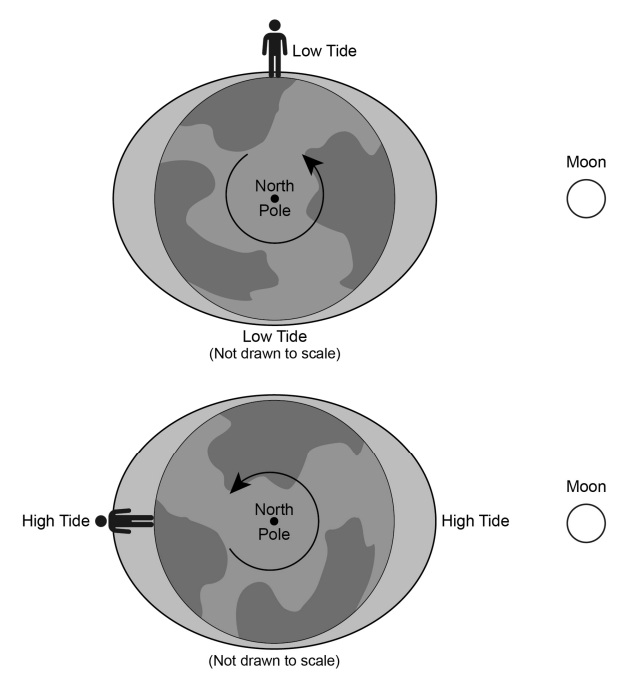
Tides are the rise and fall of Earth's ocean waters caused by the gravitational pull of the Moon and the Sun. The gravitational forces of the Moon and the Sun create a tidal bulge on the side of Earth closest to them, which causes a high tide. The opposite side of Earth experiences a high tide as well due to the centrifugal force created by the Earth's rotation. The areas in between experience a low tide. The tides change cyclically because of the changing positions of the Moon, Earth, and Sun relative to each other.
Seasons:
The changing seasons on Earth are caused by the Earth's tilt on its axis. The Earth's axis is tilted at an angle of 23.5 degrees relative to its orbit around the Sun. This tilt causes the amount of sunlight that reaches different parts of the Earth to vary throughout the year. When a hemisphere is tilted towards the Sun, it receives more direct sunlight and experiences summer. When it is tilted away from the Sun, it receives less direct sunlight and experiences winter. The two solstices occur when the tilt is at its maximum and the equinoxes occur when the tilt is at its minimum.
The Effect of the Moon on Earth:
Earth’s Moon is the only celestial object beyond Earth where humans have set foot. It is the brightest and largest object in the night sky. The Moon makes Earth a more livable planet by moderating the wobble of Earth on its axis, leading to a relatively stable climate. The models below represent two different positions of a person on Earth’s surface six hours apart. The relative height of the ocean tides at these positions are indicated. The arrow represents the direction of Earth’s rotation.
Figure 1.