Distance and Gravitational Pull
Students in a physics class learn about the solar system. They learn that the earliest models of the solar system were geocentric. Geocentric is defined as “having the Earth at the center.” It was believed for many centuries that the Earth has a special position in the solar system. Later models, including the one used today, are heliocentric. Heliocentric is defined as “having the sun as the center”. Today’s heliocentric model was not generally accepted until only about 500 years ago.
The students want to investigate more about why the sun and not Earth is at the center of the universe. Like a magnetic force, gravitational interactions occur at a distance and not through direct contact. As part of their data collection, the students record the planets’ distance from the sun in Table 1.
Table 1.
Distance from the Sun of the Major Objects in the Solar System
Planet | Distance (miles) |
|---|
Mercury | 35,980,000 |
Venus | 67,230,000 |
Earth | 92,897,000 |
Mars | 141,600,000 |
Jupiter | 483,600,000 |
Saturn | 888,200,000 |
Uranus | 1,786,400,000 |
Neptune | 2,798,800,000 |
Figure 1.
Jupiter and its Moons Io, Europa, Ganymede, and Callisto
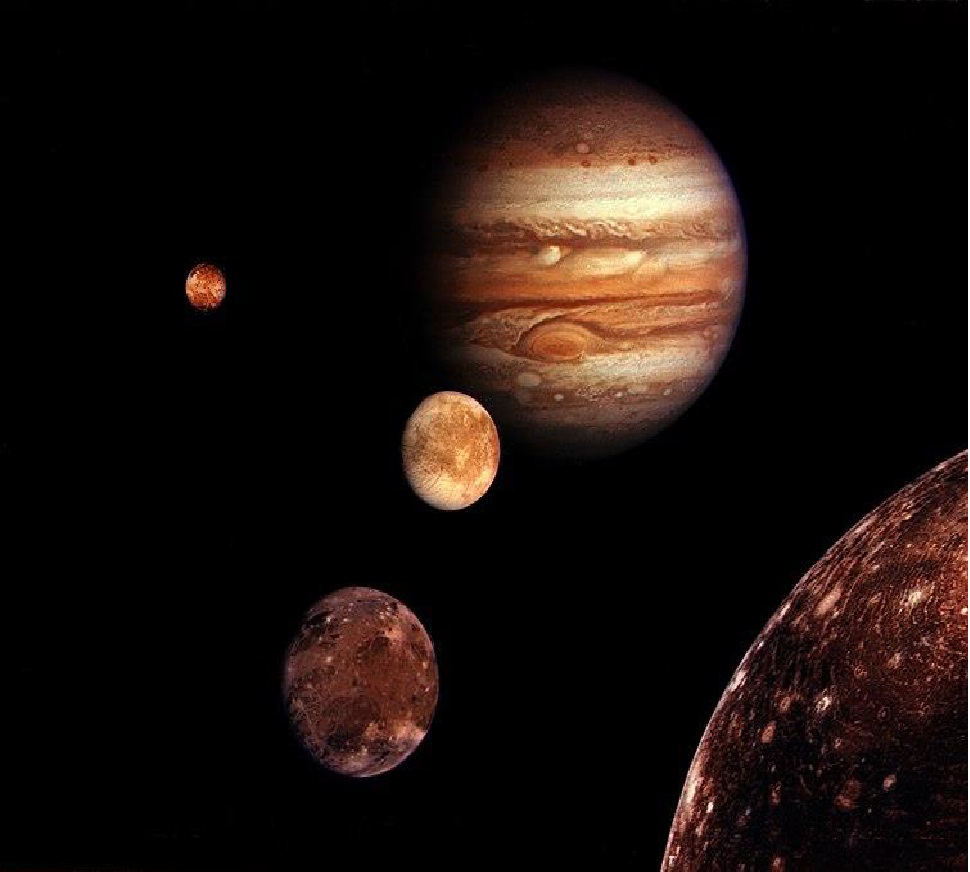
Image in the Public Domain. Source: NASA
The students are interested in learning more about other planetary objects in Earth’s solar system and the surface gravity of the planets. They learn that surface gravity is the gravitational pull of an object at the surface of a planet toward its center. They also find out that there are hundreds of moons in the solar system. Earth has one moon. In the outer solar system, planets have dozens of moons. For example, Jupiter has between 80 and 95 moons. One of Jupiter’s moons is Ganymede, the largest moon in the solar system. Its diameter is larger than the planet Mercury but has less surface gravity than Mercury. Ganymede has a surface gravity of 1.428 m/s2 and a mass of 0.148 x 1024 kg. Figure 1 shows Jupiter and four of its moons.