Motion of Orbiting Objects
Using mathematical or computational representations allows for the prediction of the motion of orbiting objects in the solar system. By applying principles of physics and mathematics, such as gravitational forces and orbital mechanics, scientists can model and forecast the trajectories and positions of planets, moons, and other celestial bodies over time. The main concepts of this concept are listed below.
Newtonian gravitational laws, also known as Newton's laws of motion, were discovered by Sir Isaac Newton in the late 17th century. These laws describe the behavior of objects in motion, including those in the solar system. They are essential to understanding how planets, moons, and other celestial bodies move around each other.
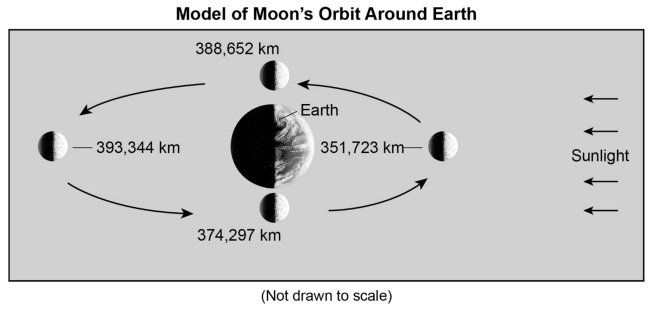
An object in orbit around another object is constantly falling towards it, but its forward momentum keeps it moving in a circular path. This motion is determined by the mass of the orbiting object, the mass of the object it is orbiting, and the distance between them. For example, the Moon orbits around the Earth because the Earth's gravitational pull is strong enough to keep the Moon in its path.
According to Newton's law of gravitation, the gravitational force between two objects decreases as the distance between them increases. This means that if two objects are moved farther apart, the gravitational force between them will weaken. Conversely, if they are moved closer together, the gravitational force will strengthen.
The closer an object is to another object, the stronger the gravitational force between them. This is because the gravitational force is dependent on the distance between the objects. The closer the objects are, the less distance there is between them, resulting in a stronger gravitational force.
The motion of objects in space can be affected by a variety of factors, including gravitational forces, collisions, and momentum. For example, the gravitational pull of Jupiter affects the orbits of asteroids in the asteroid belt, and collisions between asteroids can alter their trajectories. Additionally, the momentum of objects can cause them to continue moving in a straight line, even in the presence of gravitational forces. Understanding these factors is crucial to predicting the behavior of objects in space and ensuring the safety of spacecraft and satellites.
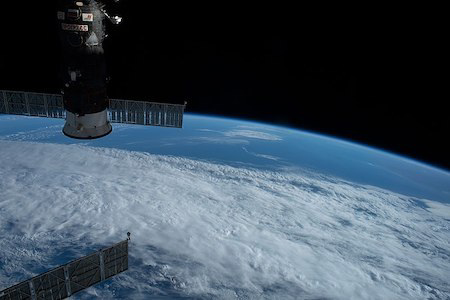
Figure 1.
Source: https://study.com/skill/practice/predict-the-motion-of-orbiting-objects-in-the-solar-system-questions.html
Figure 2.
The image shows a simplified version of the Afternoon-train, a satellite constellation of Earth observation satellites from 2013.
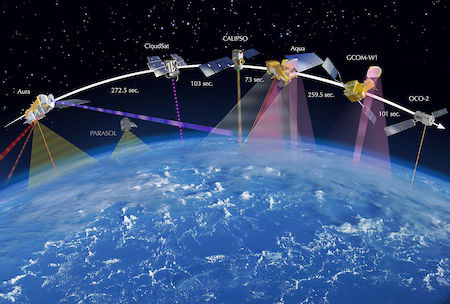
Figure 3.
The image shows a satellite orbiting Earth.