Star Lifespan and Luminosity
Because our Sun is the foundation of all life on Earth, it has played a large role in humankind’s thinking since prehistoric times. For example, some historic cultures thought of the Sun as a god of sorts, and all people paid attention to influences of the Sun such as day/night (for hunting, farming, various life activities) and temperature. Even today in a technological culture with artificial light and temperature-controlled living spaces, we think of how the Sun connects to big complex issues such as climate change or smaller personal decisions such as using sunblock or clothing to prevent skin cancer.
Although we know the Sun does vary sometimes, beyond Earth-related interactions such as weather that can make the Sun appear brighter or dimmer, or Earth’s tilt in its annual orbit that can make the Sun feel hotter or colder at different seasons, the Sun itself tends to not vary too dramatically. Year after year, century after century, the Sun more or less goes on in a steady fashion with only small variations.
Which leads us to wondering… is the Sun basically static (unchanging in major ways) forever, or is there a pattern to how the Sun might change over many, many, many years. One thing we know about most stars is that they are HUGE – over 1,000,000 Earths could fit inside the Sun, and our Sun is only a medium-sized star!
With all of that mass, that means gravity is also strong, especially inside the Sun when you are close to the core, with all of that mass being gravitationally pulled toward the core. But because the mass doesn’t continue to be pulled directly into the Sun’s core, there must be something ‘pushing back’ inside the Sun to balance out the gravitational pull.
In addition to other possible evidence about individual stars that scientists might collect, one obvious and important feature is its brightness. The idea of ‘star brightness’ is actually a bit tricky since we have to collect that evidence from Earth – if a bright star were far away, it would look relatively dim. And, if a dim star were nearby, then it might appear bright in comparison to most other stars.
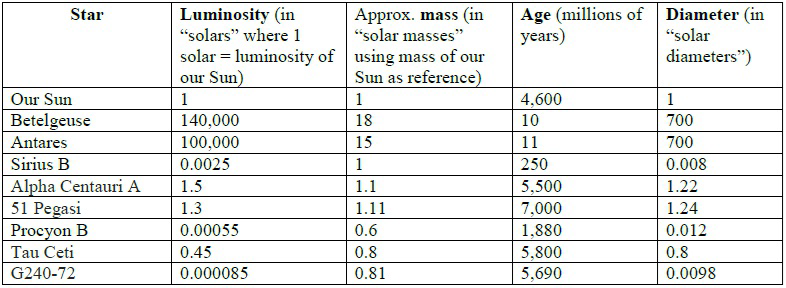
Scientists also have techniques for estimating distances of stars, and so knowing the distance lets us take the observed brightness from Earth and transform it into actual brightness of the star itself – as if you could see the star from right next to it. Rather than brightness, which can be an unclear term, astronomers usually use the term “luminosity,” which is the amount of energy (or light) being emitted from the star’s surface. Scientists are also able to get estimates of a star’s mass by observing how it gravitationally interacts with nearby objects.
In addition to luminosity and mass, astronomers can use that data plus other information such as a star’s rotation rate (which varies at known rates depending on the age of a star) and light spectrum (which gives information about its composition) to compute an estimated age of a star.
Table 1.
Data for a few select stars that the work of many astronomers over time have contributed to.