Albedo and Greenhouse Gases
Reflection
Sunlight travels through space at nearly 300,000 kilometers per second (186,000 miles per second). When that sunlight reaches the Earth, if it is not absorbed by a surface, it is reflected. Reflection occurs when incoming solar radiation bounces off of an object or surface. The proportion of incoming solar radiation that is reflected by the Earth is known as its albedo.
Earth has different colors and textures, with some bright areas and some dark areas. These different colors and shades are important for the Earth’s Energy Budget. One of the most important behaviors of energy from the sun is reflection. When energy emitted by the sun interacts with an object, like the Earth's surface, some of the energy will bounce off the surface. A surface's reflective properties will determine how much light will be reflected and how much will be absorbed or transmitted. This is the albedo effect. Albedo indicates what percentage of the incoming solar radiation (shortwave radiation) is reflected by a surface. The greater the albedo of a surface, the more solar energy will be reflected; the lower the albedo, the more solar radiation will be absorbed.
Have you ever noticed that you feel hotter outside under the Sun when you wear black and you feel cooler when you wear white? This is because albedo has a lot to do with the color of a surface. Darker colors have a lower albedo, so they absorb more light. Light colors have a much higher albedo, so they reflect more light.
Albedo of Earth
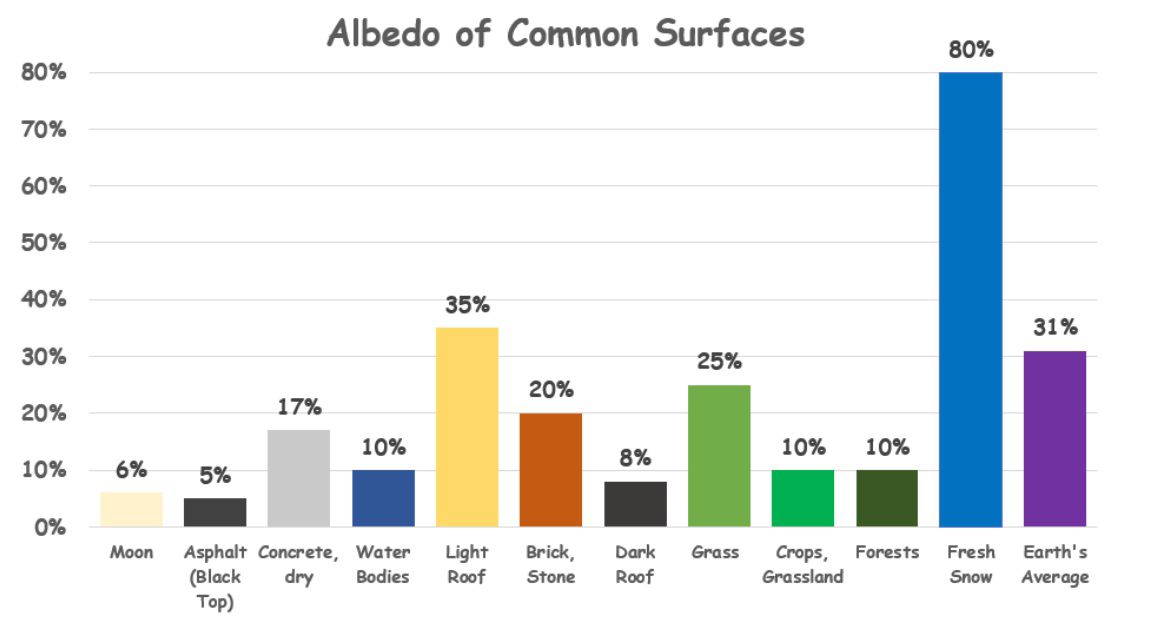
Albedo plays a significant role in our planet’s average surface temperature. When a surface reflects incoming sunlight, it sends the energy back to space, where it doesn’t affect temperature or climate. When we globally average the albedo of the Earth’s surface as measured by NASA satellites, the average albedo of Earth’s surface is 0.31 or 31%. The diagram below displays the albedo of common surfaces of the Earth, along with Earth's average albedo.
Graph 1.
Absorption
Absorption of sunlight causes the molecules of the object or surface it strikes to vibrate faster, increasing its temperature. This energy is then re-radiated by the Earth as longwave, infrared radiation, also known as heat. The more sunlight a surface absorbs, the warmer it gets, and the more energy it re-radiates as heat. This re-radiated heat is then absorbed and re-radiated by greenhouse gasses and clouds, and warms the atmosphere through the greenhouse effect.
Trapping Energy
Have you ever wondered how your local florist has fresh flowers in spite of it being the middle of winter? Chances are that your local flower shop uses something called a greenhouse. This is a structure that is used to grow plants like flowers, fruits, and vegetables by trapping the Sun's energy inside, keeping the air and soil temperatures warm.
The Greenhouse Effect
The effect of greenhouse gasses is to take in some of the infrared or heat energy that would normally travel out to space and send it back to the surface. This results in a warming effect on Earth's surface. Greenhouse gasses in Earth's atmosphere include water vapor $H_2O$, carbon dioxide $CO_2$, methane $CH_4$, nitrous oxide $N_2O$, and chlorofluorocarbons (CFCs), and others.
Greenhouse Gas Trends
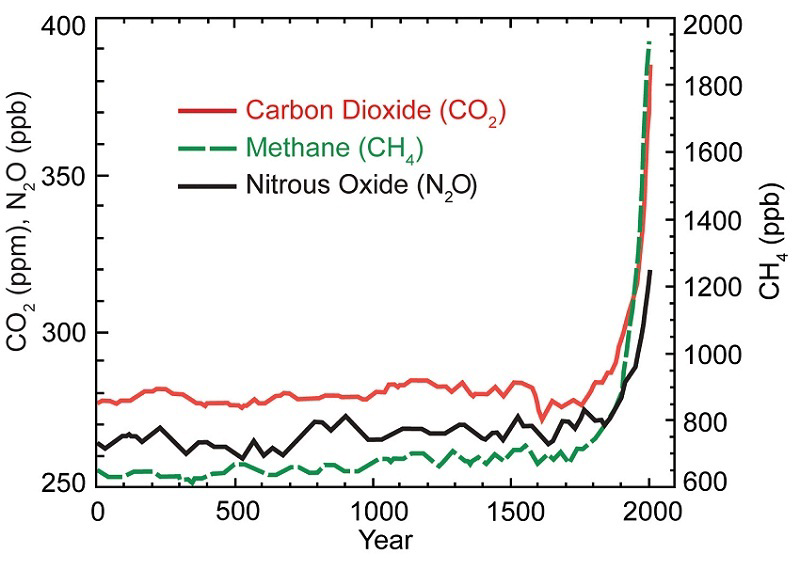
Now that we understand the role of greenhouse gasses, let's explore another important factor... change over time. This graph displays greenhouse gas trends from the last 2,000 years. On the graph you can view trends for carbon dioxide $CO_2$, methane $CH_4$, and nitrous oxide $N_2O$. Notice that there are two different scales for the units of these gases on the y-axis.
Graph 2.