Specific Heat and Weather
The oceans play a large role in climate at both a regional and global scale because water has an ability to resist sudden changes in temperature. Because of this, water is said to have a high specific heat. Specific heat is the amount of heat it takes to raise or lower the temperature of one gram of a substance by $1^\circ C$.
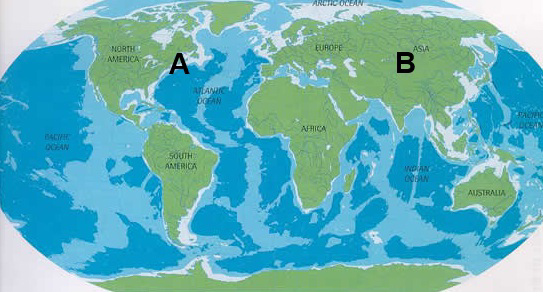
Because water absorbs and releases heat at a rate much slower than land, air temperatures in areas near large bodies of water tend to have smaller fluctuations. The high specific heat of water, and the mixing that occurs as a result of wind interaction with water, help to moderate the temperature of land located near an ocean. Water temperatures near the ocean surface range from a little below $0^\circ C$ in Arctic and Antarctic regions to about $30^\circ C$ in the Red Sea. Most tropical waters stay at a fairly constant $28^\circ C$. By contrast, temperatures over the land range from $-70^\circ C$ to $60^\circ C$. In the desert, daily temperature variations are extreme. It can be very hot during the day and very cold at night. This is because deserts, by definition, lack large amounts of liquid water. Non-desert areas not located near bodies of water, such as Wyoming in the United States, can have wide ranges of temperatures throughout the course of the year compared to coastal cities.
Though at one location the water receives the same amount of sunlight as the land, water’s high specific heat keeps its temperature within a relatively narrow range. The daily temperature fluctuations of our entire planet are more moderate than they would be if we were devoid of water. Even individual organisms benefit from the high specific heat of water. Most living things are comprised of a high proportion of water and this helps them resist changes in their body temperatures.
Figure 1.
 Source:
https://www.acer-acre.ca/resources/climate-change-in-context/general-concepts/proximity-to-water-bodies