Sun’s Role in Climate Change
What Is the Sun’s Role in Climate Change?
The Sun powers life on Earth; it helps keep the planet warm enough for us to survive. It also influences Earth’s climate: We know subtle changes in Earth’s orbit around the Sun are responsible for the comings and goings of the past ice ages. But the warming we’ve seen over the last few decades is too rapid to be linked to changes in Earth’s orbit, and too large to be caused by solar activity.
The Sun doesn’t always shine at perpetually the same level of brightness; it brightens and dims slightly, taking 11 years to complete one solar cycle. During each cycle, the Sun undergoes various changes in its activity and appearance. Levels of solar radiation go up or down, as does the amount of material the Sun ejects into space and the size and number of sunspots and solar flares. These changes have a variety of effects in space, in Earth’s atmosphere and on Earth’s surface.
The current solar cycle (Solar Cycle 25) began in December 2019 and has quickly ramped up in activity. Although the Sun won’t reach peak levels until 2025, it is already exceeding early predictions. NASA’s upcoming Geospace Dynamics Constellation Mission, currently scheduled to launch in 2027, will provide valuable insights into Solar Cycle 26.
Figure 1.
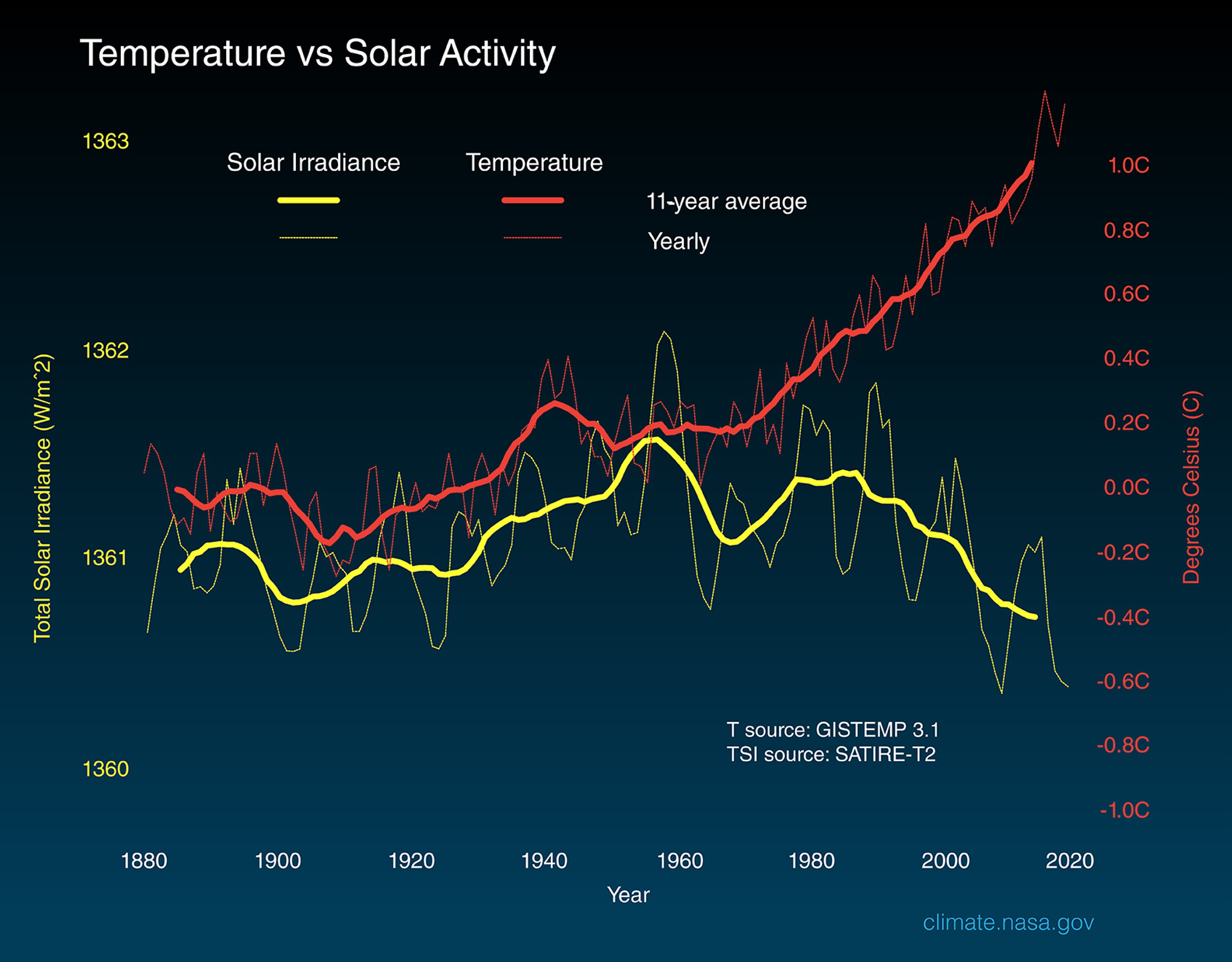
The above graph compares global surface temperature changes (red line) and the Sun's energy that Earth receives (yellow line) in watts (units of energy) per square meter since 1880. The lighter/thinner lines show the yearly levels while the heavier/thicker lines show the 11-year average trends. Eleven-year averages are used to reduce the year-to-year natural noise in the data, making the underlying trends more obvious.
The amount of solar energy that Earth receives has followed the Sun’s natural 11-year cycle of small ups and downs with no net increase since the 1950s. Over the same period, global temperature has risen markedly.