Rate of Global Climate Change
Source: https://reviewearthscience.com/ngss/review-sheets/HS-ESS3-5.php
Analyzing geoscience data and results from global climate models involves making evidence-based forecasts of current global or regional climate change rates and their future impacts on Earth systems. This analysis helps predict how climate change will affect various environmental factors, such as temperature, precipitation patterns, and sea levels, and assess potential consequences for ecosystems, weather events, and human activities. The main concepts include:
Analyzing geoscience data is a critical step in making evidence-based forecasts about the current rate of global or regional climate change and associated future impacts. Geoscientists use a range of techniques and tools to study the Earth's climate and environment, including analyzing atmospheric, oceanic, and terrestrial data, and monitoring trends in temperature, precipitation, sea level, ice cover, and other factors.
Global climate models (GCMs) are a type of computer simulation used to simulate Earth's climate system and to make projections of future climate change. These models use mathematical equations to represent the various processes and feedback mechanisms that govern the Earth's climate, including the interactions between the atmosphere, oceans, and land surface.
Climate change impacts can include changes in precipitation and temperature patterns, sea level rise, melting of glacial ice volumes, and changes in the composition of the atmosphere and ocean. These impacts can have far-reaching consequences for human societies and natural ecosystems. For example, sea level rise can lead to flooding in coastal communities and loss of coastal wetlands, while changes in temperature and precipitation can affect crop yields and water resources.
Geoscientists are working to improve our understanding of the drivers of climate change and the potential impacts of these changes. By analyzing geoscience data and developing more sophisticated climate models, scientists can better predict the future impacts of climate change and inform policies and actions to mitigate and adapt to these impacts.
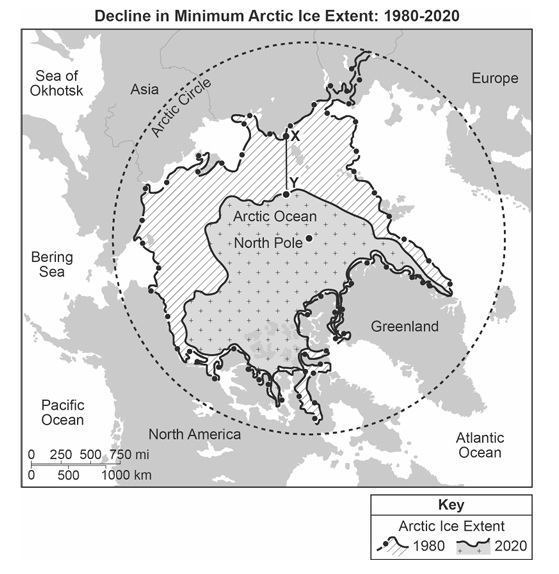
The map below shows some information about the change in Arctic Ocean ice extent. Line X–Y is a reference line.