Solar Energy
Solar energy
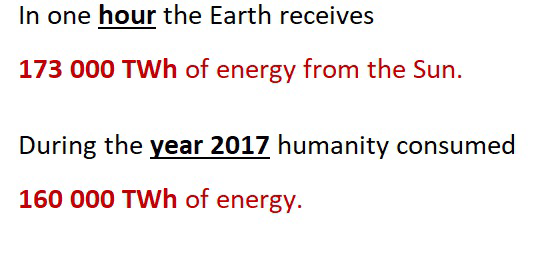 The facts behind this amazing statistic
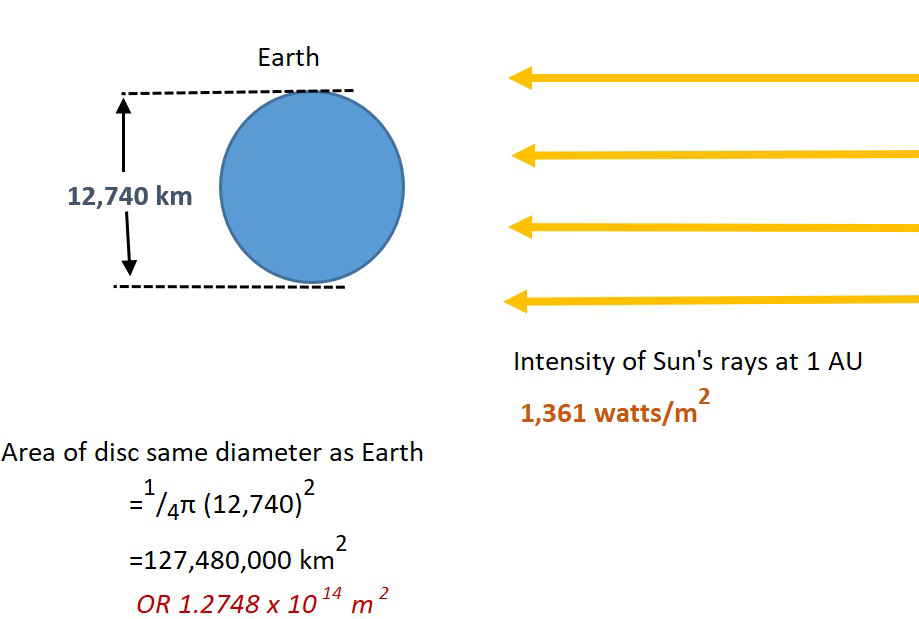
The Sun generates energy by nuclear reactions which occur at its dense hot core. It produces a massive 382.8 trillion trillion ($3.828 \times 10^{26}$) watts of electromagnetic radiation (Williams 2018) mostly in the form of visible light, infrared and ultraviolet. As you get further from the Sun, the intensity, which is power per unit area, falls as the square of the distance.
The solar constant is the average intensity of the Sun’s radiation at a distance of 1 astronomical unit (the average distance of the Earth from the Sun). It has a value of 1,361 watts per square metre (W/m$^2$). In fact, the output of the Sun is variable and fluctuates by 0.1% around this value.
Figure 1.
The potential for solar energy.
One advantage that solar energy has over other forms of green energy is that it has an almost unlimited potential because of the vast amount of energy reaching the Earth from the Sun. If the problems of distribution and storage could be overcome, it would only be necessary to cover a small fraction of the Earth’s surface with solar panels to meet all of humanity’s energy needs.
To calculate the size of this area, the first thing we need to consider is the amount of solar radiation which actually reaches the Earth’s surface. Although the solar constant is $1{,}361\ \text{W/m}^2$, this is the intensity of the radiation which hits the top of the Earth’s atmosphere. Even on a cloudless day not all this radiation reaches the ground; some is reflected back into space and some is absorbed by the atmosphere.
If we average out over an entire 24 hour cycle the amount of solar radiation hitting the Earth’s surface (known as the solar irradiance) on a clear day at the equator on the equinox is approximately $340\ \text{W/m}^2$. The most efficient solar panels on the market convert approximately 22% of solar irradiance to electrical energy. This means that, averaged over an entire 24 hour cycle, the solar electric power which could be generated is $73\ \text{W/m}^2$, which is approximately 5% of the solar constant. At higher latitudes the Sun is lower in the sky and so the amount of solar electric power which could be generated is less. The amount of solar energy is reduced by cloud cover. For example, in the cloudy north west of Scotland the solar irradiance averaged out over a year is only $72\ \text{W/m}^2$, about one fifth of its value at the equator.
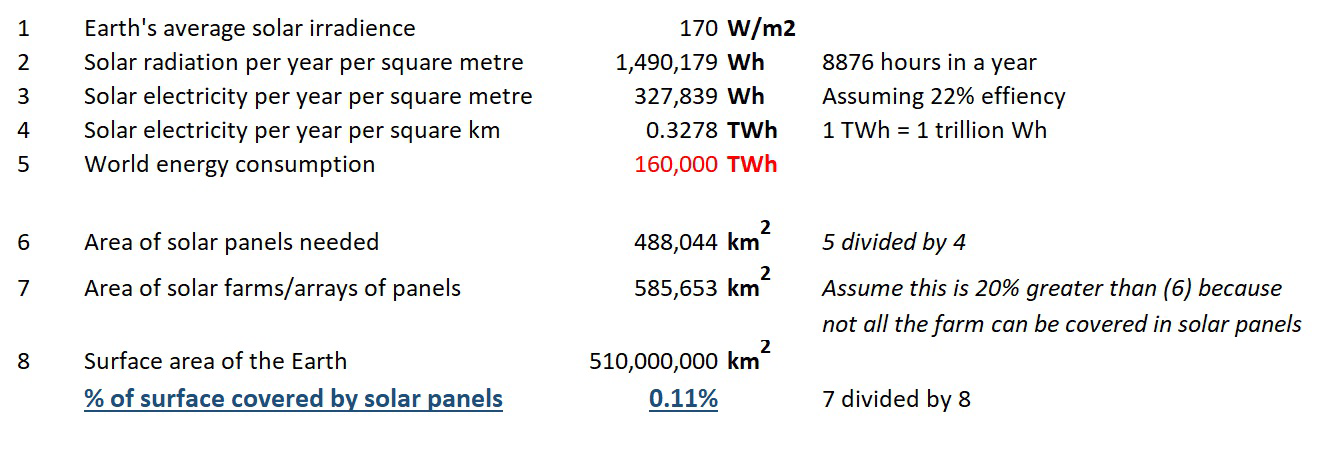
If averaged out over 12 months and over all locations on the Earth’s surface, then the average solar irradiance is $170\ \text{W/m}^2$. This means that we would need to cover 586,000 square km of the Earth’s surface with solar panels to generate all the world’s energy needs, an area about 15% larger than Spain. The details of the calculation are given the notes at the bottom of this post. This number is relatively small, only 0.11% of the surface area of the Earth. However, the main issue is that countries which could generate the most solar energy (particularly those in Africa) actually have modest energy consumption and many densely populated countries, particularly those in Northern Europe, have high energy consumption and receive relatively little sunlight.
Figure 2.